About Kosovo
Kosovo is a small, landlocked territory in southeastern Europe, in the central Balkans. Pristina is the capital and largest city.
Kosovo declared independence from Serbia in 2008. Its status remains internationally contested: many countries recognise Kosovo as an independent state, while Serbia and several other countries do not.
CapitalPristina
RegionBalkans / Europe
PopulationAbout 1.8 million
CurrencyEuro
LanguagesAlbanian & Serbian
Independence declared17 February 2008
The flag of Kosovo
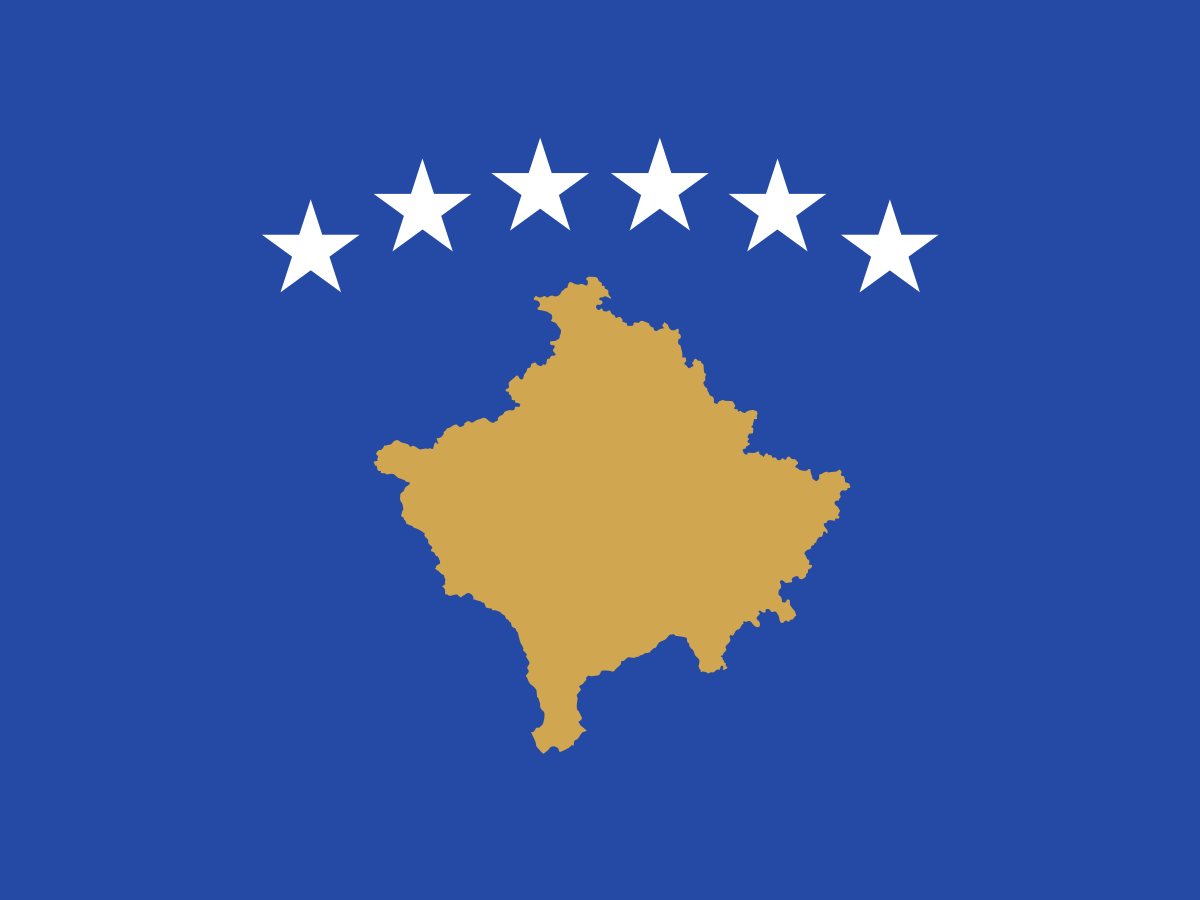
Kosovo's national flag has a blue field with a gold silhouette of Kosovo and six white stars arranged above the map.
The design was chosen to emphasise a multi-ethnic European identity.
The blue and gold colouring has been associated with Kosovo's European aspirations, while the map represents the territory of Kosovo. The six stars are commonly explained as representing the country's major ethnic communities.
The flag was adopted following the declaration of independence in 2008 and was selected through a public design competition.
What do the colours mean?
Kosovo's flag uses a deep blue background and gold map. The colour combination is strongly associated with Kosovo's European orientation.
Unlike many older European national flags, the design deliberately avoids a traditional heraldic pattern and instead places the country's outline at the centre.
The blue field
The blue background represents Kosovo's European aspirations and identity. It also provides the field against which the gold map and white stars stand out clearly.
The colour combination was intended to give the new flag a modern, outward-looking appearance.
The gold map
The golden silhouette represents the territory of Kosovo. Placing the map at the centre makes the country's geographical identity the main visual feature of the flag.
The outline is shown without internal administrative boundaries.
The six stars
Six white stars appear above the map. They are commonly understood to represent Kosovo's major ethnic communities, reflecting the constitution's emphasis on a multi-ethnic state.
The stars are evenly spaced and form a distinctive arc across the upper part of the flag.
Why six stars?
The six-star design is commonly linked with Kosovo's principal ethnic communities, including Albanians, Serbs, Turks, Bosniaks, Gorani and Roma/Ashkali/Egyptian communities.
The precise wording and grouping can vary, but the central idea is that the stars represent Kosovo as a multi-ethnic society.
A short history of Kosovo
Kosovo has a complex history shaped by Illyrian and Roman-era settlement, medieval Serbian states, Ottoman rule, Albanian national movements, Yugoslavia and the conflicts of the 1990s.
The modern political question surrounding Kosovo is closely connected to competing historical, national and territorial claims.
History timeline
Antiquity — Illyrian and Roman BalkansThe territory formed part of the wider ancient Balkan world and later came under Roman rule.
Medieval period — Serbian statesKosovo became an important centre of the medieval Serbian state and Orthodox Christian culture.
1389 — Battle of KosovoA major battle was fought between Serbian-led forces and the Ottoman army. Its memory became central to Serbian national history.
15th century — Ottoman ruleThe territory was incorporated into the expanding Ottoman Empire and remained under Ottoman rule for centuries.
19th century — National movementsAlbanian and Serbian national movements increasingly shaped political debates about Kosovo.
1912–13 — Balkan WarsOttoman rule ended and Kosovo became part of the Kingdom of Serbia.
1918 — Kingdom of Serbs, Croats and SlovenesKosovo became part of the new South Slav state, later known as Yugoslavia.
1945 — Socialist YugoslaviaKosovo became an autonomous province within the Socialist Republic of Serbia.
1974 — Expanded autonomyThe Yugoslav constitution granted Kosovo extensive autonomy, although it remained formally within Serbia.
1989 — Autonomy reducedUnder Slobodan Milošević, Kosovo's autonomy was substantially curtailed.
1990s — Parallel institutions and conflictAlbanian political organisations developed parallel institutions while tensions with Serbian authorities intensified.
1998–99 — Kosovo WarArmed conflict between Serbian/Yugoslav forces and the Kosovo Liberation Army was followed by NATO intervention.
1999 — UN administrationUN Security Council Resolution 1244 placed Kosovo under international administration while formally recognising the territorial framework of the Federal Republic of Yugoslavia.
2008 — Declaration of independenceKosovo declared independence on 17 February 2008.
2013 — Brussels AgreementKosovo and Serbia reached an EU-facilitated agreement intended to normalise relations and address governance in northern Kosovo.
TodayKosovo operates its own institutions and is recognised by many states, while its international status remains disputed.
Ancient Kosovo
The territory of Kosovo formed part of the wider ancient Balkan world and was influenced by Illyrian peoples, Roman administration and later Byzantine rule.
Archaeological sites provide evidence of long-standing settlement and trade across the region.
Medieval Serbia and Kosovo
During the medieval period, Kosovo became an important centre of the Serbian medieval state. Orthodox monasteries and churches established in the region remain important cultural and religious sites.
For Serbian history, Kosovo holds profound symbolic significance.
The Battle of Kosovo — 1389
The Battle of Kosovo took place in 1389 between a coalition led by Serbian Prince Lazar and the Ottoman army of Sultan Murad I.
The battle became a foundational event in Serbian historical memory. Its immediate political consequences and the later legends surrounding it are both important to understanding its significance.
Ottoman Kosovo
Following the expansion of the Ottoman Empire, Kosovo became part of the Ottoman administrative system for several centuries.
During this period the region's population, religious communities and towns changed substantially, while Ottoman institutions shaped local life.
Albanian national movement
During the nineteenth century, Albanian intellectual and political movements increasingly sought to defend Albanian language, culture and political interests.
The League of Prizren, founded in 1878, is an especially important milestone in Albanian national history.
The League of Prizren
The League of Prizren was established in 1878 in the city of Prizren. It initially sought to defend the interests of Albanian-inhabited territories within the declining Ottoman Empire.
It later became a powerful symbol of Albanian national political organisation.
The Balkan Wars
The Balkan Wars of 1912–13 ended Ottoman political control over most of the Balkans. Kosovo was incorporated into the Kingdom of Serbia.
The change of rule intensified competing Serbian and Albanian political claims over the territory.
Kosovo in Yugoslavia
After the First World War, Kosovo became part of the new Kingdom of Serbs, Croats and Slovenes, later Yugoslavia. After the Second World War it became an autonomous province within Serbia.
The 1974 Yugoslav constitution gave Kosovo substantial autonomy, but it did not make Kosovo a republic of Yugoslavia.
Kosovo's autonomy
In 1974, Kosovo received extensive autonomy under the Yugoslav constitution. It had its own assembly, government and representation within the federal system.
However, Kosovo remained constitutionally part of the Socialist Republic of Serbia.
The loss of autonomy
In 1989, the Serbian government under Slobodan Milošević sharply reduced Kosovo's autonomy. Large-scale political tensions and protests followed.
Many Kosovo Albanians responded by creating parallel political, educational and social institutions.
The Kosovo Liberation Army
The Kosovo Liberation Army (KLA) emerged as an armed organisation during the 1990s. It fought Serbian and Yugoslav security forces and sought independence for Kosovo.
The conflict involved attacks and abuses by multiple actors and eventually became an international crisis.
The Kosovo War
The Kosovo War of 1998–99 involved the KLA, Serbian and Yugoslav forces and a growing international intervention.
The conflict caused large-scale displacement and serious human-rights abuses. NATO launched an air campaign against the Federal Republic of Yugoslavia in 1999.
NATO intervention and 1999
Following the NATO air campaign and the Kumanovo Agreement, Serbian and Yugoslav forces withdrew from Kosovo.
International forces entered the territory and the United Nations established an interim administration under Security Council Resolution 1244.
UN administration
From 1999, Kosovo was administered internationally through UNMIK, while NATO-led KFOR provided security.
Kosovo developed provisional self-government institutions during this period as discussions over its final status continued.
Kosovo's declaration of independence
On 17 February 2008, Kosovo's assembly declared independence from Serbia.
Many countries recognised the declaration, including the United Kingdom and the United States. Serbia rejected it, and several other countries have also not recognised Kosovo.
International recognition
Kosovo is recognised as an independent state by many countries, but recognition is not universal. Serbia, Russia, China and several other states do not recognise Kosovo's independence.
Because of this, Kosovo's international status remains politically contested. It is not a member of the United Nations.
Kosovo and Serbia today
Relations between Kosovo and Serbia remain a major European diplomatic issue. EU-facilitated negotiations have sought to normalise relations and resolve practical disputes.
The 2013 Brussels Agreement was an important milestone, although many issues remain unresolved.
Pristina
Pristina is Kosovo's capital and largest city. It is the country's political, economic, educational and cultural centre.
The city combines Ottoman-era heritage with Yugoslav-era buildings and rapidly developing modern architecture.
Prizren
Prizren is one of Kosovo's best-known historic cities. Its old town contains mosques, churches, stone bridges and Ottoman-era buildings.
Prizren is also strongly associated with Albanian cultural and political history.
Kosovo's geography
Kosovo is a landlocked mountainous country in the central Balkans. Much of the territory consists of valleys and uplands surrounded by mountain ranges.
The country borders Serbia, North Macedonia, Albania and Montenegro.
Kosovo's climate
Kosovo has a temperate continental climate, with warm summers and cold winters. Mountainous areas are cooler and receive more snowfall.
Seasonal temperature differences can be considerable.
Kosovo's wildlife
Kosovo's mountains and forests support species including brown bears, wolves, lynx, deer and wild boar.
Protected areas are important for preserving remaining forest and mountain habitats.
The Rugova Canyon
The Rugova Canyon near Peja is one of Kosovo's most dramatic natural landscapes. The canyon cuts through the mountains and is popular for hiking and outdoor activities.
The surrounding Accursed Mountains are among the most scenic areas of the Balkans.
Kosovo culture
Kosovo's culture reflects a mixture of Albanian, Serbian, Ottoman, Balkan and broader European influences.
Music, food, religious traditions, family life and hospitality are important parts of everyday culture.
Languages
Albanian and Serbian are Kosovo's official languages. Turkish, Bosnian and Roma are also spoken by significant communities.
Language is closely connected to Kosovo's multi-ethnic identity and political history.
Kosovo food
Kosovan cuisine includes flija, burek, tavë, grilled meats, stuffed peppers, breads and dairy products.
The food reflects wider Balkan, Albanian, Ottoman and Mediterranean influences.
Kosovo's economy
Kosovo has a developing economy based on services, trade, construction, agriculture, manufacturing and remittances.
The country has a young population and a growing technology and services sector, while unemployment and emigration remain important challenges.
The euro in Kosovo
Kosovo uses the euro as its main currency despite not being a member of the European Union or the euro area.
The euro was adopted after the end of the Kosovo conflict and remains the currency used in everyday transactions.
Kosovo today
Modern Kosovo has its own government, parliament, courts, police and security institutions. It is a parliamentary republic whose international recognition remains incomplete.
The country continues to pursue closer European integration while working through its relationship with Serbia.
Why is Kosovo's flag interesting?
Kosovo's flag is deliberately different from the traditional flags of the Balkans. The gold map, blue field and six stars were designed to emphasise Kosovo's territory, European orientation and multi-ethnic identity.
Its history is inseparable from the much older and deeply contested history of the Balkans.
Explore Kosovo on FlagAtlas
Continue exploring Kosovo and the world's flags with these FlagAtlas resources.