About Kuwait
Kuwait is a small, oil-rich country on the northwestern shore of the Persian Gulf. Kuwait City is the capital and largest urban centre.
Its modern history has been shaped by maritime trade, the Al-Sabah ruling family, the discovery of oil, independence, and the Iraqi invasion of 1990.
CapitalKuwait City
RegionGulf / West Asia
PopulationAbout 4.3 million
CurrencyKuwaiti dinar
Official languageArabic
Independence19 June 1961
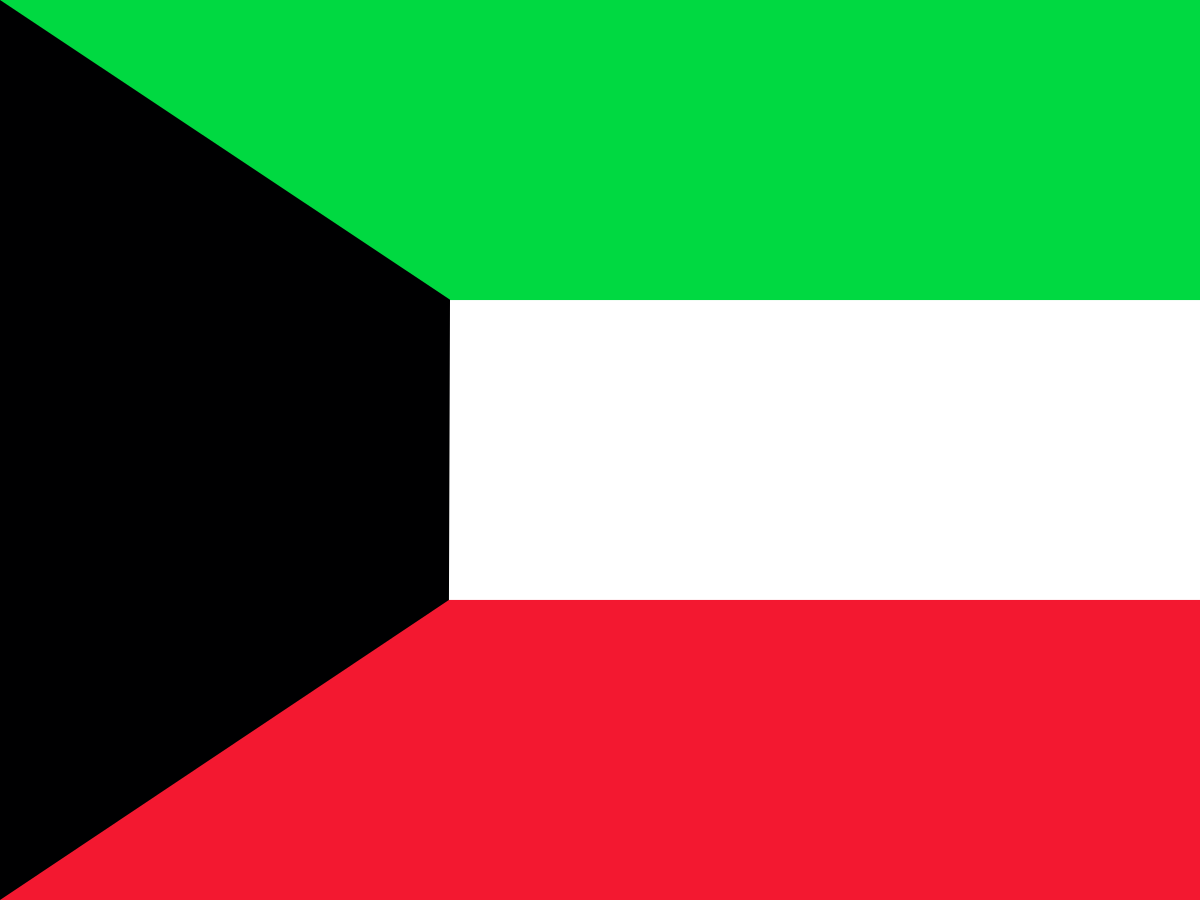
The flag of Kuwait
Kuwait's national flag has four colours: green, white, red and black. The flag consists of three horizontal bands with a black trapezoid at the hoist.
The four colours come from traditional Arab symbolism.
Green represents fertile land, white pure deeds, red blood shed in battle and black the defeat of enemies.
The current flag was adopted in 1961, following Kuwait's independence from Britain.
What do the colours mean?
The four colours of Kuwait's flag are part of the wider Pan-Arab colour tradition. Each colour has a traditional symbolic meaning associated with Arab history and poetry.
The combination of green, white, red and black also gives Kuwait's flag a strong visual connection with several other Arab national flags.
The green band
Green represents fertile land and the beauty of the land. Although much of Kuwait is desert, the colour is part of the traditional symbolism used in the flag.
Green is also a common colour in Arab and Islamic visual traditions.
The white band
White represents pure deeds. It forms the central horizontal band of the flag.
Its bright appearance also creates a strong contrast with the red and green bands.
The red band
Red represents the blood shed in battle. It forms the lowest horizontal band of the flag.
The symbolism connects the national flag with courage, sacrifice and the defence of Kuwait.
The black trapezoid
Black represents the defeat of enemies. The black shape at the hoist is a distinctive feature of the Kuwaiti design.
Its wedge shape gives the flag a particularly recognisable appearance when it is flying.
A short history of Kuwait
Kuwait developed from a small Gulf settlement into an important centre of maritime trade, pearling and shipbuilding. The Al-Sabah family became the ruling dynasty in the eighteenth century.
The discovery of oil transformed Kuwait during the twentieth century, while the Iraqi invasion of 1990 became one of the defining events of modern Kuwaiti history.
History timeline
18th century — Al-Sabah ruleThe Al-Sabah family emerged as Kuwait's ruling dynasty as the settlement developed into a trading and maritime centre.
18th–19th centuries — Pearling and tradeKuwait's economy depended heavily on pearl diving, fishing, shipbuilding and Gulf trade.
1899 — Anglo-Kuwaiti agreementKuwait entered an agreement with Britain that increased British influence over its external affairs while preserving the ruling family's authority.
1938 — Oil discoveredLarge oil reserves were discovered, beginning the transformation of Kuwait's economy.
1946 — Oil exports beginCommercial oil exports began and Kuwait's revenues rose rapidly.
1950s — Rapid modernisationOil wealth financed major improvements in roads, housing, education, healthcare and infrastructure.
1961 — IndependenceKuwait became independent from Britain on 19 June 1961.
1962 — ConstitutionKuwait adopted a constitution establishing a constitutional emirate and an elected National Assembly.
1980s — Regional tensionsKuwait faced the wider instability of the Iran-Iraq War while maintaining its own Gulf identity.
1990 — Iraqi invasionIraq invaded Kuwait on 2 August 1990 and occupied the country.
1991 — LiberationA US-led international coalition expelled Iraqi forces during the Gulf War. Kuwait was liberated in February 1991.
1990s — ReconstructionKuwait rebuilt infrastructure damaged during the occupation and restored its economy.
2000s–present — Modern KuwaitKuwait remains a wealthy Gulf state with a major oil industry, extensive welfare provision and a prominent parliamentary tradition.
Early Kuwait
Kuwait's location at the head of the Gulf made it a natural centre for maritime trade. Before oil, people depended on fishing, pearling, shipbuilding and commerce.
Its position connected the Arabian Peninsula with Mesopotamia, Persia and the wider Indian Ocean trading world.
The Al-Sabah dynasty
The Al-Sabah family has ruled Kuwait since the eighteenth century. The ruling family became closely associated with the development of Kuwait as a Gulf trading state.
The Emir is Kuwait's head of state, while the country also has an elected National Assembly.
Pearling and maritime trade
For centuries, pearl diving was one of Kuwait's most important industries. Kuwaiti sailors also built ships and traded across the Gulf.
The traditional maritime economy shaped Kuwait's communities before oil transformed the country.
British influence
In 1899, Kuwait and Britain signed an agreement that gave Britain a strong role in Kuwait's external relations. Kuwait remained under the Al-Sabah family's rule.
The arrangement lasted until independence in 1961.
The discovery of oil
Oil was discovered in Kuwait in 1938, and commercial exports began after the Second World War. Petroleum rapidly transformed the country's wealth and infrastructure.
Oil remains central to Kuwait's economy and government revenues.
Kuwait's independence
Kuwait became independent from Britain on 19 June 1961. The country adopted its modern national flag in the same year.
Independence marked the beginning of Kuwait's modern sovereign state.
The 1962 constitution
Kuwait's 1962 constitution established the country's system as a constitutional emirate. It created an elected National Assembly alongside the hereditary monarchy.
Kuwait has therefore had one of the Gulf's most distinctive parliamentary traditions.
The Iraqi invasion — 1990
On 2 August 1990, Iraqi forces invaded Kuwait and quickly occupied the country. The invasion triggered an international crisis and the formation of a large coalition against Iraq.
The occupation lasted about seven months and caused widespread destruction and displacement.
The Gulf War
The Gulf War began in January 1991 after diplomatic efforts failed to secure Iraq's withdrawal. A US-led coalition launched a major military campaign against Iraqi forces.
Kuwait was liberated in February 1991.
Kuwait's liberation
Kuwaiti and coalition forces entered Kuwait in February 1991. Retreating Iraqi forces set fire to hundreds of oil wells, creating one of the most dramatic environmental disasters of the war.
Kuwait subsequently undertook a major programme of reconstruction.
Rebuilding after the Gulf War
Kuwait rebuilt damaged roads, buildings, oil facilities and public infrastructure after liberation. The country's oil wealth allowed reconstruction to proceed rapidly.
Kuwait City subsequently developed a modern skyline of towers, shopping centres and major public buildings.
Kuwait City
Kuwait City is the country's political, financial and cultural centre. Its skyline includes the Kuwait Towers, Al Hamra Tower and numerous modern high-rises.
The city was extensively rebuilt following the 1990–91 occupation and war.
The Kuwait Towers
The Kuwait Towers are among the country's most recognisable landmarks. Their spherical forms and blue-green ornamentation have become symbols of modern Kuwait.
The towers were completed in the 1970s and sit on the Arabian Gulf waterfront.
Kuwait's geography
Kuwait occupies a small area at the northwestern end of the Persian Gulf. It borders Iraq to the north and Saudi Arabia to the south.
The country is predominantly flat desert, with a long Gulf coastline and several offshore islands.
Kuwait's islands
Kuwait has several islands, the best known being Bubiyan, Failaka, Warbah and Green Island.
Failaka is particularly important archaeologically and contains evidence of ancient settlement and trade.
Kuwait's climate
Kuwait has an arid hot-desert climate. Summers are extremely hot, while winters are milder and can occasionally be cool.
Rainfall is low and irregular, making water supply and desalination important parts of national infrastructure.
Kuwait's wildlife
Despite its desert environment, Kuwait supports wildlife including gazelles, foxes, desert birds, reptiles and extensive marine life.
The coastline and mudflats are important habitats for migratory birds.
Kuwait's marine environment
The shallow waters of the Gulf support fish, seabirds, turtles and other marine species. Kuwait's coastline is also important for shipping and industry.
Environmental protection has become increasingly important following decades of oil production and urban development.
Kuwaiti culture
Kuwaiti culture combines Arabian, Gulf, Islamic and maritime traditions. Hospitality, family, poetry, music and traditional food remain important.
Modern Kuwait also has a strong arts, media and publishing scene.
Kuwaiti Arabic
Arabic is Kuwait's official language. Kuwaiti Arabic is a Gulf Arabic dialect used in everyday conversation, while Modern Standard Arabic is used in formal contexts.
English is also widely used in business, education and everyday life.
Kuwaiti food
Traditional Kuwaiti cuisine includes machboos, harees, margoog, mutabbaq samak and grilled meats.
Seafood has historically been important because of Kuwait's maritime location, while rice and spices reflect wider Gulf and Indian Ocean connections.
Islam in Kuwait
Islam is the dominant religion in Kuwait, with both Sunni and Shia Muslim communities. Islamic traditions influence public life, holidays, architecture and food.
Kuwait's constitution identifies Islam as the state religion.
Kuwait's economy
Kuwait has a wealthy economy dominated by petroleum and petroleum-related industries. The country is a significant oil producer and exporter.
Government spending, investment and the sovereign wealth fund are also central to the country's economic model.
The Kuwait Investment Authority
The Kuwait Investment Authority is one of the world's oldest sovereign wealth funds. It manages state assets and invests internationally.
Its long-term role is linked to managing Kuwait's oil wealth for future generations.
Oil and natural gas
Petroleum is the foundation of Kuwait's modern wealth. The country also produces natural gas and refined petroleum products.
Kuwait has sought to diversify its economy while remaining heavily dependent on hydrocarbons.
Kuwait today
Modern Kuwait is a wealthy Gulf monarchy with a constitutional system and an elected parliament. Its economy remains strongly dependent on oil, while the government continues to invest in infrastructure and diversification.
The legacy of the 1990 invasion and liberation remains an important part of national identity.
Why is Kuwait's flag interesting?
Kuwait's flag is a classic example of Pan-Arab colours, but its black trapezoid gives it a particularly distinctive shape.
The four colours connect Kuwait with Arab history, while the country's modern story—from pearling to oil wealth, invasion and reconstruction—gives the flag a powerful national context.
Explore Kuwait on FlagAtlas
Continue exploring Kuwait and the world's flags with these FlagAtlas resources.