About Kyrgyzstan
Kyrgyzstan is a mountainous country in Central Asia, famous for high alpine landscapes, nomadic traditions and the legacy of the Silk Road. Bishkek is the capital and largest city.
The country became independent from the Soviet Union in 1991 and remains closely connected to the traditions of the Kyrgyz people, including the yurt, horse culture and the epic of Manas.
CapitalBishkek
RegionCentral Asia
PopulationAbout 6.6 million
CurrencyKyrgyzstani som
LanguagesKyrgyz & Russian
Independence31 August 1991
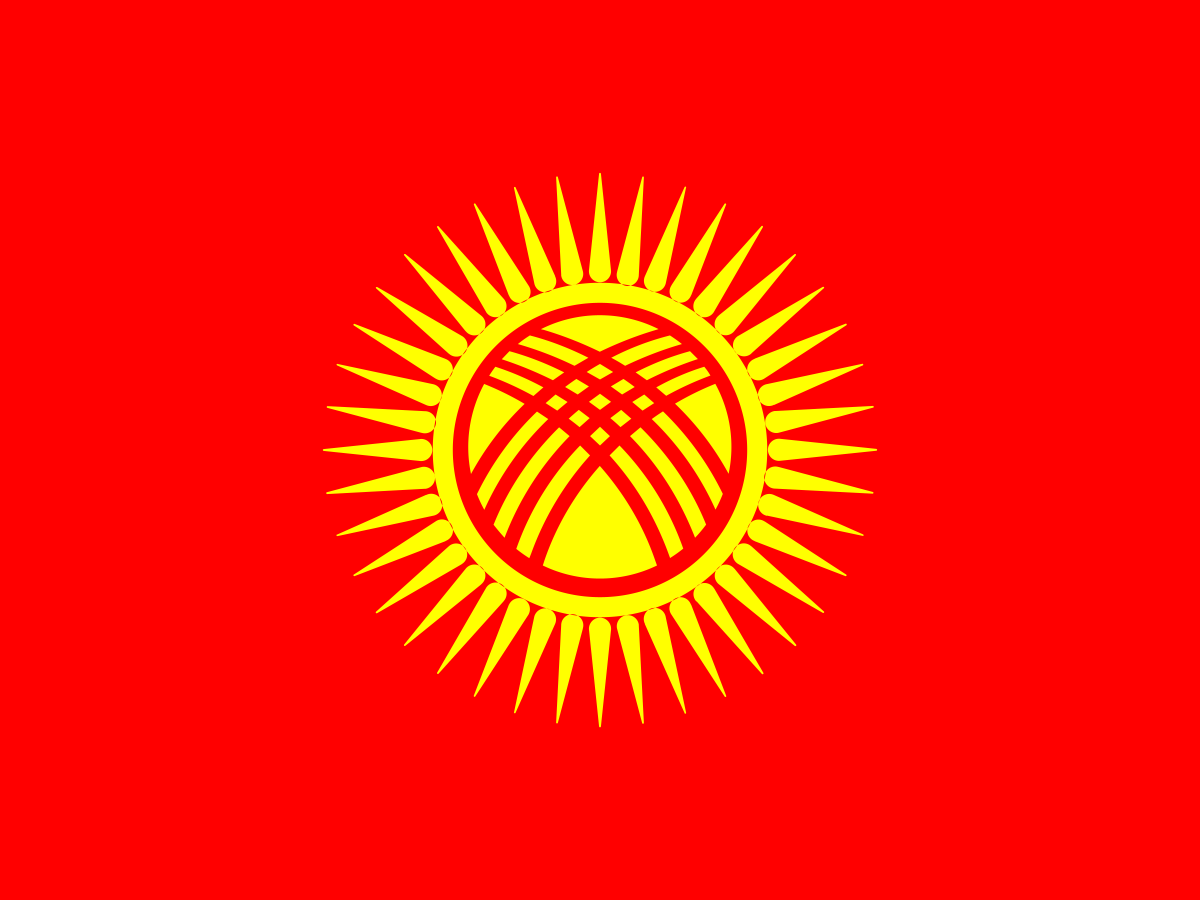
The flag of Kyrgyzstan
Kyrgyzstan's flag has a red field with a golden sun at its centre. Inside the sun is a stylised tunduk, the crown-like structure at the top of a traditional Kyrgyz yurt.
The flag brings together Kyrgyz history, nomadic culture and national unity.
The 40 rays of the sun are associated with the 40 Kyrgyz tribes united by the legendary hero Manas, while the tunduk represents the family home and the shared homeland.
The current design was adopted at independence in 1991, with changes to the sun's central tunduk pattern made in 2023.
What does the red colour mean?
The red field is traditionally associated with courage and bravery. It is also connected with the legendary hero Manas, whose banner is traditionally described as red.
The colour gives the flag a bold and highly recognisable appearance.
The golden sun
The golden sun represents life, light and prosperity. It is the central feature of the flag and surrounds the tunduk.
The sun has 40 rays, linking the modern flag to the traditional story of Kyrgyz tribal unity.
The 40 rays
The sun's 40 rays represent the 40 Kyrgyz tribes traditionally associated with the hero Manas.
The idea of bringing the tribes together is an important theme in Kyrgyz national identity and in the epic tradition of Manas.
The tunduk
At the centre of the sun is the tunduk, the circular crown of a traditional Kyrgyz yurt. It is formed by crossed wooden roof supports.
The tunduk is a powerful symbol of the home, family and shared homeland. It is also featured on the national emblem of Kyrgyzstan.
The yurt and national identity
The yurt is one of the strongest symbols of Kyrgyz culture. Traditional yurts are portable homes designed for a mobile pastoral lifestyle.
The tunduk is the structural centre at the top of the yurt and has become a national symbol representing the home shared by the Kyrgyz people.
A short history of Kyrgyzstan
Kyrgyzstan's history has been shaped by nomadic peoples, Turkic traditions, the Silk Road, Mongol and Central Asian empires, Russian expansion and Soviet rule.
The modern republic emerged after the collapse of the Soviet Union in 1991.
History timeline
Ancient era — Central Asian peoplesThe region was home to nomadic and settled communities connected by trade routes across Central Asia.
Silk Road periodRoutes crossing the Tian Shan connected Central Asia with China, Persia and the wider Eurasian world.
9th century — Kyrgyz KhaganateThe Kyrgyz established a powerful steppe state before later migrations into the Tian Shan region.
13th century — Mongol expansionThe region came under Mongol influence and was incorporated into wider Central Asian political systems.
15th–18th centuries — Kyrgyz tribal confederationsKyrgyz groups increasingly occupied and organised across the Tian Shan and surrounding regions.
19th century — Russian expansionThe Russian Empire expanded into Central Asia and gradually incorporated Kyrgyz territories.
1916 — Central Asian revoltA major uprising against Russian imperial policies led to severe violence and displacement.
1920s — Soviet reorganisationKyrgyz territories were reorganised within the Soviet system and later became the Kirghiz Soviet Socialist Republic.
1936 — Kirghiz SSRKyrgyzstan became a full Soviet republic within the USSR.
1991 — IndependenceKyrgyzstan declared independence on 31 August 1991 following the collapse of the Soviet Union.
2005 — Tulip RevolutionLarge protests led to the removal of President Askar Akayev.
2010 — Political revolutionPresident Kurmanbek Bakiyev was removed after major protests, followed by political and ethnic unrest.
2021 — New constitutionA constitutional referendum strengthened the powers of the presidency and changed the political system.
2023 — Flag design changeThe central tunduk pattern on the national flag was changed from a wavy design to straighter crossed lines.
The Silk Road
Kyrgyzstan lies among the mountains of the Tian Shan, through which routes of the Silk Road passed. Traders, travellers and ideas moved between China and Central Asia.
Historic sites such as Tash Rabat reflect the importance of these transcontinental routes.
Nomadic Kyrgyz culture
For centuries, many Kyrgyz communities lived a pastoral nomadic lifestyle, moving with horses, sheep, cattle and yaks between seasonal pastures.
Although most Kyrgyz people now live settled lives, nomadic traditions remain central to national culture.
The Epic of Manas
The Epic of Manas is one of the world's longest oral epic traditions. It tells stories surrounding the legendary hero Manas and his descendants.
The epic is a major part of Kyrgyz cultural identity and is closely associated with the idea of uniting Kyrgyz tribes.
Manas and the 40 tribes
In the national story, Manas united 40 Kyrgyz tribes. This tradition is reflected directly in the 40 rays of the sun on the national flag.
The symbolism turns a traditional epic story into one of the most recognisable elements of the modern national identity.
Russian expansion
During the nineteenth century, the Russian Empire expanded into Central Asia. Kyrgyz territories gradually came under Russian control.
The period brought new administrative systems, migration and major changes to traditional land and pastoral arrangements.
The 1916 revolt
In 1916, resistance to Russian imperial policies erupted across Central Asia. The uprising was brutally suppressed and caused large-scale displacement and deaths.
The episode remains a significant and painful part of Kyrgyz historical memory.
Kyrgyzstan under Soviet rule
During the Soviet period, Kyrgyzstan experienced rapid changes in education, industry, agriculture and urbanisation. Bishkek grew into a major regional centre.
Soviet policies also transformed traditional nomadic life and collectivised agriculture.
Independence in 1991
Kyrgyzstan declared independence on 31 August 1991 as the Soviet Union collapsed.
The country retained many Soviet-era institutions while developing its own national symbols, constitution and foreign policy.
The Tulip Revolution
In 2005, widespread protests known as the Tulip Revolution forced President Askar Akayev from office.
Kyrgyzstan became known for a more competitive and changeable political environment than several other Central Asian states.
The 2010 revolution
Another major political crisis occurred in 2010, when President Kurmanbek Bakiyev was removed following mass protests.
The year also saw serious ethnic violence in southern Kyrgyzstan.
Bishkek
Bishkek is Kyrgyzstan's capital and largest city. It sits near the northern edge of the Tian Shan and is known for its wide Soviet-era streets, parks and mountain backdrop.
The city is the country's main political, economic and cultural centre.
The Tian Shan mountains
The Tian Shan dominate Kyrgyzstan's landscape. Much of the country is mountainous, with high valleys, glaciers and alpine lakes.
The mountains make Kyrgyzstan one of the most spectacular countries in Central Asia.
Lake Issyk-Kul
Lake Issyk-Kul is one of the world's largest high-altitude lakes. Its name means roughly “warm lake” because it rarely freezes despite its elevation.
The lake is surrounded by mountains and is one of Kyrgyzstan's most important tourist destinations.
Mountains and farming
Only a relatively small proportion of Kyrgyzstan's land is suitable for intensive farming because of its mountainous terrain. The original FlagAtlas page notes that only around 7% of the land is flat enough for farming.
Pastoral livestock farming remains important, particularly in mountain valleys and high summer pastures.
Kyrgyzstan's climate
Kyrgyzstan has a strongly continental and alpine climate. Summers can be warm in valleys while winters are cold, particularly at higher elevations.
Mountain areas receive significant snowfall and support glaciers that feed rivers and lakes.
Kyrgyzstan's wildlife
The country's mountains provide habitats for snow leopards, ibex, argali sheep, wolves, marmots and golden eagles.
The snow leopard is an especially important conservation symbol across the high mountains of Central Asia.
Horse culture
Horses remain deeply important to Kyrgyz culture. Traditional games include kok-boru, a fast-paced horseback game played by teams.
Horse riding is also closely associated with nomadic life and Kyrgyz identity.
Traditional games
Kyrgyz traditional sports include kok-boru, eagle hunting and horseback competitions. Many are linked to the practical skills of nomadic pastoral life.
National festivals often showcase these traditions to younger generations and visitors.
Kyrgyz food
Kyrgyz cuisine reflects its nomadic heritage. Popular foods include beshbarmak, plov, lagman, manty and fermented dairy products.
Meat, noodles, bread and dairy have historically been important parts of the diet.
Kyrgyzstan's languages
Kyrgyz is the state language and belongs to the Turkic language family. Russian also has official status and remains widely used.
The country's multilingual environment reflects both its Central Asian heritage and Soviet history.
Kyrgyzstan's economy
Kyrgyzstan has a developing economy based on services, agriculture, mining, remittances and trade.
Gold mining is especially important, while livestock, farming and tourism provide employment across rural areas.
Gold mining
Gold is one of Kyrgyzstan's most important mineral resources. The Kumtor Gold Mine has historically been a major contributor to the economy.
Mining remains economically important but has also generated environmental and political debate.
Tourism
Kyrgyzstan has growing potential for mountain tourism, trekking, skiing, horse trekking and cultural tourism.
Its dramatic landscapes and relatively undeveloped mountain regions make it an increasingly popular destination for adventure travellers.
Kyrgyzstan today
Modern Kyrgyzstan combines a rapidly changing urban society with strong rural and nomadic traditions. The country maintains close links with its Central Asian neighbours and Russia while also engaging with China and other international partners.
Its mountains, nomadic heritage and the epic of Manas remain central to its national identity.
Why is Kyrgyzstan's flag interesting?
Kyrgyzstan's flag is unusual because the central symbol is not a conventional coat of arms but the tunduk of a yurt inside a 40-rayed sun.
It combines the country's landscape, nomadic heritage, tribal history and national mythology into one simple design.
Explore Kyrgyzstan on FlagAtlas
Continue exploring Kyrgyzstan and the world's flags with these FlagAtlas resources.