About Latvia
Latvia is a Baltic country in Northern Europe, bordered by Estonia, Lithuania, Russia and Belarus, with a coastline on the Baltic Sea. Riga is the capital and largest city.
Latvia has a long history shaped by Baltic peoples, German and Swedish rule, the Russian Empire, independence in 1918, Soviet and Nazi occupations during the Second World War, and the restoration of independence in 1991.
CapitalRiga
RegionBaltic / Northern Europe
PopulationAbout 1.9 million
CurrencyEuro (€)
Official languageLatvian
Independence restored1991
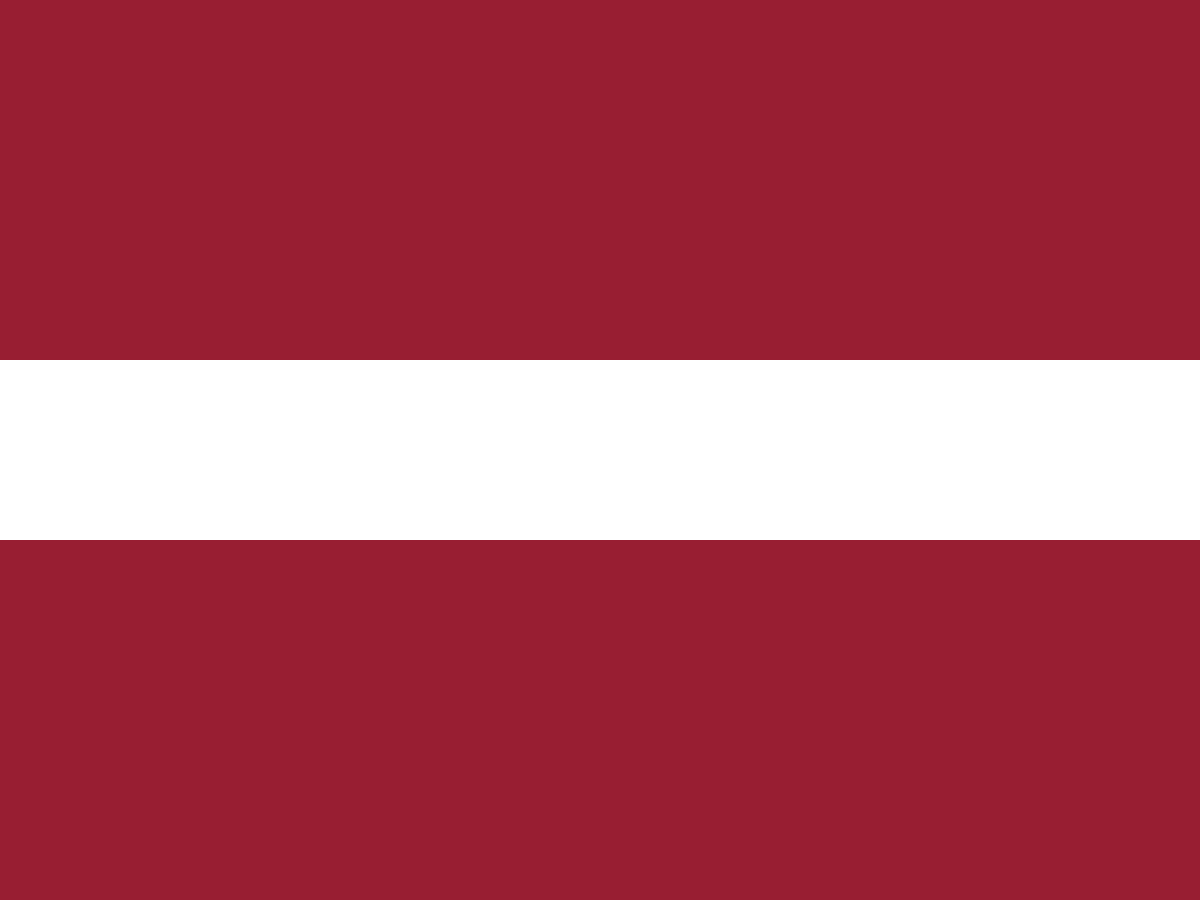
The flag of Latvia
Latvia's national flag consists of two broad carmine-red horizontal bands separated by a narrow white band.
Latvia has one of Europe's oldest recorded flag traditions.
The distinctive dark red and white design is associated with Latvian identity and is traditionally linked to a medieval legend about a wounded Latvian leader.
The proportions of the modern Latvian flag are distinctive: the white stripe is narrower than the two red bands.
The carmine-red colour
The flag uses a deep carmine or Latvian red rather than a bright scarlet. It is strongly associated with Latvian national identity.
Traditional explanations connect the red with blood and sacrifice, while the white stripe is linked to the cloth on which the wounded leader was carried.
The white stripe
The narrow white stripe creates the central division between the two red bands. In the traditional legend, the white area represents the unbloodied part of a sheet.
Its strong contrast with the dark red makes the Latvian flag immediately recognisable.
The legend of the wounded chief
A traditional Latvian legend tells of a wounded Latvian chief who was carried from a battle on a white sheet. Blood stained the sheet on both sides, leaving a white strip between the red areas.
The story is one explanation for the modern flag's unusual red-white-red design.
A short history of Latvia
Latvia's history has been shaped by Baltic tribes, medieval German influence, Swedish and Polish-Lithuanian rule, the Russian Empire, two world wars and Soviet rule.
Latvia declared independence in 1918, was occupied during the Second World War, and restored its independence in 1991.
History timeline
Ancient era — Baltic peoplesLatvia was inhabited by Baltic-speaking peoples including the Curonians, Semigallians, Selonians and Latgalians.
12th–13th centuries — German crusading ordersGerman crusaders and the Livonian Order expanded into the eastern Baltic, bringing new political and religious structures.
1201 — Riga foundedRiga was founded by Bishop Albert and developed into an important Baltic trading centre.
16th century — Livonian WarThe Livonian Confederation collapsed during a major regional conflict involving Russia, Sweden, Denmark and Poland-Lithuania.
17th century — Swedish Livonia and CourlandParts of present-day Latvia came under Swedish and Polish-Lithuanian influence, while Courland developed as a duchy.
18th century — Russian EmpireMost Latvian territories were incorporated into the Russian Empire during the Great Northern War and later partitions.
19th century — National awakeningLatvian language, literature and cultural identity strengthened during the national awakening.
1918 — IndependenceLatvia declared independence on 18 November 1918 following the collapse of the Russian and German imperial systems.
1920s–30s — First RepublicLatvia developed as an independent parliamentary republic before an authoritarian regime was established in 1934.
1940 — Soviet occupationThe Soviet Union occupied Latvia and incorporated it into the USSR.
1941 — Nazi occupationNazi Germany occupied Latvia during the Second World War.
1944–45 — Soviet returnSoviet forces returned and Latvia remained part of the USSR until 1991.
1980s — Singing RevolutionMass peaceful demonstrations across the Baltic states demanded greater political freedom and national sovereignty.
1990–91 — Restoration of independenceLatvia declared the restoration of independence in 1990 and regained full independence following the failed Soviet coup of August 1991.
2004 — EU and NATOLatvia joined both the European Union and NATO.
2014 — Euro adoptedLatvia adopted the euro as its currency.
2018 — CentenaryLatvia celebrated 100 years since the establishment of its independent republic.
Riga
Riga is Latvia's capital and largest city. Founded in 1201, it became an important Hanseatic trading centre and remains the Baltic region's largest urban centre.
Riga is famous for its medieval Old Town, Art Nouveau architecture and position on the Daugava River.
The Baltic Sea
Latvia has a coastline on the Baltic Sea, including the Gulf of Riga. Its ports have historically been important for trade and transport.
The coastline includes sandy beaches, dunes, forests and wetlands.
Latvian national awakening
During the nineteenth century, the Latvian national awakening strengthened national consciousness, literature, language and cultural institutions.
Writers, musicians and intellectuals helped develop a modern Latvian national identity.
Latvia's independence in 1918
Latvia declared independence on 18 November 1918. The new republic fought a difficult War of Independence before securing its sovereignty.
The interwar period saw the development of Latvian state institutions, education and culture.
Latvia in the Second World War
Latvia experienced both Soviet and Nazi German occupation during the Second World War. The period brought mass arrests, deportations, persecution and the Holocaust.
Latvia's wartime history remains a deeply important part of national memory.
Soviet Latvia
After the Second World War, Latvia was incorporated into the Soviet Union. The period brought industrialisation, urbanisation and immigration from other Soviet republics, alongside political repression.
Latvian language and cultural identity nevertheless remained strong.
The Singing Revolution
In the late 1980s, Latvia became part of the peaceful Baltic Singing Revolution. Huge public gatherings used national songs and cultural expression to demand independence.
Latvia restored its independence as the Soviet Union collapsed.
Restored independence
Latvia declared the restoration of independence in 1990 and regained full control after the failed Soviet coup in August 1991.
The modern Latvian state considers itself a continuation of the republic established in 1918.
Latvia in the European Union
Latvia joined the European Union and NATO in 2004. Membership strengthened its political, economic and security links with Western Europe.
Latvia adopted the euro in 2014.
Latvia's geography
Latvia is relatively flat, with extensive forests, wetlands, rivers, lakes and low-lying plains. The Daugava is its most important river.
Its position between Estonia, Lithuania, Russia and Belarus has made the country an important crossroads in the eastern Baltic.
Latvia's forests
Forests cover a large share of Latvia's territory. They support biodiversity, forestry and recreation.
Wood products and forestry have historically been important to the Latvian economy.
Latvia's climate
Latvia has a temperate climate influenced by the Baltic Sea. Winters are cold, while summers are generally mild to warm.
Weather varies between the coastal west and the more continental interior.
Latvia's wildlife
Latvia's forests and wetlands support elk, deer, wild boar, wolves, lynx, beavers and many bird species.
The country's relatively extensive natural areas provide important habitats for European wildlife.
Latvian culture
Latvian culture places strong emphasis on folk songs, traditional dress, seasonal festivals, crafts and the Latvian language.
The vast collection of Latvian folk songs, known as dainas, is an especially important cultural heritage.
The Latvian Song and Dance Festival
The Latvian Song and Dance Festival brings together thousands of singers and dancers. It is a major expression of national identity.
Song festivals played an important role in the Singing Revolution and remain central to Latvian cultural life.
Latvian language
Latvian is a Baltic language and the country's official language. It is one of only two surviving Baltic languages, alongside Lithuanian.
Latvian language and literature have played an important role in maintaining national identity through periods of foreign rule.
Latvian food
Traditional Latvian cuisine includes rye bread, grey peas, smoked fish, potatoes, pork, soups and dairy products.
Seasonal ingredients and foods suited to the country's northern climate are common in traditional cooking.
Latvia's economy
Latvia has a high-income European economy based on services, manufacturing, transport, information technology, forestry and food production.
Riga is the country's main economic centre and an important regional transport hub.
Latvia and the Baltic states
Latvia is one of the three Baltic states, alongside Estonia and Lithuania. All three regained independence from the Soviet Union in 1991 and joined the EU and NATO in 2004.
The countries share many historical experiences while retaining distinct languages and cultures.
Latvia today
Modern Latvia is a parliamentary republic and a member of the European Union, NATO, euro area and Schengen Area.
The country continues to balance its Baltic identity with its location close to Russia and the wider eastern European region.
Why is Latvia's flag interesting?
Latvia's flag is one of the world's more distinctive national designs because of its dark carmine-red colour and unusually narrow white stripe.
The design has a long historical tradition and became a powerful symbol of Latvian independence and national identity.
Explore Latvia on FlagAtlas
Continue exploring Latvia and the world's flags with these FlagAtlas resources.