About Lebanon
Lebanon is a small country on the eastern Mediterranean coast, bordered by Syria and Israel. Beirut is the capital and largest city.
Lebanon has an exceptionally long history, from the Phoenician cities of the ancient Mediterranean to the Roman and Ottoman periods, French mandate, independence, civil war and the complex modern politics of the region.
CapitalBeirut
RegionMiddle East / Mediterranean
PopulationAbout 6.8 million
CurrencyLebanese pound
Official languageArabic
Independence22 November 1943
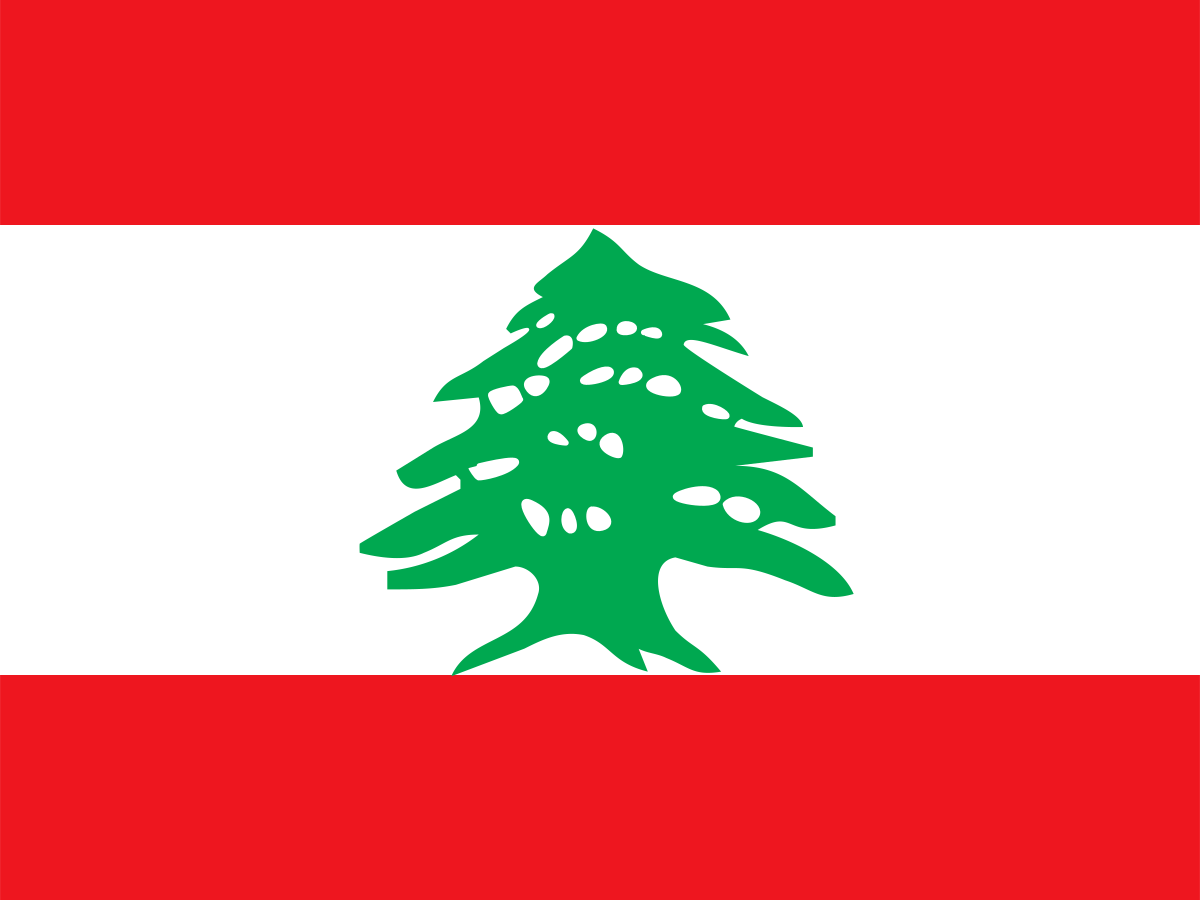
The flag of Lebanon
Lebanon's flag has a white central band between two red bands, with a green Cedar of Lebanon in the centre.
The cedar is the defining symbol of the Lebanese flag.
Red is traditionally associated with sacrifice, white with peace and purity, and the green cedar with immortality, holiness and peace.
The modern flag was adopted in 1943 as Lebanon became independent from the French Mandate.
The red bands
The two red bands are commonly associated with sacrifice and the blood shed in Lebanon's struggles and conflicts.
The strong red colour frames the white centre and makes the cedar especially prominent.
The white band
The broad white band represents peace and purity. It also provides the background for the green cedar.
The white centre occupies twice the height of each red band.
The Cedar of Lebanon
The Cedar of Lebanon is the central emblem of the flag. Cedars have been important symbols of Lebanon for thousands of years.
The tree is associated with immortality, holiness, peace and strength, and cedars are mentioned in the Bible and other ancient texts.
Cedars in the Bible and ancient world
The cedar was prized throughout the ancient Near East for its strong, fragrant and durable timber. Ancient rulers used Lebanese cedar for temples, palaces and ships.
The Bible contains numerous references to the cedars of Lebanon, helping make the tree a lasting symbol of the country.
A short history of Lebanon
Lebanon's history reaches back thousands of years. Its coast was home to the Phoenician city-states, while the region later came under Assyrian, Persian, Greek, Roman, Byzantine, Arab, Crusader, Mamluk and Ottoman rule.
Lebanon became a French Mandate territory after the First World War and gained independence in 1943.
History timeline
Ancient era — Phoenician citiesCoastal cities including Byblos, Sidon and Tyre became major Mediterranean centres of trade, shipbuilding and culture.
1st millennium BCE — Phoenician expansionPhoenician merchants established trading networks and colonies across the Mediterranean, including Carthage.
64 BCE — Roman ruleLebanon became part of the Roman world and cities such as Baalbek developed into major centres.
4th–7th centuries — Byzantine periodThe region remained part of the eastern Roman, or Byzantine, Empire.
7th century — Arab conquestThe region became part of the expanding Islamic world.
11th–13th centuries — Crusader eraParts of the Lebanese coast and surrounding region came under Crusader control.
16th century — Ottoman ruleLebanon became part of the Ottoman Empire and remained within it for roughly four centuries.
1860 — Mount Lebanon conflictSerious sectarian violence led to international intervention and the creation of an autonomous Mount Lebanon administration.
1920 — French MandateFrance established the Mandate for Lebanon and Syria under the League of Nations system.
1943 — IndependenceLebanon declared independence and achieved full independence from French control on 22 November 1943.
1958 — Political crisisLebanon experienced a serious internal crisis followed by a US military intervention.
1975–90 — Lebanese Civil WarA devastating civil war involved Lebanese factions and regional and international forces.
1989 — Taif AgreementThe Taif Agreement helped establish the framework for ending the civil war.
1990 — Civil war endsMajor fighting ended and Lebanon entered a long period of reconstruction.
2005 — Cedar RevolutionLarge demonstrations followed the assassination of former Prime Minister Rafic Hariri and contributed to the withdrawal of Syrian troops.
2006 — Lebanon WarWar between Israel and Hezbollah caused extensive damage and displacement.
2019 — Nationwide protestsLarge demonstrations challenged Lebanon's political system and economic management.
2020 — Beirut port explosionA massive explosion devastated parts of Beirut and became one of the country's defining modern tragedies.
TodayLebanon continues to face serious economic, political and social challenges while maintaining a rich cultural identity.
Phoenician Lebanon
The ancient Lebanese coast was home to the Phoenicians, a network of maritime city-states including Tyre, Sidon and Byblos.
Phoenician sailors and merchants were major traders in the Mediterranean and are strongly associated with the spread of an alphabetic writing system.
Byblos
Byblos is one of the world's oldest continuously inhabited cities. The ancient port was an important centre of trade and had close connections with Egypt.
The modern name “Bible” is traditionally linked to the Greek name for Byblos because of the city's association with papyrus and books.
Tyre and Sidon
Tyre and Sidon were two of the most important Phoenician city-states. Tyre became famous for maritime trade and the production of the valuable purple dye known as Tyrian purple.
Both cities remain important Lebanese coastal centres today.
Baalbek
Baalbek is famous for its enormous Roman temple complex in the Beqaa Valley. The site contains some of the largest ancient stone blocks used in monumental construction.
It reflects the importance of Lebanon within the Roman Mediterranean.
Lebanon under the Ottoman Empire
Lebanon remained within the Ottoman Empire for around four centuries. Mount Lebanon developed distinctive local political arrangements and strong religious communities.
The Ottoman period helped shape many of the institutions and communal identities that remain important in Lebanon today.
The French Mandate
After the First World War, Lebanon became part of the French Mandate established under the League of Nations. Greater Lebanon was proclaimed in 1920.
French influence affected education, administration, architecture and the political system.
Lebanese independence
Lebanon achieved independence in 1943. The country's political system developed around a power-sharing arrangement among its major religious communities.
22 November is celebrated as Lebanese Independence Day.
The Lebanese Civil War
The Lebanese Civil War lasted from 1975 to 1990 and involved numerous Lebanese factions as well as Syrian, Israeli, Palestinian and other regional forces.
The war caused enormous loss of life, displacement and destruction and reshaped Lebanon's political landscape.
The Taif Agreement
The Taif Agreement of 1989 provided the political framework for ending the Lebanese Civil War. It adjusted the distribution of political power among Lebanon's religious communities.
Major fighting ended in 1990.
The Cedar Revolution
The Cedar Revolution in 2005 saw large demonstrations demanding political change after the assassination of former Prime Minister Rafic Hariri.
Syrian military forces subsequently withdrew from Lebanon after decades of significant influence.
The Beirut port explosion
On 4 August 2020, a massive explosion at Beirut's port devastated large parts of the city. Hundreds of thousands of people were affected and the blast caused extensive damage.
The disaster occurred during an already severe economic and political crisis.
Beirut
Beirut is Lebanon's capital and largest city. It is a major cultural, educational, media and commercial centre of the eastern Mediterranean.
The city combines ancient history with Ottoman, French colonial and modern architecture.
Lebanon's geography
Lebanon is a narrow country between the Mediterranean Sea and the mountains of the Lebanon range. The Beqaa Valley lies between the Lebanon and Anti-Lebanon ranges.
Despite its small size, the country contains coastal plains, mountains, valleys and high-altitude areas.
The Lebanon Mountains
The Lebanon Mountains run roughly parallel to the Mediterranean coast. They contain some of the country's highest peaks and receive substantial winter snowfall.
The mountains have historically provided natural divisions between communities and regions.
The Beqaa Valley
The Beqaa Valley is a fertile agricultural region between the Lebanon and Anti-Lebanon mountain ranges.
It is important for vineyards, fruit, vegetables and other crops.
Lebanon's climate
Lebanon has a mainly Mediterranean climate, with hot, dry summers and cooler, wetter winters. Mountain areas are considerably colder and can receive heavy snow.
The contrast between the coast and mountains creates a surprising range of landscapes in a small country.
Lebanon's wildlife
Lebanon's forests, mountains and Mediterranean habitats support wild boar, foxes, wolves, hyenas, birds of prey and many migratory birds.
Habitat loss, urbanisation and hunting create ongoing conservation pressures.
Lebanese culture
Lebanon has a highly diverse culture shaped by Arab, Phoenician, Mediterranean, Ottoman, French and wider Middle Eastern influences.
Music, literature, food, religious traditions and a large global diaspora all contribute to Lebanese cultural identity.
Lebanon's religious diversity
Lebanon is home to many religious communities, including Sunni and Shia Muslims, Maronite and other Christians, Druze and others.
This diversity is a defining feature of Lebanese society and is also reflected in the country's political system.
Lebanese Arabic
Arabic is the official language of Lebanon. Lebanese Arabic is widely spoken in everyday life, while French and English are also commonly used.
Lebanon's multilingual culture reflects its history and international connections.
Lebanese food
Lebanese cuisine is famous around the world for dishes such as hummus, tabbouleh, kibbeh, falafel, manakish, grilled meats and mezze.
Olive oil, herbs, vegetables, grains and fresh produce are central to the cuisine.
Lebanese wine
The Bekaa Valley has a very long tradition of wine production, with archaeological evidence linking winemaking in the region to ancient Phoenician culture.
Lebanon's modern wineries have helped maintain this ancient agricultural tradition.
Lebanon's economy
Lebanon historically had a service-oriented economy based on banking, trade, tourism, education and professional services.
Since 2019, the country has experienced a severe financial and economic crisis, causing major disruption to households and businesses.
The Lebanese diaspora
Millions of people of Lebanese origin live outside Lebanon. The Lebanese diaspora is particularly large in the Americas, Europe, Africa and the Gulf.
Diaspora communities play an important role in Lebanese culture, business and family life.
Lebanon today
Modern Lebanon remains a culturally rich and politically complex country. Its Mediterranean position, religious diversity, ancient heritage and large diaspora give it a distinctive identity.
The country continues to work through major economic and political challenges while preserving a remarkably strong cultural presence.
Why is Lebanon's flag interesting?
Lebanon's flag is instantly recognisable because of its green cedar. Few national flags use a tree as their central emblem, and the cedar connects modern Lebanon with thousands of years of regional history.
It is a rare example of a national flag where an ancient natural symbol remains at the heart of modern national identity.
Explore Lebanon on FlagAtlas
Continue exploring Lebanon and the world's flags with these FlagAtlas resources.