About Liberia
Liberia is a country on the Atlantic coast of West Africa, bordered by Sierra Leone, Guinea and Côte d'Ivoire. Monrovia is the capital and largest city.
Liberia has a distinctive history as a republic founded by formerly enslaved and free Black people from the United States. It declared independence in 1847 and is one of Africa's oldest modern republics.
CapitalMonrovia
RegionWest Africa
PopulationAbout 5.3 million
CurrencyLiberian dollar
Official languageEnglish
Independence26 July 1847
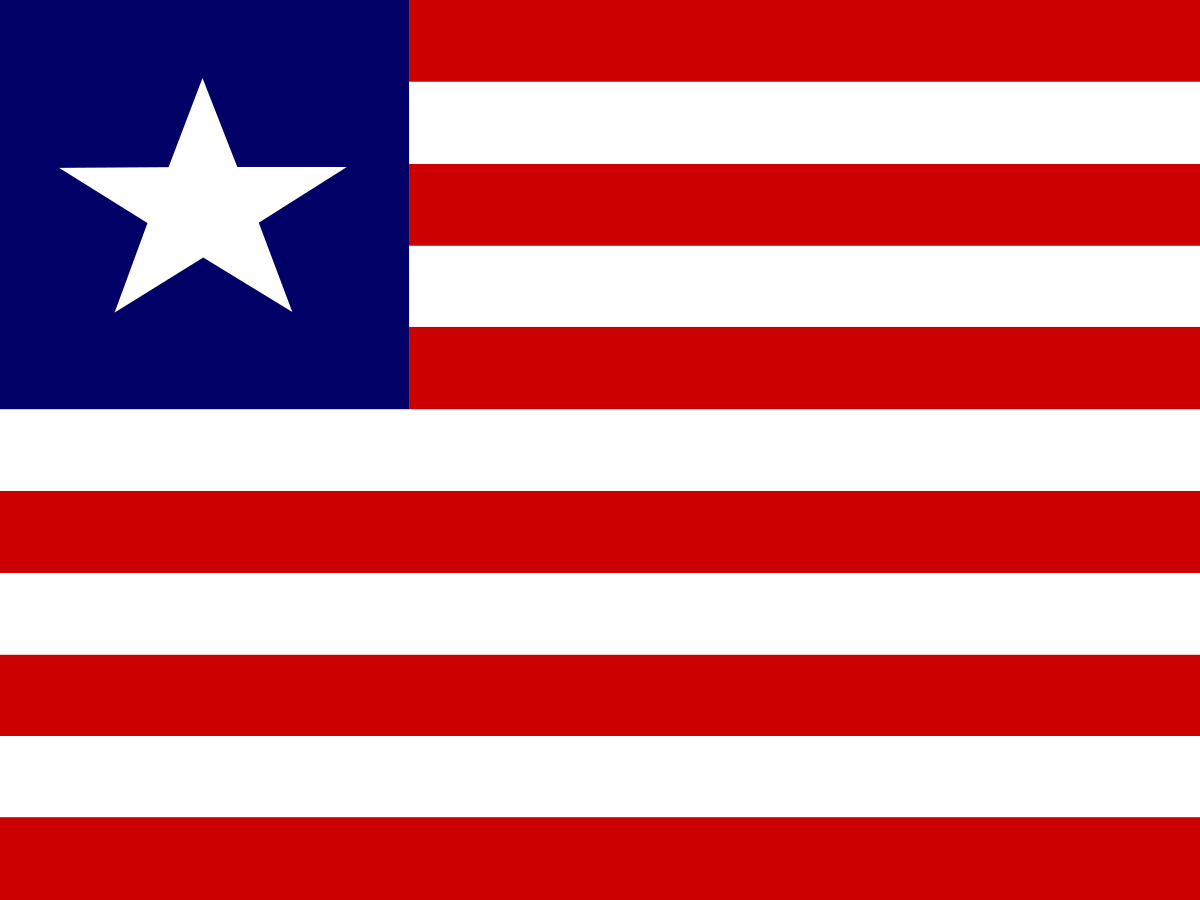
The flag of Liberia
Liberia's flag has 11 alternating red and white stripes, with a blue canton containing a single white star.
The flag deliberately resembles the flag of the United States.
The 11 stripes are associated with the 11 signatories of Liberia's Declaration of Independence, while the white star represents Liberia as an independent republic and the blue canton reflects the country's African setting.
The flag was adopted in 1847 when Liberia declared independence.
The 11 stripes
The flag's 11 red and white stripes are traditionally associated with the eleven signatories of Liberia's Declaration of Independence.
The design strongly echoes the American flag, reflecting Liberia's historical links with the United States.
The white star
The single white star symbolises Liberia's independence and freedom. It replaced the multiple stars of the United States flag with one star representing the new African republic.
The star makes Liberia's flag distinctive despite its obvious American influence.
The blue canton
The blue canton contains the white star and is often interpreted as representing the African continent or Liberia's place among independent nations.
Its position at the upper hoist makes the flag instantly recognisable.
Why does Liberia's flag look like the American flag?
Liberia's flag was deliberately based on the United States flag. The country's founding was closely connected with the American Colonization Society and the settlement of formerly enslaved and free Black Americans in West Africa.
The similarity is therefore a direct visual reminder of Liberia's unusual founding history.
A short history of Liberia
Liberia's modern history began with the settlement of Black Americans on the West African coast in the nineteenth century. The settlement developed into the Republic of Liberia, which declared independence in 1847.
The country later experienced political tensions, military rule and two devastating civil wars before returning to democratic government.
History timeline
1816 — American Colonization SocietyThe American Colonization Society was formed to support the resettlement of free Black Americans in Africa.
1822 — Settlement at Cape MesuradoSettlers established a permanent colony on the site of modern Monrovia.
1824 — Monrovia namedThe settlement was named Monrovia in honour of US President James Monroe.
1847 — IndependenceLiberia declared independence on 26 July 1847 and adopted its own constitution.
1848 — First president inauguratedJoseph Jenkins Roberts became Liberia's first president.
Late 19th century — Expansion of state authorityThe Liberian government expanded its control inland, although relations with indigenous communities were often unequal and contested.
20th century — International economic linksRubber, shipping, mining and foreign investment became increasingly important to Liberia's economy.
1944 — William Tubman becomes presidentTubman began a long presidency marked by infrastructure development, foreign investment and the Open Door policy.
1971 — Tubman diesWilliam Tolbert succeeded him and introduced some political and economic reforms.
1980 — Military coupSamuel Doe seized power, ending the Americo-Liberian political order.
1989 — First Liberian Civil WarRebellion against Doe's government developed into a prolonged civil war.
1990 — Samuel Doe killedDoe was captured and killed during the conflict.
1997 — Charles Taylor electedCharles Taylor won presidential elections after the civil war period.
1999 — Second Liberian Civil WarA new rebellion began against Taylor's government.
2003 — Taylor leaves officeTaylor resigned and went into exile after international and regional pressure.
2005 — Ellen Johnson Sirleaf electedJohnson Sirleaf became Africa's first elected female head of state.
2014–16 — Ebola epidemicLiberia was one of the countries worst affected by the West African Ebola outbreak.
2018 — George Weah becomes presidentFormer footballer George Weah won the presidency.
2024 — Joseph Boakai becomes presidentJoseph Boakai took office after defeating George Weah in the 2023 election.
The founding of Liberia
Liberia's founding was linked to the idea of resettling free Black Americans in Africa. The American Colonization Society helped establish settlements along the West African coast from 1822.
The settlers developed institutions based partly on American political traditions, eventually creating the independent Republic of Liberia.
Monrovia
Monrovia is Liberia's capital. It was named after US President James Monroe and developed around the original settlement at Cape Mesurado.
The city is Liberia's main political, commercial and cultural centre.
Americo-Liberian society
For much of Liberia's early history, political power was concentrated among the Americo-Liberian elite descended from settlers from the United States and the Caribbean.
This created major social and political divisions with Liberia's many indigenous communities.
Indigenous peoples of Liberia
Liberia is home to numerous indigenous ethnic groups, including the Kpelle, Bassa, Gio, Mano, Kru, Grebo and Loma, among others.
These communities have their own languages, traditions and histories and form the majority of Liberia's population.
William Tubman
William V. S. Tubman was Liberia's longest-serving president, governing from 1944 to 1971. His administration promoted foreign investment, infrastructure and a policy known as the Open Door.
He also introduced reforms intended to bring indigenous Liberians more fully into the political system, although inequalities remained.
The 1980 coup
In 1980, Master Sergeant Samuel Doe led a military coup that overthrew and killed President William Tolbert.
The coup ended the long period of Americo-Liberian political dominance and began a turbulent era of military rule and civil conflict.
The Liberian Civil Wars
Liberia suffered two major civil wars between 1989 and 2003. The conflicts caused enormous loss of life, displacement and destruction of infrastructure.
Regional organisations, neighbouring countries and international peacekeeping forces became heavily involved in efforts to end the fighting.
Ellen Johnson Sirleaf
In 2005, Ellen Johnson Sirleaf was elected president, becoming Africa's first elected female head of state.
Her presidency focused on rebuilding institutions, attracting investment, reducing corruption and recovering from the civil wars.
George Weah
George Weah, a former international football star, was elected president in 2017 and took office in 2018.
His election was notable because of his extraordinary transition from global sporting fame to national political leadership.
Liberia's geography
Liberia has a long Atlantic coastline with sandy beaches, lagoons and mangrove areas. Inland, the landscape rises into rolling hills and forested highlands.
Major rivers include the St Paul, St John, Cestos and Cavalla.
Liberia's tropical forests
Liberia contains some of the largest remaining areas of Upper Guinean rainforest in West Africa.
These forests support exceptional biodiversity and are important for climate regulation, water resources and local communities.
Mount Wuteve
Mount Wuteve in Lofa County is Liberia's highest mountain, rising to roughly 1,440 metres.
Although modest by global standards, Liberia's highlands form an important part of the country's inland landscape.
Liberia's climate
Liberia has a tropical climate with high temperatures and a pronounced wet season. Coastal areas receive especially heavy rainfall.
The long rainy season supports the country's forests and agriculture.
Liberia's wildlife
Liberia's forests support species including forest elephants, pygmy hippos, chimpanzees, leopards and many rare birds.
Habitat loss, hunting and development create ongoing conservation challenges.
Liberian culture
Liberian culture combines the traditions of many indigenous peoples with influences brought by settlers from the United States and Caribbean.
Music, dance, storytelling, textiles and food vary considerably between communities.
Liberian languages
English is Liberia's official language, while numerous indigenous languages are spoken across the country. Liberian English varieties are widely used in everyday communication.
The country's linguistic diversity reflects its many ethnic communities.
Liberian food
Liberian cuisine includes rice, cassava, plantains, palm oil, fish, chicken and spicy stews.
Rice is a particularly important staple, while cassava and plantain are common across the country.
Rubber in Liberia
Rubber became one of Liberia's most important export commodities during the twentieth century. The country developed major rubber plantations and attracted foreign investment.
Rubber remains an important agricultural product.
Iron ore and mining
Liberia has significant deposits of iron ore and other minerals. Mining has played an important role in the country's economy and export earnings.
The sector has also faced challenges related to infrastructure, employment, environmental protection and global commodity prices.
Liberia's economy
Liberia's economy depends on agriculture, mining, rubber, forestry, services and international assistance.
The country has made substantial progress since the civil wars but continues to face development challenges.
The Ebola epidemic
Liberia was one of the countries most severely affected by the 2014–16 West African Ebola epidemic. Thousands of people died and health services came under extreme pressure.
The outbreak also had major social and economic consequences.
Liberia today
Modern Liberia is a democratic republic with a young population and a strong connection to the United States through its unusual founding history.
Rebuilding infrastructure, expanding education and healthcare, developing natural resources sustainably and creating jobs remain important national priorities.
Why is Liberia's flag interesting?
Liberia's flag is one of the clearest examples of a national flag shaped by another country's history. Its 11 stripes and single white star echo the United States while representing Liberia's own independence and identity.
The flag therefore tells part of Liberia's founding story before you even know the country's history.
Explore Liberia on FlagAtlas
Continue exploring Liberia and the world's flags with these FlagAtlas resources.