About Libya
Libya is a large country on the North African coast of the Mediterranean Sea, bordered by Egypt, Sudan, Chad, Niger, Algeria and Tunisia. Tripoli is the capital and largest city.
Libya has been shaped by ancient Mediterranean civilisations, Ottoman rule, Italian colonialism, independence under King Idris, the long rule of Muammar Gaddafi and the upheavals that followed the 2011 revolution.
CapitalTripoli
RegionNorth Africa
PopulationAbout 7.0 million
CurrencyLibyan dinar
Official languageArabic
Independence24 December 1951
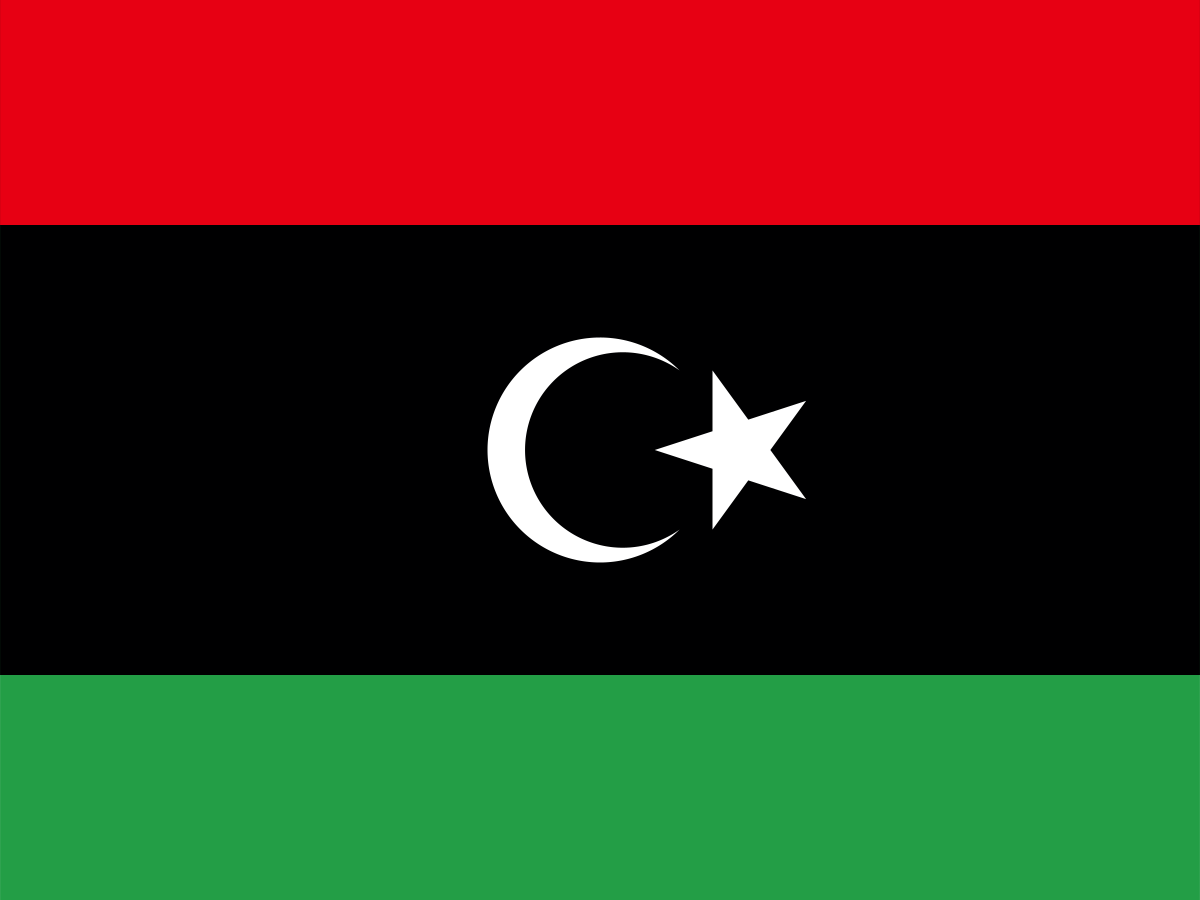
The flag of Libya
Libya's present flag has three horizontal bands of red, black and green, with a white crescent and five-pointed star in the centre of the black band.
The design was first used by the Kingdom of Libya and restored after the 2011 revolution.
The colours are associated with Libya's history and the country's three major historical regions, while the crescent and star are widely associated with Islam.
The red-black-green tricolour replaced Gaddafi's plain green flag after the 2011 uprising.
The red band
The red band is traditionally associated with sacrifice and the blood shed during Libya's struggles against foreign rule.
It is also connected with the historical flag traditions of Cyrenaica and the wider Senussi movement.
The black band
The central black band is associated with the Senussi dynasty and with the historical region of Cyrenaica in eastern Libya.
It is the widest band and provides the background for the white crescent and star.
The green band
The green band is associated with prosperity and the historical region of Tripolitania. Green also has strong associations with Islam.
Under Muammar Gaddafi, green became the sole colour of Libya's national flag from 1977 until 2011.
The crescent and star
The white crescent and five-pointed star are widely recognised symbols associated with Islam.
The crescent and star appeared on the flag of the Kingdom of Libya and were restored when the pre-Gaddafi tricolour returned in 2011.
The three historical regions
Libya is traditionally divided into three major historical regions: Tripolitania in the west, Cyrenaica in the east and Fezzan in the southwest.
The red, black and green colours of the national flag are closely associated with this historical regional identity.
Why did Libya have a plain green flag?
From 1977 to 2011, Libya used a completely plain green flag under Muammar Gaddafi. It was introduced after Libya's political system was transformed into the Jamahiriya.
It was one of the world's simplest national flags and contained no emblem, writing or other design.
A short history of Libya
Libya's history stretches from the ancient Berber peoples and Greek and Phoenician settlements through Roman rule, Arab conquest, Ottoman rule, Italian colonisation, independence and the Gaddafi era.
The country has experienced major political change since the 2011 uprising.
History timeline
Ancient era — Berber peoplesIndigenous Berber peoples inhabited the region long before the arrival of Greek and Phoenician settlers.
7th century BCE — Greek CyreneGreek settlers founded Cyrene in eastern Libya, creating an important centre of the ancient Mediterranean world.
Phoenician and Carthaginian influenceWestern Libya developed strong links with Phoenician and later Carthaginian trading networks.
146 BCE onward — Roman ruleRoman influence expanded across the region after the destruction of Carthage.
7th century — Arab conquestArab armies conquered the region and Islam and the Arabic language became increasingly dominant.
16th century — Ottoman ruleOttoman authority was established along the Libyan coast, with local rulers retaining varying degrees of autonomy.
1840s — Senussi movementThe Senussi Islamic order became highly influential in Cyrenaica and the Sahara.
1911 — Italian invasionItaly invaded Ottoman Libya, beginning a long and violent colonial conflict.
1920s–30s — Resistance and repressionLibyan resistance continued, most famously under Omar Mukhtar, while Italy imposed harsh colonial policies.
1931 — Omar Mukhtar captured and executedThe resistance leader Omar Mukhtar was captured and executed by the Italian authorities.
1943 — Allied controlItalian and German forces were defeated in North Africa and Libya came under Allied administration.
1951 — IndependenceThe United Kingdom of Libya became independent on 24 December 1951 under King Idris I.
1959 — Oil discoveredMajor oil discoveries transformed Libya's economic prospects and later generated substantial export revenues.
1969 — Gaddafi coupMuammar Gaddafi and fellow officers overthrew King Idris in a military coup.
1977 — Jamahiriya establishedGaddafi declared the Libyan Arab Jamahiriya and introduced the plain green flag.
1986 — US air strikesThe United States bombed targets in Libya following tensions over alleged Libyan involvement in terrorism.
1988 — Lockerbie bombingPan Am Flight 103 was destroyed over Lockerbie, Scotland, killing 270 people. Libyan nationals were later convicted in connection with the attack.
2003 — Libya renounces WMD programmesLibya announced that it would abandon programmes to develop weapons of mass destruction and improve relations with Western countries.
2011 — Revolution and civil warProtests against Gaddafi developed into armed conflict and international intervention.
2011 — Gaddafi killedGaddafi was captured and killed in October 2011 as the conflict ended.
2014 — Renewed civil conflictPolitical divisions and armed conflict deepened, producing rival governments and competing centres of power.
2020 — CeasefireA nationwide ceasefire helped reduce large-scale fighting and created a framework for political negotiations.
2021 — Government of National UnityA transitional Government of National Unity was formed, although political divisions remained.
TodayLibya continues to work towards political unification and stable national institutions while managing significant regional and economic challenges.
Ancient Libya
Ancient Libya was home to Berber peoples and later became a meeting point between North Africa and the Mediterranean.
Greek settlements developed in Cyrenaica while Phoenician and Carthaginian influence was strongest in the west.
Cyrene
Cyrene, founded by Greek settlers in the seventh century BCE, became one of the most important cities of the ancient Greek world.
The ruins near modern Shahat are among Libya's most significant archaeological sites.
Roman Libya
Under Roman rule, Libya became part of a prosperous Mediterranean world. Leptis Magna developed into one of the empire's most impressive cities.
Roman ruins remain an important part of Libya's cultural heritage.
Leptis Magna
Leptis Magna was a major ancient port city and the birthplace of Roman emperor Septimius Severus. Its monumental forum, basilica, theatre and arches survive remarkably well.
It is one of the finest Roman archaeological sites in North Africa.
The Senussi movement
The Senussi was an Islamic reform movement founded in the nineteenth century. It became particularly influential among communities in eastern Libya and the Sahara.
The Senussi dynasty later provided Libya's first king, Idris I.
Italian colonial rule
Italy invaded Libya in 1911 and gradually imposed colonial rule. Resistance continued for decades.
Italian repression included mass deportations, concentration camps and severe restrictions on Libyan communities.
Omar Mukhtar
Omar Mukhtar became the most famous leader of the Libyan resistance against Italian colonial rule. Known as the “Lion of the Desert”, he led resistance forces in Cyrenaica.
He was captured and executed in 1931 and remains a major national symbol of resistance.
Libyan independence
Libya became independent on 24 December 1951 as the United Kingdom of Libya. King Idris I became the country's first monarch.
Libya was unusual because it became independent as a united state from three historically distinct regions.
The discovery of oil
Large oil reserves were discovered in Libya in the late 1950s. Oil exports transformed the country's economy and provided the government with major revenues.
Libya's oil wealth remains central to its economy today.
Muammar Gaddafi
Muammar Gaddafi seized power in 1969 and ruled Libya for more than four decades. His government promoted a distinctive political ideology and pursued an often confrontational foreign policy.
His rule ended during the 2011 revolution.
The Libyan Arab Jamahiriya
In 1977 Gaddafi declared the Libyan Arab Jamahiriya, describing it as a system of direct popular rule. The country's flag became plain green.
The political system remained highly centralised around Gaddafi despite its claims of direct democracy.
Lockerbie
In 1988, Pan Am Flight 103 exploded over Lockerbie in Scotland, killing 270 people. The attack became one of the most notorious acts of terrorism associated with Libya.
Libya later accepted responsibility in the context of international negotiations and sanctions were subsequently eased.
The 2011 Libyan Revolution
The 2011 uprising began during the wider Arab Spring. Armed conflict developed between forces loyal to Gaddafi and opposition groups, followed by international military intervention.
Gaddafi's government collapsed and he was killed in October 2011.
Libya since 2011
After Gaddafi's fall, Libya struggled to establish a stable unified political system. Rival governments, armed groups and foreign involvement contributed to prolonged instability.
A ceasefire in 2020 reduced large-scale fighting, but political divisions have continued.
Tripoli
Tripoli is Libya's capital and largest city. Located on the Mediterranean coast, it has been an important port and political centre for centuries.
The city's old medina contains historic mosques, markets and Ottoman-era buildings.
Libya's geography
Libya is dominated by the Sahara Desert, with most of the population concentrated along the Mediterranean coast and in a few inland oases.
The country has a very long Mediterranean coastline and large areas of extremely sparsely populated desert.
The Sahara
Much of Libya lies within the Sahara Desert. Vast areas consist of sand seas, rocky plateaus and gravel plains.
Desert conditions have shaped settlement, transport and traditional nomadic life for centuries.
The Great Sand Sea
The Great Sand Sea stretches across parts of western Egypt and southeastern Libya. It contains enormous fields of sand dunes and some of the world's most remote desert landscapes.
Oases provide vital water sources in the desert.
Libya's Mediterranean coast
The Mediterranean coast contains most of Libya's cities, farmland and population. Coastal areas have a more moderate climate than the desert interior.
Tripoli, Benghazi, Misrata and other coastal cities are important population and economic centres.
Libya's climate
Libya is predominantly arid and desert. Summers can be extremely hot, while rainfall is limited and highly seasonal.
The Mediterranean coast receives more rainfall than the Sahara, with the Jebel Akhdar region in the northeast being comparatively wetter.
Libya's wildlife
Despite its desert environment, Libya supports gazelles, desert foxes, reptiles, migratory birds and marine species.
Desert and coastal ecosystems are adapted to extreme conditions and water scarcity.
Libyan culture
Libyan culture reflects a mixture of Arab, Amazigh, Tuareg, Berber, Mediterranean and Saharan traditions.
Family, religion, hospitality, poetry, music and traditional crafts are important parts of cultural life.
Amazigh communities
Amazigh communities in Libya have their own languages, traditions and cultural heritage. They are particularly associated with parts of the Nafusa Mountains and western Libya.
Amazigh identity has become more publicly visible since the 2011 revolution.
Tuareg communities
The Tuareg are a traditionally nomadic Saharan people whose communities extend across several countries, including southern Libya.
Trade, livestock, desert travel and distinctive clothing have long been central to Tuareg culture.
Libyan Arabic
Arabic is the dominant language of Libya. Several regional dialects are spoken, alongside Amazigh languages and other local varieties.
Libya's linguistic landscape reflects its long history as a meeting point between the Mediterranean, North Africa and the Sahara.
Libyan food
Libyan cuisine combines North African, Mediterranean and Arab influences. Popular foods include couscous, bazeen, shorba, grilled meats, dates and seafood.
Olive oil, grains, vegetables and spices are common ingredients.
Libya's oil economy
Libya has the largest proven oil reserves in Africa. Petroleum dominates exports and provides most government revenue.
Production and exports have frequently been affected by political conflict and disruptions to oil infrastructure.
Libya's economy
Libya's economy is heavily dependent on oil and natural gas. Other sectors include construction, trade, agriculture and services.
Political instability has made economic planning and infrastructure development difficult.
Libya today
Modern Libya remains a country of enormous geographical scale and natural-resource wealth, but it continues to face political division and institutional challenges.
Its Mediterranean location, oil reserves and position between North Africa and the Sahara give it considerable strategic importance.
Why is Libya's flag interesting?
Libya's flag tells a remarkable political story. The same red-black-green design was used by the independent kingdom, replaced by Gaddafi's plain green flag, and then restored after the 2011 revolution.
Few modern national flags have changed so dramatically in response to a country's political history.
Explore Libya on FlagAtlas
Continue exploring Libya and the world's flags with these FlagAtlas resources.