About Lithuania
Lithuania is the largest of the three Baltic states, on the eastern shore of the Baltic Sea. It borders Latvia, Belarus, Poland and Russia's Kaliningrad region. Vilnius is the capital and largest city.
Lithuania has a long history as a powerful medieval state, later becoming part of the Polish-Lithuanian Commonwealth, the Russian Empire, the interwar independent republic and the Soviet Union before restoring independence in 1990.
CapitalVilnius
RegionBaltic / Northern Europe
PopulationAbout 2.8 million
CurrencyEuro (€)
Official languageLithuanian
Independence restored11 March 1990
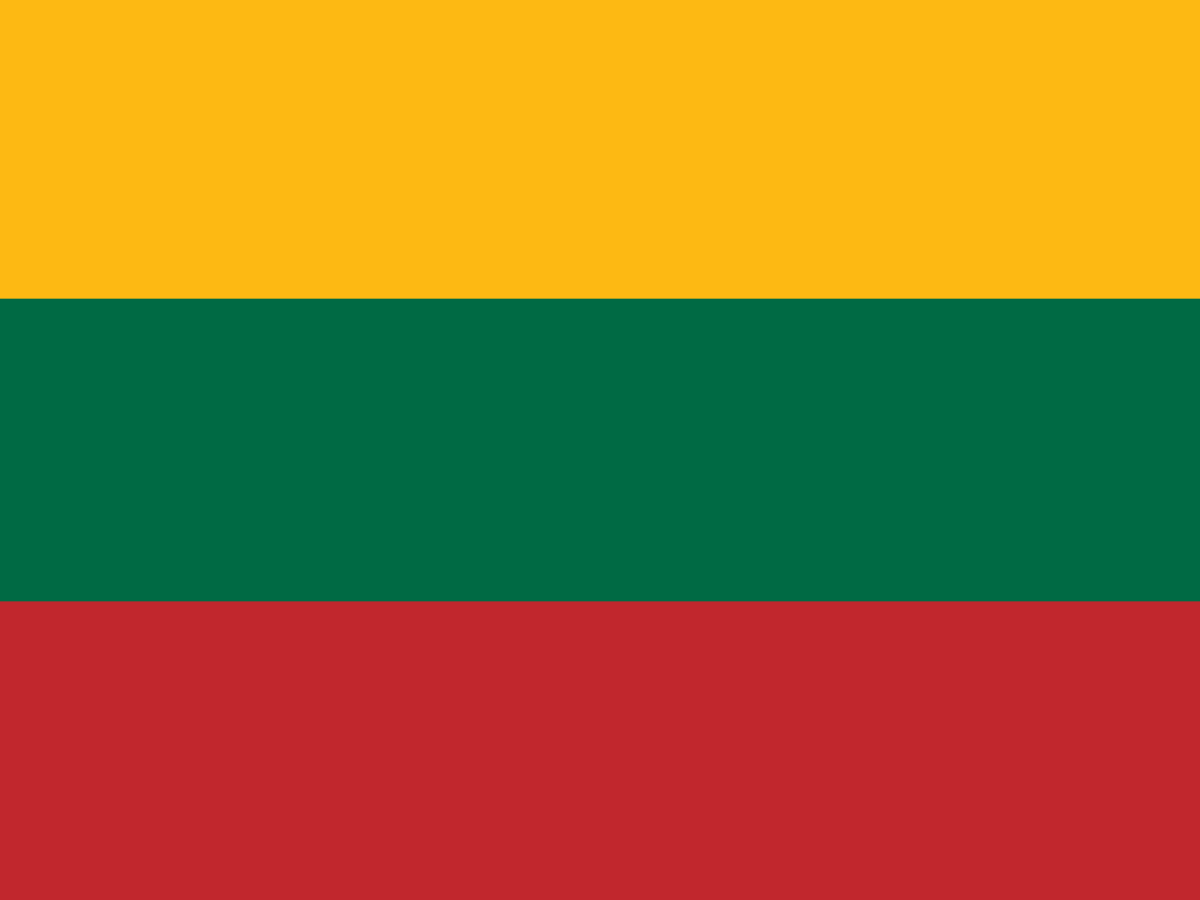
The flag of Lithuania
Lithuania's flag has three horizontal bands of yellow, green and red.
The colours are commonly associated with Lithuania's natural landscape and national history.
Yellow represents the sun, light and prosperity; green is associated with forests, nature and hope; red represents courage, blood and sacrifice for the homeland.
The present tricolour was adopted in 1918 and restored in 1988 during the national revival.
The yellow band
The yellow band is associated with the sun, light, wheat and prosperity.
It gives the flag its distinctive warm upper band and can be seen as representing optimism and a prosperous future.
The green band
The green band represents Lithuania's forests, nature, freedom and hope.
Forests cover a significant part of the country and have long been an important part of Lithuanian identity.
The red band
The red band is associated with courage, love of country and the blood shed in Lithuania's struggles for freedom.
The colour has particular resonance given Lithuania's long history of resistance to foreign rule.
A short history of Lithuania
Lithuania developed into a powerful medieval state under the Grand Duchy of Lithuania. It later formed a political union with Poland and became part of the Polish-Lithuanian Commonwealth.
After partitions of the Commonwealth, Lithuania was incorporated into the Russian Empire. It regained independence in 1918, was occupied during the Second World War and incorporated into the Soviet Union before restoring independence in 1990.
History timeline
13th century — Lithuanian state emergesMindaugas united Lithuanian lands and was crowned King of Lithuania in 1253.
14th century — Grand Duchy expandsThe Grand Duchy of Lithuania grew into one of Europe's largest states, extending deep into eastern Europe.
1387 — ChristianisationGrand Duke Jogaila accepted Christianity for Lithuania, beginning the country's formal Christianisation.
1410 — Battle of GrunwaldLithuanian and Polish forces defeated the Teutonic Order in one of medieval Europe's major battles.
1569 — Polish-Lithuanian CommonwealthThe Union of Lublin created the Polish-Lithuanian Commonwealth.
1795 — Third PartitionThe Commonwealth disappeared and most Lithuanian territory became part of the Russian Empire.
19th century — National revivalLithuanian language, literature and national identity strengthened despite Russian imperial restrictions.
1918 — IndependenceLithuania declared independence on 16 February 1918.
1920s–30s — First RepublicIndependent Lithuania developed its own democratic institutions before an authoritarian government emerged under Antanas Smetona.
1940 — Soviet occupationThe Soviet Union occupied Lithuania and incorporated it into the USSR.
1941 — Nazi occupationNazi Germany occupied Lithuania during the Second World War.
1944–45 — Soviet returnSoviet forces returned and Lithuania remained under Soviet rule for decades.
1940s–50s — Armed resistanceLithuanian partisans fought a guerrilla war against Soviet rule.
1988 — Sąjūdis movementA mass national movement demanded greater political freedom and eventually independence.
11 March 1990 — Independence restoredLithuania became the first Soviet republic to declare restoration of independence.
1991 — International recognitionFollowing the failed Soviet coup, Lithuania's independence was widely recognised and Soviet forces later withdrew.
2004 — EU and NATOLithuania joined both the European Union and NATO.
2015 — Euro adoptedLithuania adopted the euro, completing the Baltic states' transition to the common currency.
TodayLithuania is a democratic European state and a member of the EU, NATO and euro area.
Mindaugas
Mindaugas was the first and only crowned King of Lithuania. He united much of the emerging Lithuanian state and was crowned in 1253.
His reign marks an important milestone in the development of Lithuania as a medieval European state.
The Grand Duchy of Lithuania
The Grand Duchy of Lithuania became one of medieval Europe's largest political entities. At its height, it included extensive territories across present-day Lithuania, Belarus, Ukraine and parts of Russia and Poland.
The state was multilingual and multiethnic, with a complex mixture of Baltic, Slavic and Jewish communities.
Jogaila and the Polish connection
Grand Duke Jogaila became King of Poland in 1386 after marrying Jadwiga. This personal union began the long political relationship between Lithuania and Poland.
The relationship eventually developed into the Polish-Lithuanian Commonwealth.
The Battle of Grunwald
The Battle of Grunwald in 1410 saw Polish and Lithuanian forces defeat the Teutonic Order.
The victory significantly weakened the Order and became an enduring symbol of Polish and Lithuanian military history.
The Polish-Lithuanian Commonwealth
The Polish-Lithuanian Commonwealth was created in 1569. It became one of Europe's largest and most influential states.
It survived for more than two centuries before being partitioned between Russia, Prussia and Austria.
Lithuanian national revival
During the nineteenth century, a Lithuanian national revival developed around language, literature, history and cultural identity.
After the 1863 uprising, Russian authorities imposed restrictions including a ban on printing Lithuanian books in the Latin alphabet. Lithuanian book smugglers became important symbols of resistance.
Lithuanian independence in 1918
Lithuania declared independence on 16 February 1918, following the collapse of the Russian and German imperial systems during the First World War.
The new republic established Vilnius as its capital, although the city and surrounding region became the subject of a major dispute with Poland.
The interwar republic
Independent Lithuania developed into a modern state during the interwar period. In 1926, Antanas Smetona returned to power after a coup and established an authoritarian presidential regime.
Kaunas served as the provisional capital while Vilnius was under Polish control.
Vilnius
Vilnius is Lithuania's capital and largest city. Its historic centre contains medieval, Gothic, Baroque and neoclassical architecture.
The city has long been a multicultural centre with Lithuanian, Polish, Jewish, Belarusian and other historical communities.
Lithuania in the Second World War
Lithuania was occupied first by the Soviet Union in 1940, then by Nazi Germany in 1941, and again by the Soviet Union from 1944.
The Second World War brought mass deportations, persecution and the Holocaust, which devastated Lithuania's historic Jewish communities.
The Lithuanian partisans
After the Second World War, Lithuanian partisans fought Soviet forces in a prolonged guerrilla resistance. The armed resistance gradually declined during the 1950s.
The partisan movement remains an important symbol of Lithuanian resistance to Soviet rule.
The Sąjūdis movement
The Sąjūdis movement emerged in 1988 and became the main force behind Lithuania's peaceful national revival.
Mass demonstrations, public singing and the restoration of national symbols helped build support for independence.
The Baltic Way
On 23 August 1989, around two million people formed a human chain stretching through Lithuania, Latvia and Estonia. The event became known as the Baltic Way.
It symbolised Baltic unity and opposition to Soviet rule.
Restoration of independence
On 11 March 1990, Lithuania declared the restoration of its independence, becoming the first Soviet republic to do so.
The Soviet government attempted economic pressure and later military action, but Lithuania maintained its independence claim.
Lithuania in the European Union
Lithuania joined the European Union and NATO in 2004. EU and NATO membership strengthened the country's political, economic and security ties with Western Europe.
Lithuania adopted the euro in 2015.
Lithuania's geography
Lithuania is the southernmost and largest of the three Baltic states. Its landscape includes low plains, forests, lakes, wetlands and a Baltic Sea coastline.
The country is relatively flat, with gently rolling terrain rather than major mountain ranges.
The Baltic Sea and Curonian Spit
Lithuania has a Baltic coastline including the remarkable Curonian Spit, a narrow sand-dune peninsula shared with Russia's Kaliningrad region.
The Curonian Spit is a UNESCO World Heritage Site known for its dunes, forests and lagoon.
Lithuania's climate
Lithuania has a temperate continental climate influenced by the Baltic Sea. Winters are cold and summers are generally mild to warm.
Snow is common in winter, while coastal areas tend to have milder conditions than the interior.
Lithuania's forests
Forests cover a significant part of Lithuania and are home to elk, deer, wild boar, wolves, lynx and many bird species.
Forestry and conservation are both important aspects of the country's land management.
Lithuanian culture
Lithuanian culture places strong emphasis on language, folk songs, traditional crafts, seasonal festivals and Catholic traditions.
Traditional patterns, amber jewellery and folk music remain important parts of national identity.
Lithuanian language
Lithuanian is one of only two surviving Baltic languages, alongside Latvian. It is considered one of Europe's most conservative Indo-European languages.
The language is central to Lithuanian national identity and played an important role in resisting cultural assimilation.
Lithuanian food
Traditional Lithuanian cuisine includes cepelinai, kugelis, rye bread, cold beet soup, potato dishes and smoked meats.
Potatoes, grains, dairy products and seasonal ingredients feature prominently.
Amber on the Baltic coast
Lithuania is associated with Baltic amber, a fossilised tree resin found along the Baltic Sea coast.
Amber has been traded and used for jewellery and ornaments in the region for thousands of years.
Lithuania's economy
Lithuania has a diversified high-income European economy based on manufacturing, services, information technology, biotechnology, transport and logistics.
Vilnius and Kaunas are major centres for business, technology and education.
Lithuania today
Modern Lithuania is a parliamentary republic and a member of the European Union, NATO, euro area and Schengen Area.
Its location on NATO's eastern flank and its shared border with Russia's Kaliningrad region make security an important part of national policy.
Why is Lithuania's flag interesting?
Lithuania's simple yellow-green-red tricolour survived as a powerful symbol of national identity through independence, Soviet occupation and the restoration of freedom.
The flag was carried prominently during the Sąjūdis movement and became one of the most recognisable symbols of Lithuania's peaceful independence movement.
Explore Lithuania on FlagAtlas
Continue exploring Lithuania and the world's flags with these FlagAtlas resources.