About Luxembourg
Luxembourg is a small landlocked country in Western Europe, bordered by Belgium, France and Germany. Luxembourg City is the capital and largest city.
Despite its small size, Luxembourg is a founding member of European integration and is one of the world's wealthiest countries by GDP per capita.
CapitalLuxembourg City
RegionWestern Europe
PopulationAbout 640,000
CurrencyEuro (€)
Official languagesLuxembourgish, French & German
GovernmentConstitutional monarchy
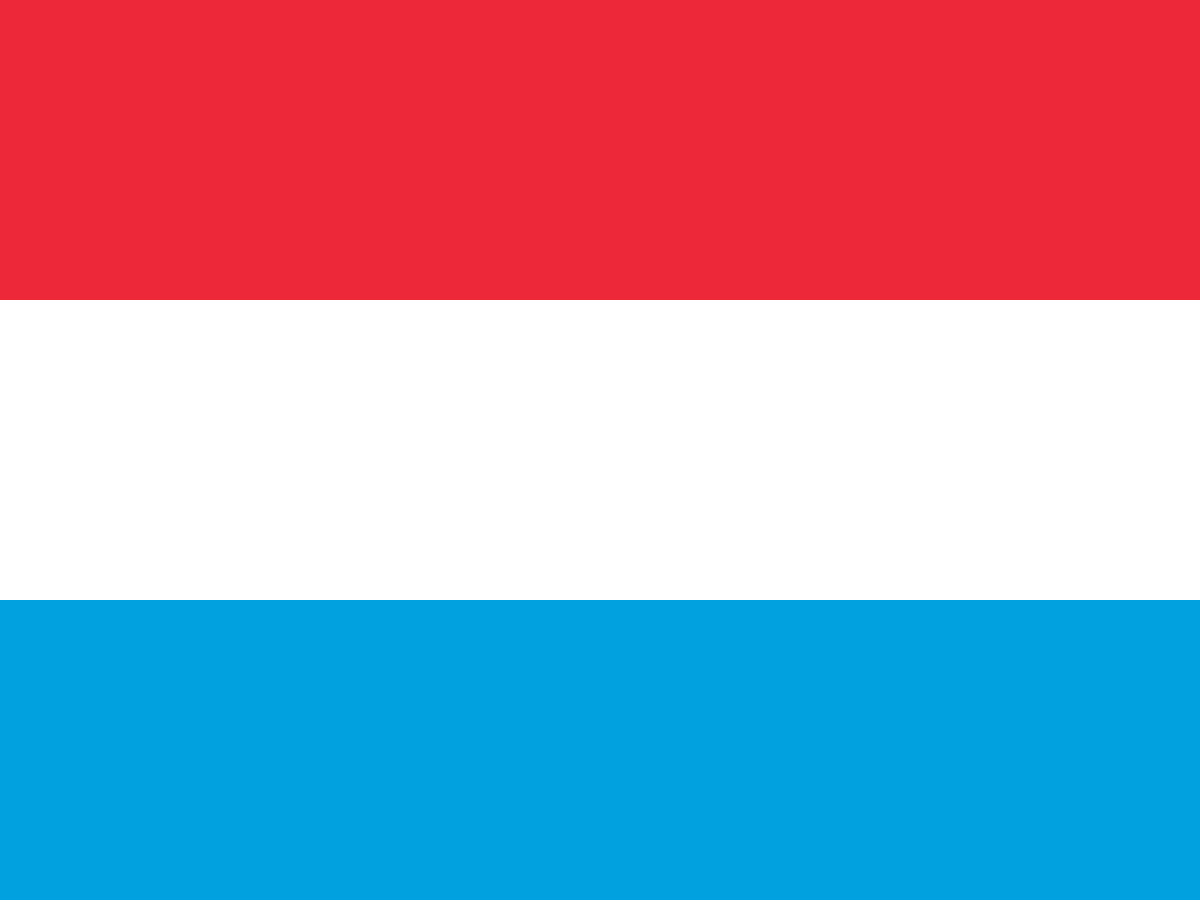
The flag of Luxembourg
Luxembourg's national flag has three horizontal bands of red, white and light blue.
It is closely related to the Dutch flag, but Luxembourg uses a noticeably lighter blue.
The tricolour developed during the nineteenth century and became an important symbol of Luxembourg's national identity.
The current flag was formally adopted in the twentieth century, although the red-white-blue colours had been associated with Luxembourg for much longer.
The red band
The red upper band is part of Luxembourg's historic national colour combination. Red was also prominent in the arms and heraldic traditions of the medieval County of Luxembourg.
The colours of the modern flag developed from Luxembourg's historical identity rather than from a single officially defined symbolism for each stripe.
The white band
The white central band completes the tricolour and provides a strong contrast between the red and blue.
Like the other flag colours, white is principally a national colour rather than having one universally agreed official meaning.
The light blue band
The light blue lower band is what most clearly distinguishes Luxembourg's flag from the Netherlands flag.
Luxembourg deliberately uses a paler shade of blue, while the Dutch flag uses a darker blue.
Luxembourg and the Netherlands flags
Luxembourg's flag and the Netherlands flag both use horizontal red, white and blue stripes. Their main visual difference is the shade of blue.
The similarity has occasionally led to proposals for a different Luxembourg flag, but the tricolour remains the national flag.
A short history of Luxembourg
Luxembourg developed from a medieval fortress and county into a strategically important territory in the heart of Europe. The House of Luxembourg produced several Holy Roman Emperors and kings of Bohemia.
After periods under different European powers, Luxembourg became a grand duchy in 1815 and gradually developed into an independent constitutional state.
History timeline
963 — Castle of LucilinburhucCount Siegfried acquired the castle known as Lucilinburhuc, traditionally regarded as the starting point of Luxembourg's dynastic history.
11th–13th centuries — County growsLuxembourg developed into an increasingly important medieval territory.
14th century — House of LuxembourgThe dynasty became one of Europe's most powerful royal families, producing kings and Holy Roman Emperors.
1354 — Duchy of LuxembourgLuxembourg was elevated from a county to a duchy.
15th century — Burgundian and Habsburg ruleLuxembourg became part of the Burgundian Netherlands and later the Habsburg Netherlands.
1795 — French ruleRevolutionary France annexed Luxembourg and incorporated it into the French state.
1815 — Grand Duchy createdThe Congress of Vienna established Luxembourg as a Grand Duchy and assigned it to King William I of the Netherlands in personal union.
1839 — Territorial settlementThe Treaty of London divided Luxembourg, with the western portion becoming part of Belgium and the remaining territory forming modern Luxembourg.
1841 — ConstitutionLuxembourg received its first constitution, beginning a gradual development towards constitutional government.
1867 — Luxembourg CrisisEuropean tensions over the proposed sale of Luxembourg to France were resolved by the Treaty of London, which confirmed Luxembourg's independence and neutrality.
1890 — Luxembourg dynasty changesAfter the death of King-Grand Duke William III, the personal union with the Netherlands ended and Adolphe became Grand Duke of Luxembourg.
1914–18 — First World WarGermany occupied Luxembourg despite its neutrality.
1940–44 — Second World War occupationNazi Germany occupied Luxembourg and attempted to integrate it into the German Reich.
1944 — LiberationAllied forces liberated Luxembourg, although the country was affected by the Battle of the Bulge later that year.
1948 — BeneluxLuxembourg joined Belgium and the Netherlands in the Benelux customs and economic union.
1951–57 — European integrationLuxembourg became a founding participant in European coal and steel cooperation and the European Economic Community.
1985 — Schengen AgreementLuxembourg was one of the five countries that signed the original Schengen Agreement.
1995 — European Capital of CultureLuxembourg City became the first European Capital of Culture.
TodayLuxembourg is a sovereign constitutional monarchy, a founding member of the EU and a major European financial and institutional centre.
The House of Luxembourg
The House of Luxembourg was a powerful medieval dynasty. Members of the family became kings of Bohemia and Holy Roman Emperors.
Emperor Charles IV was one of the dynasty's most famous rulers and helped make Luxembourg an important centre of European power.
Luxembourg Castle and fortress
The origins of Luxembourg are closely linked to the fortified Lucilinburhuc castle acquired by Count Siegfried in 963.
The fortress developed over centuries into one of Europe's most important defensive complexes, earning Luxembourg City the nickname “Gibraltar of the North”.
Luxembourg City
Luxembourg City is the country's capital and political centre. Its old quarters and fortifications are a UNESCO World Heritage Site.
The city is also home to major European Union institutions and has become an important international financial centre.
The Grand Duchy
Luxembourg is a Grand Duchy, meaning it is ruled by a grand duke rather than a king or prince. It is the world's only remaining sovereign grand duchy.
The current system is a constitutional monarchy with a parliamentary government.
The Grand Duke
The Grand Duke of Luxembourg is the country's head of state. The monarchy has constitutional and ceremonial responsibilities.
Luxembourg's grand-ducal institution has evolved considerably from the hereditary European dynasties of the medieval period.
The Luxembourg Crisis of 1867
In 1867, France considered acquiring Luxembourg from King William III of the Netherlands. Prussia opposed the idea, creating a serious European diplomatic crisis.
The Treaty of London settled the dispute, confirmed Luxembourg's independence and established its permanent neutrality.
Luxembourg in the First World War
Although Luxembourg was officially neutral, German forces occupied the country in 1914.
The occupation lasted throughout the war and placed Luxembourg in a difficult position between the major European powers.
Luxembourg in the Second World War
Nazi Germany invaded Luxembourg on 10 May 1940. The country was occupied until liberation by Allied forces in 1944.
The occupation brought forced Germanisation, deportations and resistance. Luxembourg also formed a government-in-exile during the war.
The Battle of the Bulge
During the winter of 1944–45, parts of Luxembourg became a battlefield during Germany's Ardennes offensive, known as the Battle of the Bulge.
The American military cemetery at Hamm in Luxembourg contains the graves of thousands of US service personnel, including General George S. Patton.
Luxembourg and European integration
Luxembourg has played a major role in European integration despite its small size. It was a founding member of the European Coal and Steel Community and the European Economic Community.
Several important EU institutions and offices are based in Luxembourg City.
The Schengen Agreement
In 1985, Luxembourg joined Belgium, France, Germany and the Netherlands in signing the original Schengen Agreement aboard a ship on the Moselle River near the village of Schengen.
The agreement laid the foundations for the passport-free travel area now used across much of Europe.
Luxembourg's geography
Luxembourg is a small, landlocked country with a varied landscape of wooded hills, river valleys, farmland and plateaus.
The northern region, known as the Oesling, is hillier and more heavily forested than the southern Gutland.
The Ardennes
Northern Luxembourg forms part of the Ardennes, a wooded highland region extending into Belgium, France and Germany.
The landscape is characterised by valleys, forests and rolling hills and is popular for hiking and outdoor activities.
The Moselle Valley
The Moselle River forms part of Luxembourg's southeastern border with Germany. The valley is famous for vineyards and wine production.
Luxembourg's Moselle wines include Riesling, Pinot Gris and other grape varieties.
Luxembourg's climate
Luxembourg has a temperate oceanic climate with relatively mild winters and moderate summers.
Rainfall occurs throughout the year, while the higher northern areas tend to be cooler.
Luxembourg's wildlife
Luxembourg's forests and countryside support roe deer, wild boar, foxes, badgers and numerous bird species.
Protected natural areas help conserve habitats despite the country's high population density.
Luxembourgish language
Luxembourgish is the national language, while Luxembourgish, French and German are official administrative languages.
Many residents are multilingual, and English is also widely used in business and international institutions.
Luxembourgish culture
Luxembourg's culture reflects its position between France, Germany and Belgium. Traditions include music, carnival, local festivals, wine culture and Luxembourgish literature.
Multilingualism is one of the most distinctive features of everyday life.
Luxembourgish food
Traditional Luxembourgish cuisine includes judd mat gaardebounen, potato dishes, sausages, pastries and foods influenced by neighbouring France, Belgium and Germany.
Wine and beer are both important parts of Luxembourg's food and drink culture.
Luxembourg's economy
Luxembourg has a highly developed high-income economy based on financial services, technology, logistics, European institutions and specialised industry.
Its very high GDP per capita reflects a small population combined with a large and internationally connected economy.
The financial centre
Luxembourg is one of Europe's major financial centres, particularly known for investment funds, banking and cross-border financial services.
Its location in the EU and its multilingual workforce have helped attract international businesses.
Steel and industrial history
Before finance became dominant, steelmaking was central to Luxembourg's economy. Iron ore from the south supported major industrial development during the nineteenth and twentieth centuries.
Companies such as ARBED helped make Luxembourg an important European steel producer.
Luxembourg today
Modern Luxembourg is a wealthy, multilingual European state with a strong international outlook. It remains a founding member of the European Union and hosts important EU institutions.
Its combination of medieval heritage, multilingual culture and modern finance makes it one of Europe's most distinctive small countries.
Why is Luxembourg's flag interesting?
Luxembourg's flag is easy to confuse with the Dutch flag because both use red, white and blue horizontal stripes.
The key difference is the shade of blue: Luxembourg uses a lighter blue, making the two flags subtly but distinctly different.
Explore Luxembourg on FlagAtlas
Continue exploring Luxembourg and the world's flags with these FlagAtlas resources.