About Madagascar
Madagascar is a large island nation in the Indian Ocean off the southeastern coast of Africa. It is the world's fourth-largest island and is famous for its extraordinary biodiversity.
Antananarivo is the capital and largest city. Madagascar has a distinctive Malagasy culture shaped by African, Austronesian and later Arab, European and other influences.
CapitalAntananarivo
RegionEast Africa / Indian Ocean
PopulationAbout 27 million
CurrencyMalagasy ariary
Official languagesMalagasy & French
Independence26 June 1960
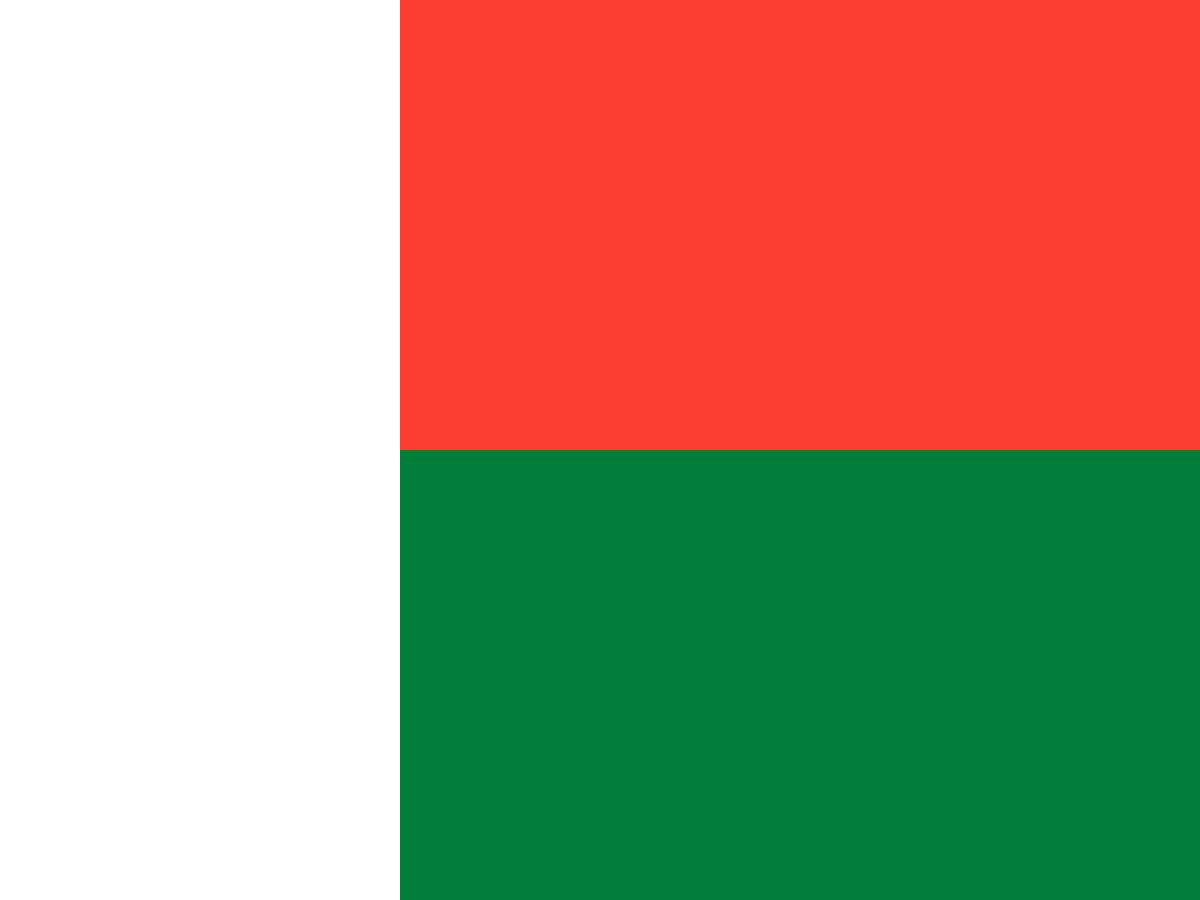
The flag of Madagascar
Madagascar's flag has a vertical white panel at the hoist and two horizontal panels of red and green on the fly.
The colours are strongly connected with Madagascar's history and identity.
White and red were traditional colours of the Merina kingdom, while green has been associated with the country's coastal peoples.
The present flag was adopted in 1958, shortly before independence.
The white panel
The white section is one of the traditional colours associated with the Merina kingdom of the central highlands.
White has also become associated with purity and peace in some interpretations of the national flag.
The red panel
The red section also has strong historical links to the Merina kingdom and Malagasy political history.
Red is often associated with sovereignty, courage and the country's historical struggles.
The green panel
The green section is traditionally associated with Madagascar's coastal peoples and is also linked with hope, agriculture and the island's natural environment.
The green band gives the flag a visual connection with Madagascar's forests and vegetation.
A short history of Madagascar
Madagascar was settled by people with roots in both Southeast Asia and East Africa, producing a distinctive Malagasy civilisation. Later Arab and European contacts added further influences.
The Merina kingdom became a major power in the central highlands before French colonial rule began. Madagascar gained independence in 1960.
History timeline
First millennium — Austronesian settlementPeople with origins in Island Southeast Asia settled Madagascar, bringing languages and cultural practices that remain visible today.
Later centuries — African and Arab influenceMigration and trade from mainland Africa and the wider Indian Ocean shaped Malagasy communities and culture.
16th century — European contactPortuguese and later other European explorers reached Madagascar.
17th–18th centuries — Regional kingdomsSeveral Malagasy kingdoms developed, including the Merina kingdom in the central highlands.
1810 — Radama IRadama I expanded Merina power and established closer relationships with Britain.
1828 — Ranavalona IQueen Ranavalona I pursued a more isolationist policy and resisted European influence while maintaining Malagasy sovereignty.
1883–95 — French expansionFrance gradually established control over Madagascar through war and diplomatic pressure.
1896 — French annexationMadagascar was formally annexed by France and the monarchy was abolished.
1947 — Malagasy UprisingA major anti-colonial uprising was brutally suppressed by French forces.
1958 — Autonomous republicMadagascar became an autonomous Malagasy Republic within the French Community and adopted its present flag.
26 June 1960 — IndependenceMadagascar became independent from France.
1975 — Democratic RepublicThe country adopted a socialist political system under Didier Ratsiraka.
1990s — Political transitionMadagascar moved towards multiparty democracy and economic reforms.
2009 — Political crisisPresident Marc Ravalomanana resigned amid mass protests and political confrontation.
2013 — Return to elected governmentNational elections helped restore a constitutional political order after the crisis.
2019 — New governmentAndry Rajoelina returned to the presidency following elections.
TodayMadagascar remains a democratic republic facing major challenges including poverty, environmental pressure and infrastructure development while protecting its unique natural heritage.
The Merina kingdom
The Merina kingdom developed in Madagascar's central highlands and became the dominant political power during the nineteenth century.
Its traditional red and white colours are important to the history of Madagascar's present flag.
King Radama I
Radama I ruled from 1810 to 1828 and expanded Merina control over much of Madagascar.
He encouraged European-style education and military organisation and developed a close relationship with British missionaries.
Queen Ranavalona I
Ranavalona I ruled from 1828 to 1861. She sought to preserve Malagasy independence and limit European influence.
Her reign is remembered both for resisting colonial pressure and for severe policies towards political opponents and Christian missionaries.
French colonial rule
France established colonial control over Madagascar during the late nineteenth century. In 1896, the country was formally annexed and the Merina monarchy abolished.
French rule transformed the economy and administration but also generated growing nationalist opposition.
The Malagasy Uprising of 1947
The 1947 Malagasy Uprising was a major anti-colonial revolt against French rule. French forces responded with extensive military operations and large-scale loss of life.
The uprising became a powerful symbol of the struggle for independence.
Independence in 1960
Madagascar became independent on 26 June 1960. Philibert Tsiranana became the country's first president.
The new republic maintained close economic and diplomatic ties with France while developing its own national institutions.
Antananarivo
Antananarivo is Madagascar's capital, located in the central highlands. It is the country's political, economic and cultural centre.
The city contains historic royal sites, busy markets and a mixture of traditional Malagasy and modern architecture.
Madagascar's geography
Madagascar has an extraordinary range of landscapes, including central highlands, tropical forests, dry forests, wetlands, grasslands and long coastlines.
The island's isolation from mainland Africa has allowed many species to evolve independently.
The Indian Ocean
Madagascar lies in the Indian Ocean, separated from mainland Africa by the Mozambique Channel.
Its position has made the island an important part of Indian Ocean trade routes for centuries.
Madagascar's climate
Madagascar has several climate zones. The east is generally humid and tropical, while the southwest is much drier. The central highlands are cooler.
Cyclones can affect the eastern and northern parts of the island during the Southern Hemisphere cyclone season.
Madagascar's unique wildlife
Madagascar is one of the world's greatest biodiversity hotspots. Around 90% of its wildlife is endemic, meaning it is found nowhere else on Earth.
Lemurs, chameleons, fossas, unusual frogs and many distinctive birds and plants evolved in isolation on the island.
Lemurs
Madagascar is famous for its lemurs, a group of primates found naturally only on the island.
There are many lemur species, from the tiny mouse lemurs to the large indri. Habitat loss is one of their greatest threats.
The fossa
The fossa is Madagascar's largest native carnivorous mammal. It looks somewhat cat-like but belongs to a distinctive Malagasy family of carnivores.
It is an important predator in Madagascar's forest ecosystems.
Baobab trees
Madagascar is home to several species of baobab, including the famous trees along the Avenue of the Baobabs near Morondava.
These enormous trees can store water in their trunks and have become one of Madagascar's most recognisable natural symbols.
Madagascar's forests
Madagascar's forests range from lush eastern rainforests to dry western forests. They contain huge numbers of endemic species.
Deforestation, agricultural expansion, fires and climate pressures threaten many habitats.
The Avenue of the Baobabs
The Avenue of the Baobabs near Morondava is one of Madagascar's best-known landscapes. Tall baobab trees line a dirt road across the western part of the island.
The site attracts visitors from around the world and has become an international symbol of Madagascar.
Madagascar's culture
Malagasy culture combines influences from Austronesia, East Africa and the wider Indian Ocean.
Music, dance, traditional ceremonies, ancestor traditions, crafts and distinctive regional customs vary across the island.
Malagasy language
Malagasy is an Austronesian language spoken throughout Madagascar, despite the country's location close to Africa.
Its vocabulary and structure reflect the complex settlement history of the island, with influences from African and other Indian Ocean languages.
Madagascar's food
Malagasy cuisine commonly features rice, meat, vegetables, beans, seafood and tropical fruit.
Rice is a particularly important staple, and dishes vary considerably between the highlands and coastal regions.
Vanilla and agriculture
Madagascar is one of the world's most important producers of vanilla. The northeastern Sava region is particularly famous for vanilla cultivation.
Coffee, cloves, cocoa, rice and other agricultural products are also important to the economy.
Madagascar's economy
Madagascar has a developing economy based on agriculture, mining, textiles, tourism and exports.
Nickel, cobalt, vanilla, cloves and other products contribute to international trade, while infrastructure and poverty remain major challenges.
Madagascar today
Modern Madagascar is a large island republic with an extraordinary natural heritage. Protecting biodiversity while improving living standards is one of the country's biggest challenges.
Its unique culture and wildlife give Madagascar a global importance far beyond its size and population.
Why is Madagascar's flag interesting?
Madagascar's flag is unusual because its design combines a vertical white panel with horizontal red and green bands.
Its colours connect the modern republic to the Merina kingdom and to the different peoples and landscapes of the island.
Explore Madagascar on FlagAtlas
Continue exploring Madagascar and the world's flags with these FlagAtlas resources.