About Malaysia
Malaysia is a diverse Southeast Asian country divided between the Malay Peninsula and the states of Sabah and Sarawak on the island of Borneo. Kuala Lumpur is the national capital, while Putrajaya is the federal administrative centre.
Malaysia is a constitutional monarchy with a distinctive rotating system of nine Malay rulers, and it is one of Southeast Asia's major economies.
CapitalKuala Lumpur
RegionSoutheast Asia
PopulationAbout 33 million
CurrencyMalaysian ringgit
Official languageMalay
Independence31 August 1957
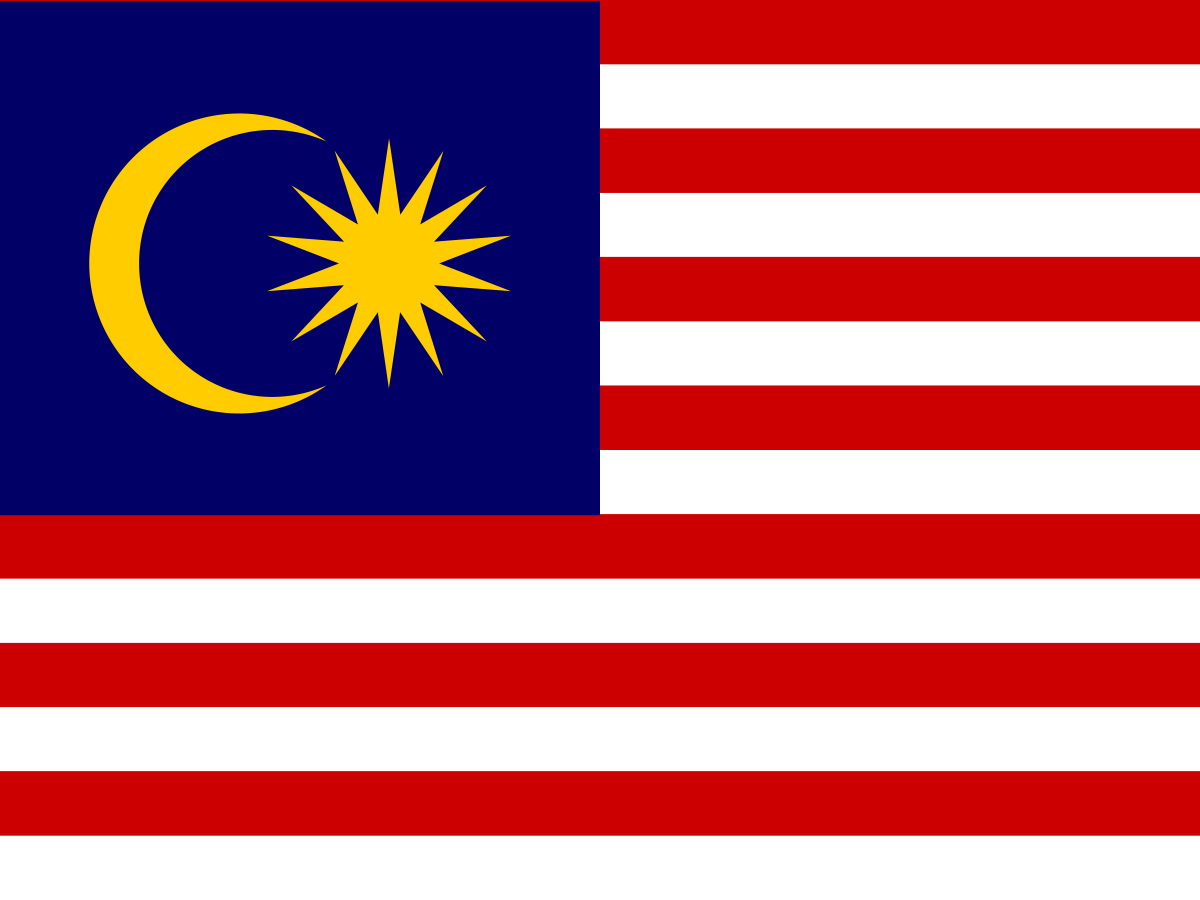
The flag of Malaysia
Malaysia's flag is known as the Jalur Gemilang, meaning “Stripes of Glory”. It has 14 alternating red and white stripes, a blue canton, and a yellow crescent and 14-pointed star.
The 14 stripes and 14-pointed star represent Malaysia's 13 states and the federal government.
The blue canton represents unity, yellow represents the royal rulers, and the crescent represents Islam.
The flag was based on the design adopted for the Federation of Malaya and was adapted when Malaysia was formed in 1963.
The 14 stripes
The flag contains 14 alternating red and white stripes. They represent the equal status and unity of Malaysia's 13 states together with the federal government.
The stripes run horizontally across the flag and give the design its distinctive appearance.
The 14-pointed star
The 14-pointed star, known as the Bintang Persekutuan, represents the unity of the 13 states and the federal government.
It sits beside the crescent in the blue canton and is coloured yellow to reflect the royal colour.
The crescent
The yellow crescent represents Islam, which is the religion of the Federation of Malaysia.
Islam has played a central role in the history and institutions of the Malay states, while Malaysia remains a multi-religious country.
The blue canton
The blue canton represents the unity of the Malaysian people.
The deep blue field provides the background for the yellow crescent and star and helps make the symbols immediately recognisable.
The colour yellow
Yellow is associated with the royal rulers of Malaysia, particularly the Malay sultans.
It is used for both the crescent and star and is a traditional royal colour.
A short history of Malaysia
The territory of modern Malaysia has been shaped by Malay sultanates, Indian and Chinese trade, Islamic kingdoms, European colonialism, British rule, Japanese occupation and independence.
The Federation of Malaya became independent in 1957, and Malaysia was formed in 1963 by combining Malaya with Sabah, Sarawak and Singapore. Singapore left the federation in 1965.
History timeline
Ancient era — Maritime tradeThe Malay Peninsula sat on important maritime routes linking India, China and the wider Indian Ocean world.
7th–13th centuries — Regional kingdomsIndian cultural and religious influences shaped early states and trading centres across the region.
14th–15th centuries — Melaka risesThe Sultanate of Malacca became one of Southeast Asia's most important trading and Islamic centres.
1511 — Portuguese capture MalaccaPortugal conquered Malacca, beginning a long period of European competition for control of the strategic port.
1641 — Dutch capture MalaccaThe Dutch East India Company took Malacca from Portugal.
18th–19th centuries — British influenceBritain gradually established control over Penang, Singapore and Malacca and expanded its influence over the Malay states.
1896 — Federated Malay StatesPerak, Selangor, Negeri Sembilan and Pahang formed the Federated Malay States under British protection.
1941–45 — Japanese occupationJapan occupied Malaya, North Borneo and Sarawak during the Second World War.
1946 — Malayan UnionBritain proposed the Malayan Union, but strong Malay opposition led to its replacement.
1948 — Federation of MalayaThe Federation of Malaya replaced the Malayan Union and restored greater authority to the Malay rulers.
1957 — IndependenceThe Federation of Malaya became independent on 31 August 1957, with Tunku Abdul Rahman as its first prime minister.
1963 — Malaysia formedMalaya joined Sabah, Sarawak and Singapore to form Malaysia on 16 September 1963.
1965 — Singapore leavesSingapore separated from Malaysia and became an independent country.
1969 — May 13 riotsSerious communal violence led to a period of emergency rule and major changes in economic and social policy.
1970s–90s — Rapid industrialisationMalaysia transformed from an agriculture and commodity-based economy into a diversified manufacturing and services economy.
1981 — Mahathir becomes prime ministerMahathir Mohamad began a long period in office associated with rapid development and major infrastructure projects.
1998 — Asian financial crisisMalaysia was heavily affected by the Asian financial crisis and introduced capital controls and other measures.
2007 — 50 years of independenceMalaysia celebrated its first half-century as an independent nation.
2018 — Political changeThe opposition coalition won the federal election, producing Malaysia's first change of governing coalition since independence.
2020–22 — Political instabilitySeveral changes of government occurred during a period of political realignment.
TodayMalaysia remains a federal constitutional monarchy with a diverse population and a major role in Southeast Asian trade and manufacturing.
The Sultanate of Malacca
The Malacca Sultanate was founded in the fifteenth century and became one of the most important trading ports in Asia.
It helped spread Islam through the Malay world and became a major centre for commerce linking China, India and the Indonesian archipelago.
The Strait of Malacca
The Strait of Malacca is one of the world's most important shipping routes. It lies between the Malay Peninsula and Sumatra and connects the Indian Ocean with the South China Sea.
Its strategic importance has shaped Malaysian history for centuries.
British rule
Britain gradually expanded control over the Malay states during the nineteenth century. British influence also grew in North Borneo and Sarawak.
Colonial rule encouraged large-scale production of rubber and tin and brought major migration from China and India.
The Japanese occupation
Japanese forces occupied Malaya, Singapore, North Borneo and Sarawak during the Second World War.
The occupation was harsh and disrupted the colonial system, helping accelerate post-war demands for independence.
Tunku Abdul Rahman
Tunku Abdul Rahman was the leading figure in Malaysia's independence movement and became the first prime minister of independent Malaya.
He is widely known as the “Father of Independence” and played a central role in the formation of Malaysia in 1963.
Independence in 1957
The Federation of Malaya became independent on 31 August 1957. The declaration was made at Merdeka Stadium in Kuala Lumpur.
The date is celebrated every year as Hari Merdeka or Independence Day.
Formation of Malaysia in 1963
Malaysia was formed on 16 September 1963 when the Federation of Malaya joined with Sabah, Sarawak and Singapore.
The new federation brought together territories with very different histories and ethnic compositions.
Singapore leaves Malaysia
Singapore separated from Malaysia on 9 August 1965 after political and economic tensions between the two governments.
Singapore became an independent republic while Malaysia continued as a federation of 13 states and the federal territories.
Malaysia's federal system
Malaysia is a federal constitutional monarchy made up of 13 states and three federal territories.
Power is divided between the federal government and state governments, with the Malay rulers retaining important constitutional and religious roles.
The Yang di-Pertuan Agong
Malaysia has a unique rotating monarchy. The Yang di-Pertuan Agong is elected by the Conference of Rulers for a five-year term.
Nine Malay states have hereditary rulers, and the kings take turns serving as Malaysia's federal monarch.
Kuala Lumpur
Kuala Lumpur is Malaysia's largest city and official national capital. It is famous for the Petronas Twin Towers and its mixture of Malay, Chinese, Indian and international influences.
The federal government is based mainly in nearby Putrajaya.
Putrajaya
Putrajaya is Malaysia's planned federal administrative capital. It was developed in the 1990s to reduce pressure on Kuala Lumpur.
The city is known for grand government buildings, landscaped avenues and the Putra Mosque.
Peninsular Malaysia and Borneo
Malaysia is divided geographically into Peninsular Malaysia and East Malaysia on Borneo. The South China Sea separates the two parts.
Sabah and Sarawak occupy the Malaysian part of Borneo and have distinctive indigenous cultures and greater constitutional autonomy in some areas.
Sabah
Sabah is on the northern part of Malaysian Borneo. It is known for Mount Kinabalu, tropical forests, islands and diverse indigenous communities.
Kota Kinabalu is the state capital and a major tourism centre.
Sarawak
Sarawak is Malaysia's largest state by area. It contains extensive rainforests, major rivers and many indigenous communities.
Kuching is the state capital and an important cultural and commercial centre.
Mount Kinabalu
Mount Kinabalu rises to 4,095 metres in Sabah and is the highest mountain in Malaysia.
It is part of Kinabalu Park, a UNESCO World Heritage Site known for exceptional plant biodiversity.
Malaysia's tropical rainforests
Malaysia contains some of the world's oldest tropical forests, particularly in Borneo and the Malay Peninsula.
These forests support orangutans, hornbills, clouded leopards, gibbons and thousands of plant species.
Orangutans
The orangutan is one of Malaysia's most famous animals and is found in the wild in Sabah and Sarawak on Borneo.
Habitat loss and the expansion of plantations have made conservation a major priority.
Malaysia's climate
Malaysia has an equatorial tropical climate with high temperatures, high humidity and rainfall throughout the year.
Seasonal monsoon winds influence rainfall patterns, with different regions affected at different times.
Malaysia's culture
Malaysia is highly multicultural, with major Malay, Chinese and Indian communities alongside many indigenous peoples.
Islam is the official religion, but Buddhism, Christianity, Hinduism and other faiths are widely practised.
Malaysian languages
Malay, known officially as Bahasa Malaysia, is the national and official language. English is widely used in business and education, while Mandarin, Cantonese, Tamil and many indigenous languages are also spoken.
Malaysia's multilingual society reflects its complex history.
Malaysian food
Malaysian cuisine is one of Southeast Asia's most diverse, combining Malay, Chinese, Indian, indigenous and regional influences.
Popular foods include nasi lemak, roti canai, laksa, satay, rendang and char kway teow.
Malaysia's economy
Malaysia has a diversified upper-middle-income economy based on manufacturing, electronics, petroleum, palm oil, tourism, services and international trade.
It is an important producer of semiconductors and electrical and electronic products.
Palm oil
Malaysia is one of the world's largest producers and exporters of palm oil. The industry is economically important but has also raised environmental concerns because of deforestation and habitat loss.
Balancing agricultural production with rainforest conservation is a major environmental issue.
Petronas and oil
Petronas is Malaysia's national oil and gas company and one of the country's best-known global corporations.
Petroleum revenues helped fund major infrastructure and development, while the economy has increasingly diversified beyond oil.
Malaysia today
Modern Malaysia is a rapidly developing, multicultural Southeast Asian country with strong manufacturing, trade and tourism sectors.
Its strategic location, large ports and proximity to major Asian markets give it an important role in the regional economy.
Why is Malaysia's flag interesting?
Malaysia's flag combines a remarkably precise set of political symbols: 14 stripes, a 14-pointed star, a crescent and royal yellow.
The design also has a fascinating history because it began as the flag of the Federation of Malaya and was adapted when the wider Malaysian federation was created in 1963.
Explore Malaysia on FlagAtlas
Continue exploring Malaysia and the world's flags with these FlagAtlas resources.