About the Maldives
The Maldives is an island country in the Indian Ocean southwest of Sri Lanka and India. It consists of a chain of coral atolls spread across a large area of ocean. Malé is the capital and largest city.
The country is famous for coral reefs, turquoise lagoons, tropical islands and tourism. It is also one of the world's most geographically low-lying countries.
CapitalMalé
RegionSouth Asia / Indian Ocean
PopulationAbout 540,000
CurrencyMaldivian rufiyaa
Official languageDhivehi
Independence26 July 1965
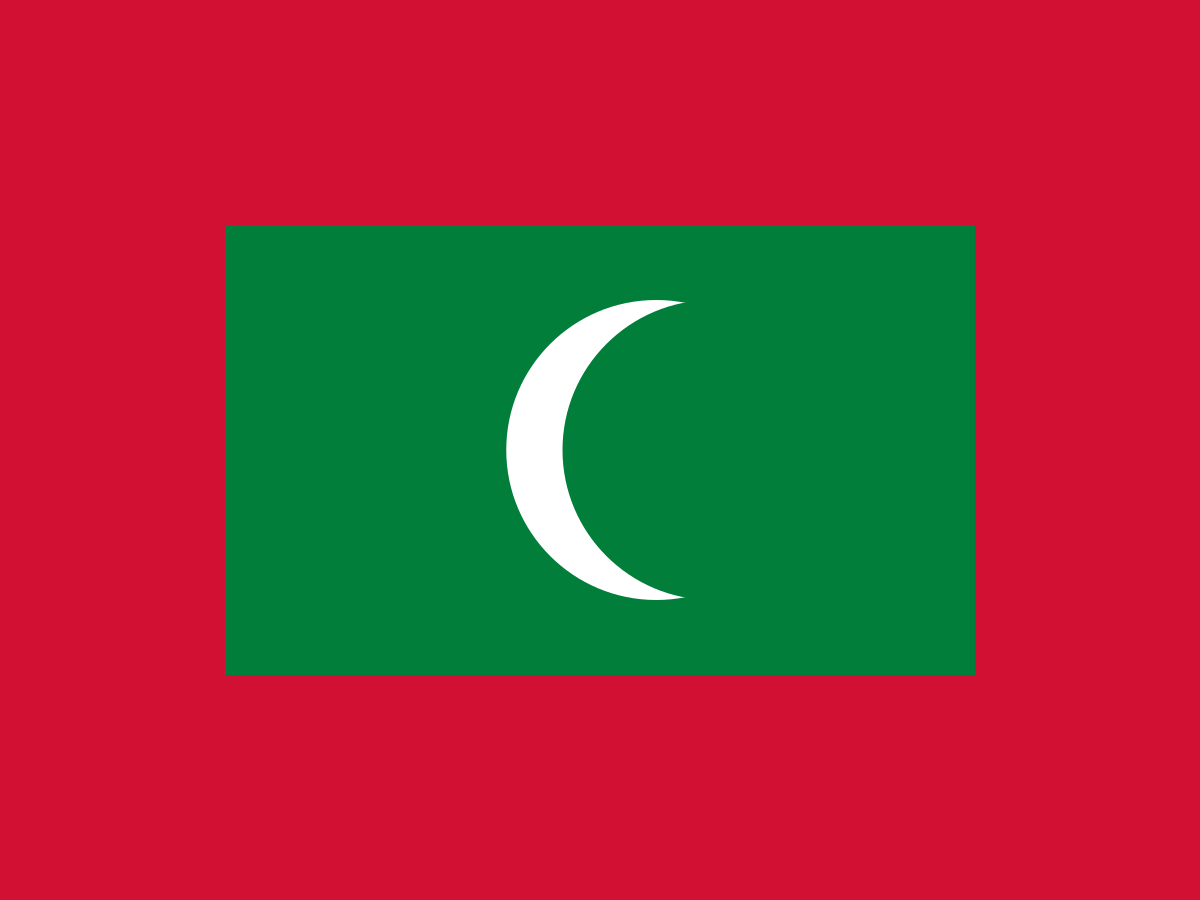
The flag of the Maldives
The Maldivian flag consists of a large red field containing a green rectangle with a white crescent.
The colours and crescent reflect the country's Islamic identity and historical traditions.
Red is associated with the blood of heroes and sacrifice, green with peace and prosperity and the palm tree tradition of the islands, while the white crescent represents Islam.
The current basic design was adopted in 1965 when the Maldives gained independence from Britain.
The red field
The red outer field is traditionally associated with the blood of those who fought to defend the country and its people.
It surrounds the green rectangle and gives the flag its dominant colour.
The green rectangle
The green rectangle represents peace and prosperity and is also associated with the palm trees and natural vegetation of the islands.
Green is a common colour in Islamic symbolism and has a particularly strong cultural association in the Maldives.
The white crescent
The white crescent is a symbol of Islam, the religion of the Maldives.
The crescent is placed inside the green rectangle and is one of the clearest visual symbols of the country's national and religious identity.
A short history of the Maldives
The Maldives has a long history as an Indian Ocean trading society. Its location between East Africa, Arabia, India and Southeast Asia brought contact with many cultures.
Islam was adopted in the twelfth century. The islands later came under Portuguese, Dutch and British influence before becoming an independent republic.
History timeline
Ancient era — Indian Ocean settlementThe islands were settled by communities connected to the wider Indian Ocean world, with links to South Asia and other maritime cultures.
12th century — Conversion to IslamIslam became established as the dominant religion of the islands, traditionally dated to 1153.
12th–16th centuries — Islamic sultanateThe Maldives developed a long-running sultanate and became part of Indian Ocean trade networks.
1558 — Portuguese occupationPortuguese forces briefly established control over Malé, but resistance eventually drove them from the islands.
17th century — Dutch influenceThe Maldives maintained relations with Dutch-controlled Ceylon while preserving its own sultanate.
1887 — British protectorateThe Maldives became a British protected state while retaining its internal government and sultanate.
1932 — First constitutionThe Maldives adopted a written constitution during the later period of the sultanate.
1953 — First republicThe monarchy was temporarily abolished and the Maldives became a republic under Mohamed Amin Didi.
1954 — Sultanate restoredThe republic collapsed and the sultanate was restored.
26 July 1965 — IndependenceThe Maldives became fully independent from British protection.
1968 — Republic establishedA referendum ended the sultanate and established the modern Republic of Maldives.
1970s — Tourism developsInternational tourism began to grow rapidly, becoming a major part of the economy.
1987 — Major storm surgeA severe storm surge caused widespread flooding in Malé and highlighted the islands' vulnerability to the ocean.
2004 — Indian Ocean tsunamiThe tsunami caused severe damage and loss of life across many Maldivian islands.
2008 — New constitutionA new constitution strengthened democratic institutions and introduced a presidential system with broader political rights.
2009 — Underwater cabinet meetingThe government held a symbolic underwater meeting to highlight the threat of sea-level rise to low-lying island nations.
2018 — Political transitionIbrahim Mohamed Solih became president after winning the presidential election.
2023 — New presidencyMohamed Muizzu became president after winning the presidential election.
TodayThe Maldives remains a presidential republic whose economy is heavily dependent on tourism and vulnerable to climate and sea-level risks.
The Maldivian sultanate
The Maldivian sultanate lasted for centuries and was central to the political identity of the islands.
Different dynasties ruled the country, while the capital at Malé became the centre of government and trade.
The conversion to Islam
The Maldives converted to Islam in the twelfth century. Traditional accounts date the conversion to 1153 and connect it with a ruler named Dhovemi.
Islam became deeply embedded in Maldivian law, culture and national identity.
Portuguese occupation
Portuguese forces occupied Malé in the sixteenth century, but Maldivian resistance eventually forced them to leave.
The episode became an important part of the country's history of defending its independence from foreign powers.
British protectorate
In 1887, the Maldives became a British protected state. Britain handled aspects of foreign affairs and defence while the sultanate retained internal authority.
The protectorate ended when the Maldives became independent in 1965.
Independence in 1965
The Maldives became independent from Britain on 26 July 1965.
The country retained its sultanate for several more years before becoming a republic in 1968.
The Republic of Maldives
The Maldives became a republic in 1968. The modern political system is presidential, with a directly elected president serving as head of state and government.
Political life has included periods of strong executive power, democratic reform and changes of government.
Malé
Malé is the capital and political centre of the Maldives. It is one of the world's most densely populated urban islands.
The city contains the country's government buildings, main commercial areas and important religious sites.
The Maldives' geography
The Maldives consists of about 1,000+ coral islands grouped into 26 natural atolls, with the islands spread along a long north-south chain.
Most islands are tiny and surrounded by shallow lagoons and coral reefs.
Coral atolls
A coral atoll is a ring-shaped reef or group of islands surrounding a lagoon. The Maldives is one of the world's clearest examples of an island nation built around atolls.
The reefs are essential to coastal protection, fisheries and tourism.
The lowest-lying country
The Maldives is widely described as the world's lowest-lying country. Its highest natural point is only around 2.4 metres above sea level.
This makes coastal erosion, flooding and sea-level rise major national concerns.
The Indian Ocean
The Maldives occupies a strategic position in the Indian Ocean, southwest of Sri Lanka and India.
Its location helped make the islands part of historic maritime trade routes connecting East Africa, Arabia, South Asia and Southeast Asia.
Maldives' climate
The Maldives has a tropical monsoon climate with warm temperatures throughout the year.
Rainfall varies with the southwest and northeast monsoons, while tropical storms and changing ocean conditions can affect the islands.
Coral reefs and marine life
The reefs around the Maldives support manta rays, whale sharks, sea turtles, reef fish, dolphins and many coral species.
Marine biodiversity is one of the country's greatest natural assets and a major attraction for visitors.
Whale sharks
The Maldives is one of the world's best-known places for encounters with whale sharks, the largest fish species.
These gentle filter feeders can be found in Maldivian waters throughout the year, particularly around certain southern atolls.
Manta rays
Large numbers of manta rays visit Maldivian reefs, where they feed on plankton-rich waters.
Several sites have become internationally known for manta encounters and marine research.
Maldives' culture
Maldivian culture reflects centuries of contact across the Indian Ocean. It combines South Asian, Arab, African and island traditions.
Music, boatbuilding, fishing, Islamic traditions and local food all contribute to national identity.
Dhivehi language
Dhivehi is the official language of the Maldives. It belongs to the Indo-Aryan branch of the Indo-European language family and has been influenced by other Indian Ocean languages.
The language has its own script, Thaana, which is used in modern Maldivian writing.
Maldivian food
Traditional Maldivian food relies heavily on fish, coconut and rice.
Tuna is particularly important, appearing in dishes such as mas huni, while curries and flatbreads show wider South Asian influences.
Boduberu
Boduberu is a traditional Maldivian performance combining large drums, singing and dance.
It is commonly performed at celebrations and cultural events and is one of the country's best-known musical traditions.
Dhoni boats
The traditional dhoni is a wooden boat historically used for fishing and transport between islands.
Modern dhonis may use engines and contemporary construction, but the design remains an important symbol of Maldivian maritime culture.
Tourism
Tourism is the backbone of the Maldivian economy. Resorts are often built on individual islands, offering diving, snorkelling and water-based activities.
The industry generates major foreign income but also creates challenges around waste, environmental protection and dependence on international visitors.
Maldives' economy
The Maldivian economy depends heavily on tourism and fisheries, with construction, transport and services also important.
Its small land area and remote geography make infrastructure expensive, while climate change presents additional long-term risks.
Climate change and sea-level rise
Because the Maldives is exceptionally low-lying, sea-level rise and coastal erosion are major national concerns.
Coral reef health is also critical because reefs provide natural protection from waves while supporting tourism and fisheries.
Maldives today
Modern Maldives is a Muslim-majority island republic known worldwide for its beaches, reefs and luxury tourism.
The country faces a difficult balancing act: protecting its fragile marine environment while supporting a tourism-dependent economy and adapting to a changing climate.
Why is the Maldives flag interesting?
The Maldives flag is distinctive because its green rectangle and white crescent sit inside a much larger red field.
It is a compact design that combines Islamic symbolism with colours connected to Maldivian history and national identity.
Explore the Maldives on FlagAtlas
Continue exploring the Maldives and the world's flags with these FlagAtlas resources.