About Mali
Mali is a large landlocked country in West Africa, stretching from the Sahara in the north to the more fertile Sahel and savanna regions in the south. Bamako is the capital and largest city.
Mali has a remarkable history as the centre of several powerful West African empires, including the Mali Empire and Songhai Empire. The country is also home to the historic city of Timbuktu.
CapitalBamako
RegionWest Africa
PopulationAbout 22 million
CurrencyWest African CFA franc
Official languageFrench*
Independence22 September 1960
*Mali's constitution and language policy have changed in recent years; many national languages are widely spoken, including Bambara.
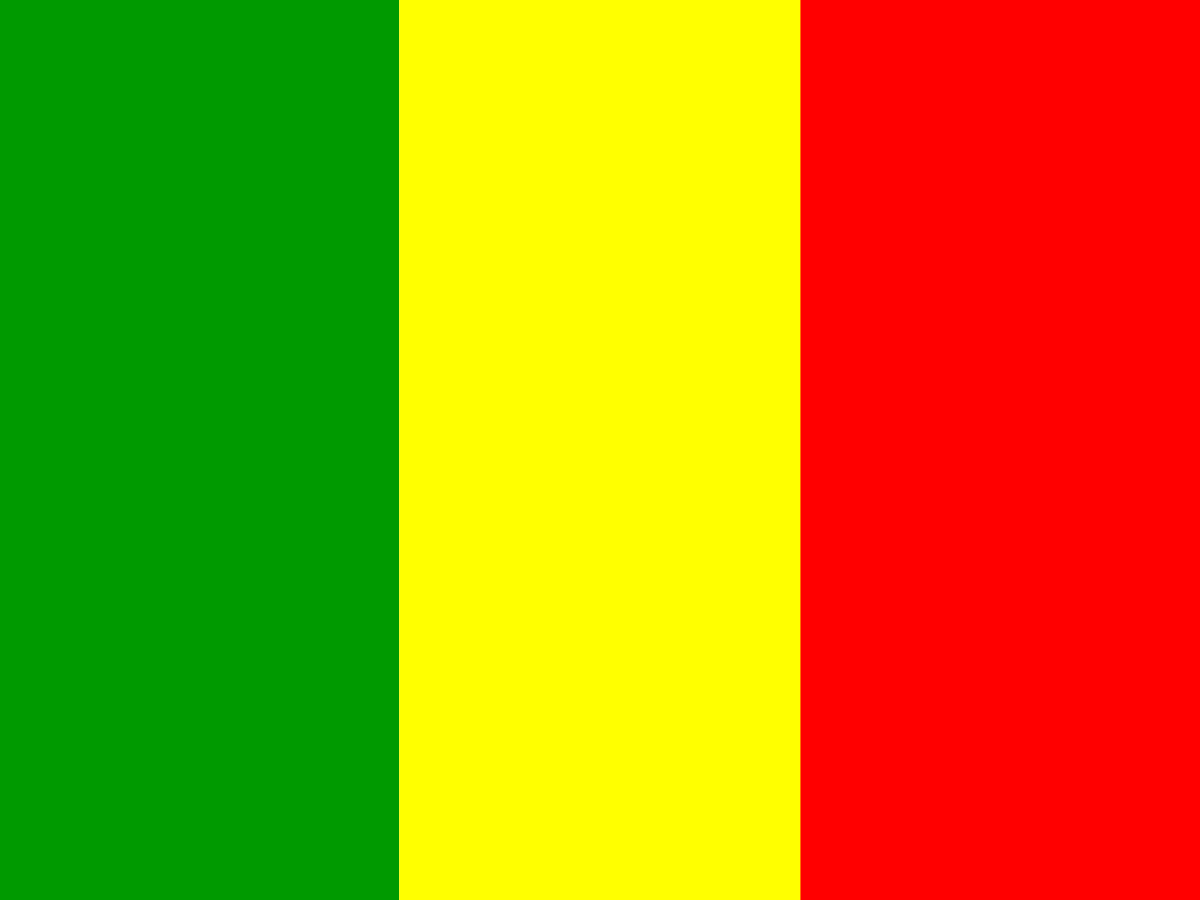
The flag of Mali
Mali's flag has three equal vertical bands of green, gold and red.
The three colours are Pan-African colours.
Green is associated with nature, agriculture and hope; gold represents purity and mineral wealth; red represents the blood and sacrifice of those who fought for independence.
The flag was adopted at independence in 1961, after Mali had briefly used a different design within the Mali Federation.
The green band
The green band represents nature and hope. It also reflects the importance of fertile land and agriculture to Mali.
Green is particularly meaningful in a country where the contrast between the dry north and greener southern regions is so dramatic.
The gold band
The gold band represents purity and mineral wealth. Gold mining remains an important part of Mali's economy.
The colour also evokes the historic wealth of the great West African empires that controlled major trans-Saharan trade routes.
The red band
The red band symbolises the blood of those who died fighting for freedom and independence.
It gives the flag a direct connection with Mali's twentieth-century struggle to end French colonial rule.
Pan-African colours
Mali's green, gold and red are part of the wider Pan-African colour tradition used by a number of African countries.
The colours were strongly associated with African independence movements and the idea of African unity.
A short history of Mali
The area of modern Mali was at the heart of some of West Africa's greatest medieval empires. The Ghana, Mali and Songhai empires controlled major trade routes and cities.
After centuries of regional states and kingdoms, France established colonial rule. French Sudan became independent in 1960, and the modern Republic of Mali emerged soon afterwards.
History timeline
c. 300–1200 — Ghana EmpireThe ancient Ghana Empire controlled important gold and salt trade routes across parts of West Africa.
1235 — Mali Empire risesTraditionally associated with Sundiata Keita and the defeat of the Sosso ruler Soumaoro Kanté.
13th–14th centuries — Mali EmpireThe empire expanded across a huge area and became one of the wealthiest states in medieval West Africa.
c. 1312–1337 — Mansa MusaMansa Musa ruled Mali during its golden age and became famous for his pilgrimage to Mecca and enormous wealth.
14th–15th centuries — Timbuktu flourishesTimbuktu developed as a major centre of trade, Islamic scholarship and manuscript culture.
15th–16th centuries — Songhai EmpireSonghai became the dominant power in the region, with Gao and Timbuktu as major centres.
1591 — Moroccan invasionMoroccan forces defeated the Songhai army at the Battle of Tondibi, weakening the empire.
17th–18th centuries — Regional kingdomsSmaller states and communities controlled different parts of the region as the great empires declined.
19th century — French expansionFrance gradually conquered territories in the western Sudan and incorporated them into its colonial empire.
1890s — French SudanThe territory became part of French West Africa and was administered as French Sudan.
1958 — Sudanese RepublicFrench Sudan became an autonomous republic within the French Community.
1959 — Mali FederationFrench Sudan and Senegal formed the short-lived Mali Federation.
20 June 1960 — Federation independenceThe Mali Federation became independent from France, although Senegal soon withdrew.
22 September 1960 — Republic of MaliModibo Keïta declared the independent Republic of Mali after the federation dissolved.
1968 — Military coupModibo Keïta was overthrown in a military coup led by Moussa Traoré.
1991 — Democratic transitionMoussa Traoré was overthrown and Mali moved towards multiparty democracy.
1992 — New constitutionAlpha Oumar Konaré won Mali's first democratic presidential election under the new system.
2012 — Crisis and rebellionA Tuareg rebellion and military coup destabilised the country, while Islamist armed groups seized territory in the north.
2013 — French military interventionFrance launched Operation Serval after Islamist forces advanced towards southern Mali.
2015 — Algiers peace agreementA peace agreement was signed between the Malian government and several northern armed groups.
2020 — Military coupPresident Ibrahim Boubacar Keïta was overthrown following months of political unrest.
2021 — Second coupMilitary leaders took further control of the transitional government.
TodayMali remains politically unstable and faces major security and development challenges, particularly in the north and centre.
The Ghana Empire
The Ghana Empire, sometimes called Wagadou, flourished before the rise of the Mali Empire. It controlled important trade routes linking gold-producing areas to North African markets.
Despite its name, the medieval Ghana Empire was centred much farther west than the modern country of Ghana.
Sundiata Keita
Sundiata Keita is traditionally regarded as the founder of the Mali Empire. According to the Epic of Sundiata, he defeated the Sosso ruler Soumaoro Kanté and united several territories.
His story became one of West Africa's most important oral historical traditions.
Mansa Musa
Mansa Musa ruled Mali in the fourteenth century and is famous for his extraordinary wealth. His pilgrimage to Mecca in 1324–25 attracted attention across the Islamic world.
He reportedly distributed so much gold during the journey that it affected gold prices in parts of the Mediterranean for years.
Timbuktu
Timbuktu became one of the most famous centres of scholarship and trade in medieval West Africa. Its location near the southern edge of the Sahara made it a meeting point for trans-Saharan commerce.
The city became particularly famous for Islamic learning, libraries and handwritten manuscripts.
The University of Sankore
The Sankore scholarly tradition in Timbuktu became a major centre for Islamic learning. Scholars studied subjects including theology, law, mathematics, astronomy and literature.
The city's manuscript collections remain an important record of West African intellectual history.
The Songhai Empire
The Songhai Empire became the dominant power in West Africa after the decline of Mali. Under rulers such as Sunni Ali and Askia Muhammad, it controlled a huge territory around the Niger River.
Its power was badly weakened after the Moroccan invasion of 1591.
French colonial rule
France conquered the region during the late nineteenth century and incorporated it into French West Africa.
Colonial rule changed administration, trade and education, while also imposing taxes, forced labour systems and new political structures.
Independence
Mali's independence developed through the Mali Federation and the political movement led by Modibo Keïta. The federation with Senegal quickly broke apart.
On 22 September 1960, Modibo Keïta declared the independent Republic of Mali.
Bamako
Bamako is Mali's capital and largest city. It lies on the Niger River in the more fertile southern part of the country.
The city is the country's political, commercial and cultural centre and has grown rapidly in recent decades.
The Niger River
The Niger River is central to life in Mali. It flows through the country's interior and supports farming, fishing, transport and settlements.
The Inner Niger Delta is a huge seasonal wetland and one of West Africa's most important natural ecosystems.
The Inner Niger Delta
The Inner Niger Delta is a vast seasonal floodplain in central Mali. When the Niger and Bani rivers flood, they create wetlands supporting fish, birds, livestock and agriculture.
Its seasonal rhythm is essential to millions of people.
The Sahara Desert
Northern Mali extends deep into the Sahara Desert. The desert covers a huge proportion of the country's territory but contains relatively few permanent settlements.
Historic caravan routes once crossed the region carrying salt, gold and other goods.
The Sahel
The Sahel forms a transition zone between the Sahara and the wetter savannas to the south.
Mali's Sahelian communities depend heavily on livestock, farming and seasonal rainfall, making them vulnerable to drought and desertification.
Mali's climate
Mali's climate ranges from hot desert in the north to tropical savanna in the south. Rainfall increases dramatically from north to south.
The rainy season is crucial for agriculture, while droughts and irregular rainfall can cause severe food and economic pressures.
Mali's wildlife
Mali's varied landscapes support elephants, antelope, hippos, crocodiles, lions and many bird species, although wildlife populations have been affected by habitat loss and insecurity.
The Gourma region is particularly important for Mali's remaining desert-adapted elephants.
The Gourma elephants
Mali is home to one of the world's northernmost populations of African elephants. The Gourma herd moves long distances between seasonal water and grazing areas.
Protecting the herd has become increasingly difficult because of climate pressure and regional insecurity.
Malian culture
Mali has an exceptionally rich cultural heritage, including music, griot traditions, mud-brick architecture, textiles and oral history.
Communities including the Bambara, Dogon, Tuareg, Fulani, Songhai and others have contributed to the country's diverse identity.
Griots
A griot, or jeli, is a traditional West African historian, musician and storyteller. Griots have preserved genealogies, political histories and epic stories through generations.
The tradition remains important to Malian music and cultural memory.
The Dogon people
The Dogon communities live mainly around the Bandiagara region and are famous for distinctive architecture, masks, festivals and cultural traditions.
The Bandiagara Cultural Landscape is recognised by UNESCO.
Malian music
Mali has produced internationally recognised musicians and musical traditions. Instruments such as the kora, ngoni and balafon are strongly associated with West African music.
Artists from Mali have helped bring traditional styles to global audiences.
Malian food
Malian cuisine commonly features millet, sorghum, rice, maize, vegetables, meat and fish.
Popular dishes include tô, rice-based meals and sauces using ingredients such as peanut, okra and baobab leaves.
Mali's economy
Mali's economy depends heavily on agriculture, livestock, gold mining and cotton.
Gold is particularly important to exports, while most people depend directly or indirectly on farming and pastoralism.
Gold mining
Mali is one of Africa's significant gold producers. Gold mining contributes substantially to export earnings and government revenue.
The industry includes large industrial mines as well as extensive artisanal and small-scale mining.
Cotton
Cotton is one of Mali's most important agricultural cash crops and provides income for many farming communities in the south.
Production depends heavily on rainfall and access to markets and infrastructure.
Mali today
Modern Mali combines an extraordinary historical legacy with serious contemporary challenges. Political instability, armed conflict, poverty, climate pressure and rapid population growth all affect development.
At the same time, Mali's music, scholarship, architecture and ancient empires remain an important part of Africa's cultural heritage.
Why is Mali's flag interesting?
Mali's flag is a simple vertical tricolour, but its green, gold and red colours connect modern Mali with the wider Pan-African movement.
The gold band is particularly striking because it also evokes Mali's historic association with the wealth of West African gold-trading empires.
Explore Mali on FlagAtlas
Continue exploring Mali and the world's flags with these FlagAtlas resources.