About Mauritania
Mauritania is a large West African country where the Sahara Desert meets the Atlantic Ocean. It borders Western Sahara, Algeria, Mali and Senegal. Nouakchott is the capital and largest city.
Mauritania has a rich history shaped by trans-Saharan trade, Islamic scholarship, nomadic pastoralism and the ancient kingdoms of the western Sahara.
CapitalNouakchott
RegionWest Africa
PopulationAbout 4.6 million
CurrencyOuguiya
Official languageArabic
Independence28 November 1960
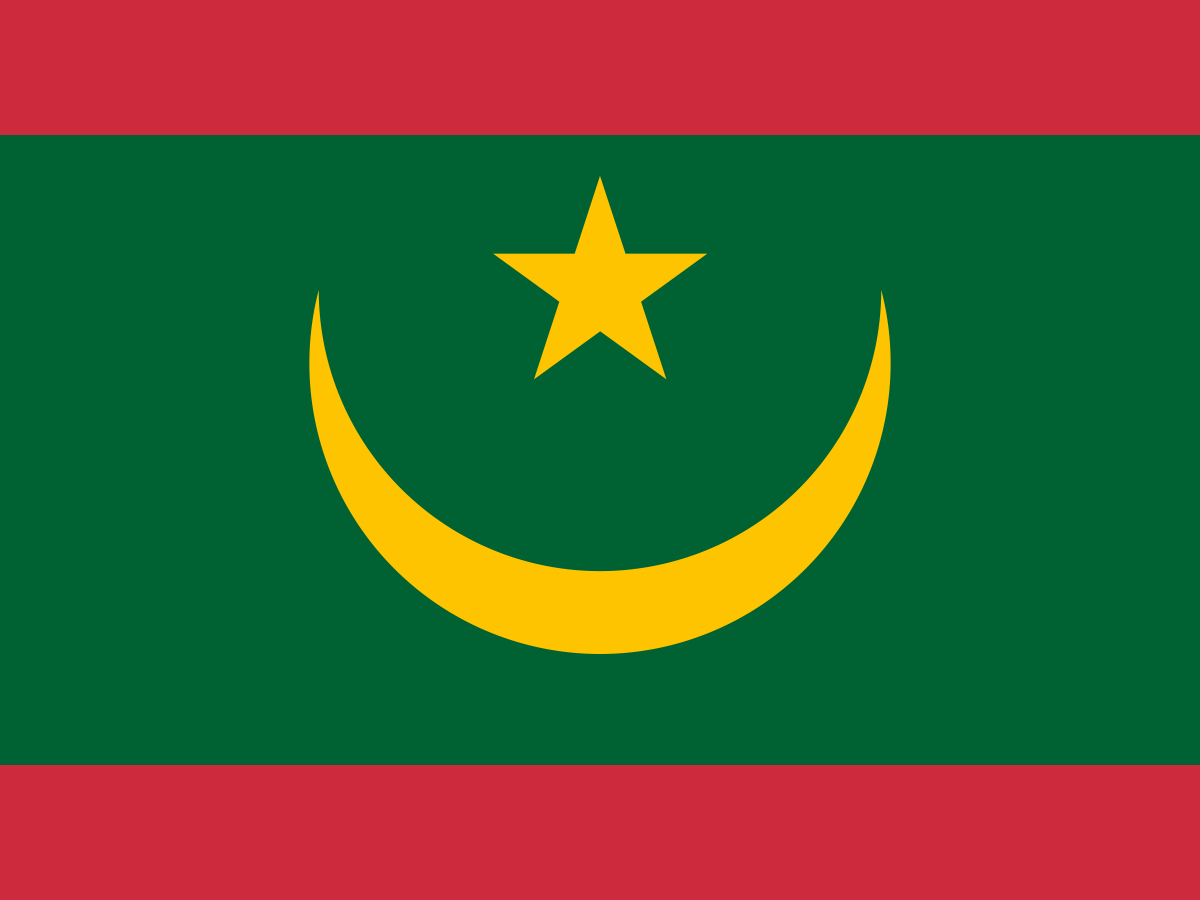
The flag of Mauritania
Mauritania's flag has a green field with a gold crescent and star, framed by two red horizontal stripes.
Green and gold reflect Islamic and national traditions, while the red stripes were added in 2017.
The crescent and star represent Islam. The red bands represent the blood of those who defended the country and its independence.
The current flag was adopted in 2017 following a constitutional referendum that added the two red stripes.
The green field
The green field is a traditional Islamic colour and is strongly associated with Mauritania's Islamic identity.
Green also fits the country's national symbolism and contrasts with the gold crescent and star.
The gold crescent and star
The gold crescent and star are symbols of Islam and are placed centrally on the green field.
The crescent and star are among the most recognisable symbols used on national flags across the Islamic world.
The red stripes
Two red stripes were added to the flag in 2017. They represent the blood shed by those who defended Mauritania and its independence.
Their addition was part of constitutional changes approved in a national referendum.
The 2017 flag change
Mauritania's original independence-era flag was green with a gold crescent and star. In 2017, two red horizontal bands were added at the top and bottom.
The change was intended to honour those who fought for the country's independence and sovereignty.
A short history of Mauritania
Mauritania sits at the crossroads of North Africa, the Sahara and West Africa. Its history includes ancient Saharan settlements, Berber and Arab dynasties, the Almoravid movement and centuries of trans-Saharan commerce.
France established colonial rule in the early twentieth century. Mauritania became independent in 1960 and later experienced military coups and political change.
History timeline
Ancient era — Saharan settlementsCommunities lived across the region long before the Sahara became as dry as it is today, leaving archaeological evidence of farming and pastoral life.
1st millennium — Trans-Saharan trade growsCaravan routes connected West African gold-producing regions with North African and Mediterranean markets.
8th century — Islam spreadsIslam expanded southward across the Sahara through merchants, scholars and political networks.
11th century — Almoravid movementThe Almoravid movement emerged among Sanhaja Berber groups in the western Sahara and became a major power in North Africa and Iberia.
13th–15th centuries — Regional statesDifferent Berber, Arab and West African groups competed for control of trade routes and oases.
15th–19th centuries — Moorish emiratesPolitical authority developed through a network of emirates, tribal confederations and trading communities.
19th century — European pressureEuropean powers increased their involvement in West African coastal trade and territory.
1903 — French protectorateFrance established a protectorate over parts of the territory that became Mauritania.
1920 — French colonyMauritania was incorporated into French West Africa as a French colony.
1957 — Nouakchott chosenThe site of Nouakchott was selected as the future capital of the emerging country.
1958 — Autonomous republicMauritania became an autonomous republic within the French Community.
28 November 1960 — IndependenceMauritania became independent from France, with Moktar Ould Daddah as its first president.
1970s — Western Sahara conflictMauritania became involved in the conflict over Western Sahara and occupied the southern part of the territory for a period.
1978 — Military coupPresident Moktar Ould Daddah was overthrown by military officers.
1979 — Mauritania withdraws from Western SaharaMauritania renounced its territorial claim and withdrew from the conflict.
1984 — Maaouya Ould Sid'Ahmed Taya takes powerA military coup brought Taya to power, beginning a long period of authoritarian rule.
2005 — CoupTaya was overthrown while abroad and a transitional military council took power.
2007 — First elected civilian presidentSidi Ould Cheikh Abdallahi became president following a competitive election.
2008 — Military coupGeneral Mohamed Ould Abdel Aziz seized power after a political crisis.
2019 — Peaceful transfer of powerMohamed Ould Ghazouani won the presidency in an election that resulted in the first peaceful transfer of power between elected presidents in Mauritania.
2024 — Ghazouani re-electedPresident Ghazouani won a second term.
TodayMauritania remains a vast, sparsely populated country whose economy depends heavily on mining, fisheries, agriculture and trade.
The ancient Sahara
The Sahara was not always as dry as it is today. Archaeological evidence shows that parts of Mauritania were once home to pastoral communities, lakes and richer vegetation.
Rock art and archaeological sites provide evidence of people living across the region thousands of years ago.
Trans-Saharan trade
Mauritania became important because of the trans-Saharan trade routes linking West Africa with North Africa.
Gold, salt and other goods moved across the desert by camel caravan. Towns and oases grew around these routes.
The Almoravids
The Almoravid movement emerged among Sanhaja Berber groups in the western Sahara during the eleventh century. It became a major Islamic power.
The Almoravids expanded into Morocco and al-Andalus, creating an empire that linked parts of North and West Africa with Islamic Spain.
Chinguetti
Chinguetti is a historic Saharan town famous for its ancient libraries and Islamic scholarship. It became an important stop on trans-Saharan caravan routes.
Its surviving manuscripts and architecture are an important part of Mauritania's cultural heritage.
Ouadane
Ouadane is another historic caravan town in the Adrar region. Founded in the eleventh century, it developed around trade and scholarship.
Its old town is part of a UNESCO World Heritage property recognising the ancient ksour of Mauritania.
French colonial rule
France gradually established control over Mauritania during the early twentieth century. The territory became part of French West Africa.
Colonial administration was relatively limited in many desert regions, where nomadic communities remained important.
Independence in 1960
Mauritania became independent on 28 November 1960. Moktar Ould Daddah became the country's first president.
Independence Day is celebrated each year on 28 November.
Moktar Ould Daddah
Moktar Ould Daddah led Mauritania from independence until the military coup of 1978.
He promoted a centralised state and Mauritanian national identity while navigating tensions between different ethnic and social communities.
Western Sahara conflict
Mauritania became involved in the Western Sahara conflict after the Spanish withdrawal from the territory in 1975. Mauritania occupied the southern part of Western Sahara.
Following military pressure from the Polisario Front and internal difficulties, Mauritania withdrew in 1979.
Nouakchott
Nouakchott is Mauritania's capital and largest city. It was planned and developed as the national capital shortly before independence.
The city has expanded rapidly as people have moved from rural and nomadic areas, and it is now the main centre of government, commerce and population.
Mauritania's geography
Mauritania is dominated by the Sahara Desert, with the more productive Sahelian zone in the south. The Atlantic Ocean forms its western boundary.
The Senegal River creates a greener agricultural region along the southern border.
The Sahara Desert
Around two-thirds of Mauritania is covered by the Sahara Desert. Much of the northern and central country is extremely arid.
Sand dunes, rocky plateaus and desert plains dominate the landscape.
The Senegal River
The Senegal River forms much of Mauritania's southern border with Senegal. Its waters support irrigation, agriculture and settlements.
The river valley is one of the country's most important agricultural areas.
The Banc d'Arguin
The Banc d'Arguin National Park is a huge coastal wetland and marine reserve on Mauritania's Atlantic coast.
It is internationally important for migratory birds and supports extensive mudflats, seagrass beds and fisheries.
The Richat Structure
The Richat Structure, sometimes called the Eye of the Sahara, is a spectacular circular geological formation in central Mauritania.
Its rings are visible from space and were once thought to have been created by a meteor impact, although scientists now understand it as a deeply eroded geological dome.
Mauritania's climate
Mauritania has an overwhelmingly arid and semi-arid climate. Rainfall is highly seasonal and increases towards the south.
Desertification, drought and irregular rainfall can place pressure on pastoral communities and agriculture.
Mauritania's wildlife
Despite its arid environment, Mauritania supports gazelles, jackals, desert birds, seals, dolphins and huge numbers of migratory seabirds.
The Atlantic coast and Banc d'Arguin are particularly rich in wildlife.
Mauritanian culture
Mauritanian culture combines Arab-Berber, West African and Saharan traditions. Nomadic heritage, Islamic scholarship, poetry and music remain important.
Traditional social structures and family networks continue to influence life across the country.
Languages
Arabic is Mauritania's official language, with Hassaniya Arabic widely spoken. French remains important in business, education and administration.
National languages including Pulaar, Soninke and Wolof are also recognised and spoken by substantial communities.
Mauritanian food
Mauritanian cuisine reflects Saharan and West African influences. Common foods include rice, couscous, meat, fish, dates and milk products.
Tea is an important part of social life and is often prepared and served through a distinctive three-glass tradition.
Nomadic life
Nomadic pastoralism has historically been central to Mauritanian society. Families moved with camels, goats, sheep and cattle between seasonal grazing areas.
Although urbanisation has reduced the proportion of people living nomadically, pastoral traditions remain important.
Mauritania's economy
Mauritania's economy depends heavily on iron ore, gold, fisheries and agriculture.
Mining and fisheries provide major export revenues, while livestock and farming remain important sources of employment and food.
Iron ore
Iron ore is one of Mauritania's most important exports. Large deposits in the north are mined and transported by railway towards the Atlantic coast.
The country's long iron ore railway is one of the world's notable freight rail systems.
The Iron Ore Train
Mauritania's famous iron ore train carries ore from mines around Zouérat to the port of Nouadhibou. At well over two kilometres long when fully assembled, it is among the world's longest trains.
Passenger travellers sometimes ride in or around the freight train, although conditions can be extremely harsh.
Gold mining
Gold has become increasingly important to Mauritania's economy. Industrial and artisanal mining both contribute to production.
Mining provides valuable income but also creates environmental and safety challenges.
Fishing
Mauritania has a rich Atlantic fishing industry, supported by nutrient-rich waters and the productive Banc d'Arguin region.
Fisheries provide employment and export earnings and are particularly important to coastal communities.
Mauritania today
Modern Mauritania is a vast country with a small population concentrated mainly along the coast and southern regions.
Its major challenges include desertification, poverty, unequal access to services and managing the environmental and economic pressures associated with rapid urbanisation and climate change.
Why is Mauritania's flag interesting?
Mauritania's flag is distinctive because it combines the familiar Islamic crescent and star with two red bands added only in 2017.
The change makes the flag unusual among national flags because its modern design is directly connected to a recent constitutional decision to honour the country's independence struggle.
Explore Mauritania on FlagAtlas
Continue exploring Mauritania and the world's flags with these FlagAtlas resources.