About Mauritius
Mauritius is a small island country in the Indian Ocean, east of Madagascar and about 2,000 kilometres from the African mainland. Its main island is Mauritius, with Rodrigues and several smaller islands also forming part of the republic.
Its location has given Mauritius a fascinating history shaped by Dutch, French, British, African, Indian and Chinese influences. Today it is known for its beaches, biodiversity, multicultural society and relatively diversified economy.
CapitalPort Louis
RegionIndian Ocean / Africa
PopulationAbout 1.3 million
CurrencyMauritian rupee
Official languageNo single official language
Independence12 March 1968
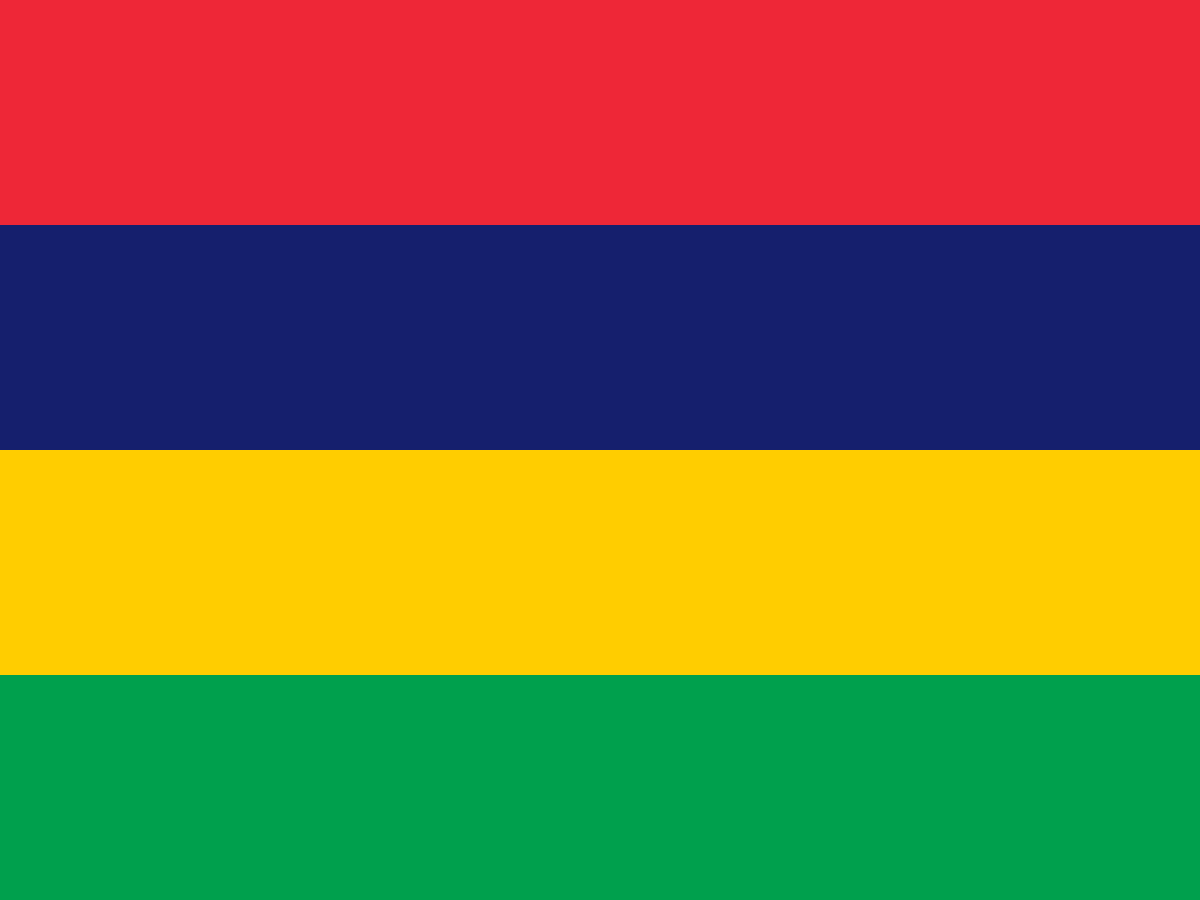
The flag of Mauritius
The Mauritian flag has four equal horizontal bands of red, blue, yellow and green.
Each colour has a national meaning.
Red represents the struggle for independence, blue represents the Indian Ocean, yellow represents the light of liberty and the country's bright future, and green represents the island's vegetation and agriculture.
The flag is commonly known as the Les Quatre Bandes, meaning "The Four Bands". It was adopted at independence in 1968.
The red band
The red band represents the struggle for freedom and independence.
It reflects the political movement that eventually ended British colonial rule and led to independence in 1968.
The blue band
The blue band represents the Indian Ocean surrounding Mauritius.
The ocean is central to the country's geography, history, economy and identity.
The yellow band
The yellow band symbolises the light of liberty and the bright future of an independent Mauritius.
It is a reminder that independence was seen as the beginning of a new national era.
The green band
The green band represents the lush vegetation and agricultural wealth of Mauritius.
Sugar cane has historically been particularly important to the island's landscape and economy.
A short history of Mauritius
Mauritius was uninhabited when European explorers first recorded it, although Arab and Portuguese sailors knew of islands in the wider Indian Ocean. The Dutch made the first sustained settlement, followed by the French and then the British.
The island became independent in 1968 and later a republic in 1992.
History timeline
10th–16th centuries — Early knowledgeArab and Portuguese navigators were aware of islands in the southwestern Indian Ocean, although Mauritius remained uninhabited.
1598 — Dutch arrivalDutch sailors landed on Mauritius and named the island in honour of Prince Maurice of Nassau.
1638 — First Dutch settlementThe Dutch established a permanent settlement, although repeated difficulties eventually led them to abandon the island.
1710 — Dutch leaveThe Dutch abandoned Mauritius, leaving the island without a permanent European settlement for a short period.
1715 — French claimFrance took possession of the island and renamed it Île de France.
1735 — Mahé de LabourdonnaisUnder governor Mahé de Labourdonnais, Port Louis developed into an important harbour and administrative centre.
1810 — British captureBritish forces captured Île de France during the Napoleonic Wars.
1814 — British rule confirmedThe Treaty of Paris formally transferred Mauritius to Britain, while the French language, legal traditions and culture remained influential.
1835 — End of slaverySlavery was abolished in Mauritius under British rule. The plantation economy subsequently recruited large numbers of indentured workers from India.
19th century — Indian immigrationIndentured labour from India transformed the population and culture of Mauritius and became a major part of the island's social history.
20th century — Political developmentLabour movements and demands for greater political representation gradually expanded during the twentieth century.
12 March 1968 — IndependenceMauritius became independent from Britain. Sir Seewoosagur Ramgoolam became the country's first prime minister.
12 March 1992 — RepublicMauritius became a republic while remaining a member of the Commonwealth.
21st century — Diversified economyMauritius expanded beyond sugar into tourism, finance, manufacturing, information technology and international services.
TodayMauritius is a stable parliamentary republic and an important economic and tourism centre in the Indian Ocean.
The Dutch period
The Dutch were the first Europeans to establish a permanent settlement on Mauritius. They introduced sugar cane, deer and other species, while also exploiting the island's timber.
The settlement was eventually abandoned because of cyclones, shortages and logistical difficulties.
The French period
France took control in 1715 and renamed the island Île de France. Under Mahé de Labourdonnais, Port Louis became an important naval and commercial base.
French influence remains very visible today in language, food, architecture and legal traditions.
British Mauritius
Britain captured Mauritius in 1810 during the Napoleonic Wars. The island became a British colony, but the French language and civil law remained influential.
British rule lasted until independence in 1968.
The abolition of slavery
Slavery was abolished in Mauritius in 1835. Plantation owners subsequently relied heavily on indentured labour, especially workers recruited from India.
This migration transformed Mauritian society and helped create the multicultural population that exists today.
Indian indentured labour
Large numbers of workers arrived from India during the nineteenth century under the indentured labour system.
Indian languages, religions, food, music and traditions became deeply embedded in Mauritian culture. A large proportion of modern Mauritians trace their ancestry to these communities.
Independence in 1968
Mauritius became independent on 12 March 1968. The country remained within the Commonwealth and developed a parliamentary political system.
The first prime minister was Sir Seewoosagur Ramgoolam, one of the central figures in the independence movement.
Mauritius becomes a republic
On 12 March 1992, Mauritius became a republic. The president became head of state while the prime minister remained head of government.
The country retained its parliamentary democratic system.
Port Louis
Port Louis is the capital, largest city and principal port of Mauritius. It lies between the Indian Ocean and a dramatic mountain range.
The city is the country's main political, financial and commercial centre and contains landmarks such as the Caudan Waterfront, Central Market and Fort Adelaide.
Mauritius geography
Mauritius is a volcanic island with mountains, plateaus, beaches and coral reefs. It is surrounded by a protective coral reef and lagoon system.
Rodrigues, a smaller island farther east, is also part of the Republic of Mauritius.
The volcanic origin
Mauritius was formed by volcanic activity millions of years ago as the Indian Ocean's tectonic and volcanic processes shaped the region.
The island's dramatic mountains and volcanic landscapes are reminders of this geological history.
The Seven Coloured Earths
The Seven Coloured Earths at Chamarel are a famous geological attraction where weathered volcanic soils display several natural colours.
The colours are produced by different mineral compositions in the weathered basaltic material.
Black River Gorges
Black River Gorges National Park protects a large area of native forest and is one of the most important natural areas in Mauritius.
The park supports endemic plants and animals and contains some of the island's most scenic hiking landscapes.
The dodo
The dodo is Mauritius's most famous extinct animal. This flightless bird evolved without major mammalian predators and became extinct by the late seventeenth century after human arrival and the introduction of non-native animals.
The dodo has become a global symbol of extinction and an important part of Mauritian national identity.
Mauritius's wildlife
Mauritius has many endemic species because its isolated volcanic islands allowed plants and animals to evolve separately from mainland populations.
Conservation programmes protect rare birds, reptiles and plants, although introduced species remain a major ecological challenge.
The Mauritius kestrel
The Mauritius kestrel became one of the world's rarest birds during the twentieth century. Intensive conservation work helped bring it back from the brink of extinction.
Its recovery is considered one of the notable successes of modern bird conservation.
Mauritius climate
Mauritius has a tropical maritime climate with warm temperatures year-round. Summers are hotter and wetter, while winters are generally cooler and drier.
Tropical cyclones can affect the island during the southern hemisphere cyclone season.
Mauritian culture
Mauritius is famous for its multicultural society, shaped by African, Indian, Chinese, French and British influences.
Religions including Hinduism, Christianity, Islam and Buddhism are practised, while music, festivals and food reflect the island's diverse heritage.
Languages of Mauritius
Mauritius does not have a single constitutionally designated official language. English and French are widely used in government, education and business, while Mauritian Creole is widely spoken in everyday life.
Languages of Indian and Chinese origin are also maintained within communities.
Mauritian food
Mauritian cuisine combines Indian, African, Chinese and French influences. Popular foods include dholl puri, rougaille, mine frit and seafood dishes.
Spices, lentils, rice, noodles, fish and tropical fruit are common ingredients.
Maha Shivaratri
Maha Shivaratri is one of the most important Hindu festivals celebrated in Mauritius. Large pilgrimages take place around sacred sites such as Grand Bassin.
The festival illustrates the importance of Indian cultural traditions within Mauritian society.
Grand Bassin
Grand Bassin, also known as Ganga Talao, is a crater lake and major Hindu pilgrimage site in Mauritius.
A large statue of Shiva overlooks the lake, and thousands of pilgrims visit during Maha Shivaratri.
Mauritius's economy
Mauritius has one of Africa's more diversified economies. Major sectors include tourism, financial services, manufacturing, sugar, information technology and international business.
The economy has developed significantly since independence, moving beyond its historic dependence on sugar.
Sugar cane
Sugar cane has shaped Mauritius's economy and landscape since the colonial period. Large plantations cover significant areas of the island.
Sugar remains an important export, although its relative importance has declined as the economy has diversified.
Tourism
Tourism is one of Mauritius's most important industries. Visitors are attracted by beaches, coral reefs, mountains, wildlife, resorts and cultural heritage.
The island is particularly well known for its lagoon waters and warm tropical climate.
Mauritius today
Modern Mauritius is a relatively prosperous, multicultural island republic with a diversified economy and strong links to Africa, Europe and Asia.
Its main challenges include protecting fragile ecosystems, managing coastal development, adapting to climate change and maintaining economic competitiveness.
Why is Mauritius's flag interesting?
Mauritius has one of the world's most straightforward but memorable four-colour flags. The four horizontal bands form a visual summary of the country's history and geography: independence, the Indian Ocean, liberty and its green landscape.
It is also one of the relatively small number of national flags that do not use a coat of arms or emblem.
Explore Mauritius on FlagAtlas
Continue exploring Mauritius and the world's flags with these FlagAtlas resources.