About Monaco
Monaco is a tiny sovereign city-state on the Mediterranean coast of the French Riviera. It is bordered on three sides by France and lies close to the Italian border. Monaco-Ville, Monte Carlo and La Condamine are among its best-known districts.
The country is famous for the Grimaldi dynasty, luxury tourism, finance, the Monte Carlo Casino and the Monaco Grand Prix. Despite its tiny territory, Monaco has a distinctive national identity and a long political history.
CapitalMonaco
RegionEurope / Mediterranean
PopulationAbout 39,000
CurrencyEuro
Official languageFrench
IndependenceSovereignty recognised in 1861
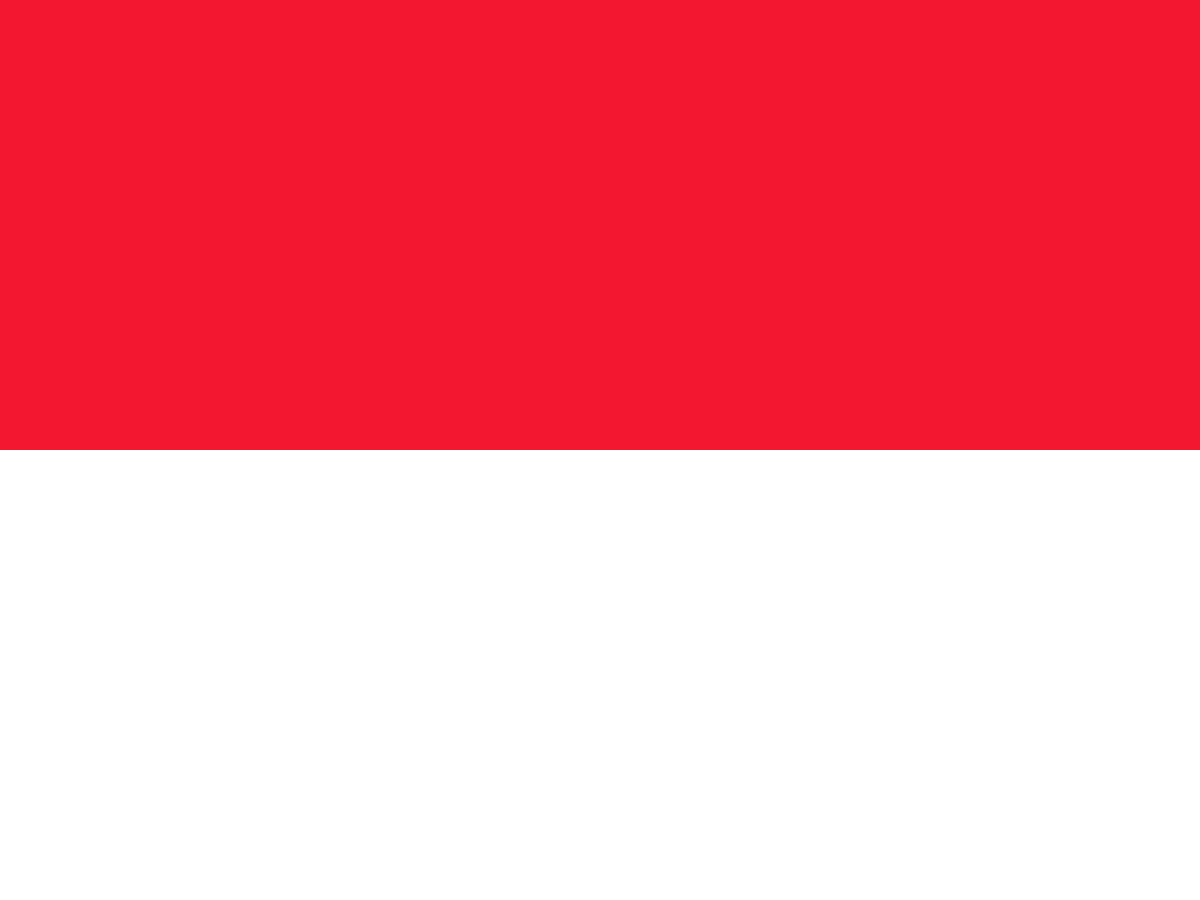
The flag of Monaco
Monaco's national flag has two equal horizontal bands: red above white.
The colours are associated with the House of Grimaldi, the dynasty that has ruled Monaco since the late thirteenth century.
The simple red-and-white bicolour was officially adopted in its modern form in 1881. Monaco's flag is very similar to Indonesia's flag, although the two have different proportions.
The red band
The red upper band is one of the traditional colours of the Grimaldi dynasty.
Red has been associated with Monaco's ruling house and national identity for centuries.
The white band
The white lower band is the second traditional Grimaldi colour.
The combination of red and white makes Monaco's flag one of Europe's simplest national flags.
Monaco and Indonesia
Monaco's flag is visually almost identical to the flag of Indonesia: both use red over white.
The main distinction is the flag's proportions. Monaco's official flag is shorter and squarer, while Indonesia's is longer. Poland also uses the same two colours but reverses them, with white above red.
The House of Grimaldi
The House of Grimaldi is the ruling dynasty of Monaco. François Grimaldi, known as "Il Malizia", is traditionally associated with the capture of the fortress of Monaco in 1297.
The dynasty's long connection with the principality is central to Monaco's national history and helps explain the colours of the flag.
A short history of Monaco
Monaco's history is closely connected with the Grimaldi family, Genoa, France and the Mediterranean. The fortified Rock of Monaco became the centre of the principality.
Over the centuries Monaco survived by balancing relationships with larger neighbours. The nineteenth-century development of Monte Carlo transformed it into a wealthy international destination.
History timeline
Ancient era — Greek and Roman influenceThe Mediterranean coast around Monaco was visited and settled by ancient peoples and later incorporated into the Roman world.
1297 — Grimaldi capture the RockFrançois Grimaldi and his followers seized the fortress of Monaco, beginning the dynasty's enduring association with the principality.
1331 — Grimaldi rule establishedThe Grimaldi family's control developed into the political entity that became modern Monaco.
15th century — Monaco gains wider recognitionThe principality consolidated its position along the Mediterranean coast while navigating relationships with Genoa and other powers.
1524–1641 — Spanish protectionMonaco came under Spanish protection while the Grimaldis retained control of the principality.
1641 — Treaty of PéronneMonaco entered into a new relationship with France, replacing Spanish protection with French protection.
1793–1814 — French annexationDuring the French Revolution and Napoleonic period, Monaco was annexed to France.
1815 — RestorationAfter Napoleon's defeat, Monaco was restored to the Grimaldi dynasty and placed under Sardinian protection.
1848 — Menton and Roquebrune revoltThe towns of Menton and Roquebrune broke away from Monaco amid political and economic tensions.
1861 — Franco-Monegasque TreatyFrance formally recognised Monaco's sovereignty, while Monaco ceded Menton and Roquebrune to France.
1863 — Monte Carlo Casino opensThe casino opened and helped transform Monaco's economic fortunes by attracting wealthy visitors from across Europe.
1881 — Modern flag adoptedMonaco formally adopted the red-and-white bicolour that remains its national flag.
1911 — ConstitutionMonaco adopted its first constitution, beginning a more formal constitutional framework for the principality.
1918 — Treaty with FranceA treaty established a close relationship between Monaco and France, including arrangements for succession and foreign affairs.
1949 — Prince Rainier IIIRainier III became sovereign prince and later oversaw major modernisation of Monaco.
1956 — Prince Rainier marries Grace KellyThe marriage of Rainier III and American actress Grace Kelly attracted worldwide attention and became a defining moment in Monaco's modern image.
1962 — New constitutionMonaco adopted a new constitution establishing the modern constitutional system.
1993 — United Nations membershipMonaco became a member of the United Nations, strengthening its international status as a sovereign state.
2005 — Prince Albert IIAlbert II became sovereign prince following the death of his father, Rainier III.
2015 — Expansion of MonacoLand reclamation projects continued to expand the principality's extremely limited territory.
TodayMonaco remains a sovereign constitutional monarchy with a highly developed service economy, global tourism profile and close relationship with France.
The Rock of Monaco
The Rock of Monaco is a dramatic promontory overlooking the Mediterranean. The historic old town, Monaco-Ville, grew around the fortified Rock.
The Prince's Palace sits at the top and remains the official residence of Monaco's sovereign.
The Prince's Palace
The Prince's Palace of Monaco has been the official residence of the Grimaldi family for centuries.
Parts of the building date back to the medieval fortress, while later additions reflect Renaissance and classical architecture.
Monaco-Ville
Monaco-Ville is the historic district on the Rock. Its narrow streets, old buildings and harbour views make it one of the country's most recognisable areas.
The district contains the Prince's Palace, Monaco Cathedral and the Oceanographic Museum.
Monte Carlo
Monte Carlo is Monaco's most famous district and is closely associated with luxury, casinos and international tourism.
The Monte Carlo Casino helped transform Monaco from a small Mediterranean principality into a wealthy international destination during the nineteenth century.
The Monte Carlo Casino
The Casino de Monte-Carlo opened in 1863 and became the centre of Monaco's early tourism and gambling industry.
Its Belle Époque architecture and international reputation helped establish the image of Monaco as a destination for wealthy visitors.
The Grimaldi dynasty
The Grimaldis have remained central to Monaco's identity for more than seven centuries. The dynasty has survived periods of foreign occupation, political upheaval and changing relationships with neighbouring states.
Prince Albert II is the current sovereign and continues the constitutional role of the Monegasque monarchy.
Prince Rainier III
Rainier III ruled Monaco from 1949 until 2005. His reign saw major economic development, urban construction and international expansion.
His marriage to Grace Kelly in 1956 became one of the twentieth century's most famous royal marriages.
Grace Kelly
American actress Grace Kelly married Prince Rainier III in 1956 and became Princess Grace of Monaco.
She remained an important figure in Monaco's international image and established the Princess Grace Foundation, which supports the arts.
Prince Albert II
Albert II became sovereign prince in 2005. He has placed particular emphasis on environmental protection, ocean conservation and Monaco's international role.
He is also known for supporting scientific and polar exploration.
Monaco's geography
Monaco occupies only about 2 square kilometres on the Mediterranean coast, making it one of the world's most densely populated countries.
Steep hills and a very limited amount of flat land have encouraged extensive high-rise construction and land reclamation.
Land reclamation
Because Monaco has almost no spare land, it has repeatedly expanded its territory through land reclamation.
Projects have created additional residential, commercial and harbour space along the Mediterranean coast.
Monaco's climate
Monaco has a Mediterranean climate with mild winters, warm sunny summers and relatively limited rainfall during the summer months.
The Mediterranean location helps make the principality a popular year-round destination.
Monaco's marine environment
Monaco's coastline opens directly onto the Mediterranean and has long supported maritime activity. The principality has also developed a strong reputation for marine conservation and ocean science.
The Oceanographic Museum and Institute founded by Prince Albert I became an important centre for marine research.
The Oceanographic Museum
The Oceanographic Museum of Monaco was founded by Prince Albert I and is built dramatically into the Rock above the Mediterranean.
It combines public exhibitions, marine science and conservation and is one of Monaco's most famous landmarks.
The Monaco Grand Prix
The Monaco Grand Prix is one of Formula 1's most famous races. Cars race through the narrow streets of Monte Carlo and around the harbour.
The event is known for its tight corners, limited overtaking opportunities and spectacular setting.
The Monaco Grand Prix circuit
The street circuit passes landmarks including the harbour, Casino Square and the famous Fairmont hairpin.
Because the track is built on public roads, the circuit has to be assembled and dismantled around the race weekend.
Monaco's economy
Monaco has a highly developed economy based on finance, tourism, real estate, professional services and luxury industries.
The country has no broad-based personal income tax for most residents, a policy that has contributed to its appeal to wealthy individuals.
Banking and finance
Financial services are a major part of Monaco's economy. The principality has developed a reputation as a centre for private banking, wealth management and international finance.
Monaco has also strengthened its regulatory and transparency systems in response to international standards.
Tourism
Tourism is central to Monaco's international identity. Visitors come for the casino, Grand Prix, harbour, museums, luxury hotels and Mediterranean setting.
Despite its small size, Monaco attracts large numbers of visitors each year.
The Monaco yacht harbour
Monaco's harbour is filled with luxury yachts and is one of the most recognisable sights of the principality.
Yachting, marina services and major international events contribute to Monaco's luxury tourism economy.
Monaco's culture
Monegasque culture combines Italian, French and Mediterranean influences with the traditions of the Grimaldi dynasty.
French is the official language, while Monegasque is the traditional local language and Italian and English are also widely heard.
Monegasque language
Monegasque is a traditional Ligurian-influenced Romance language. It has been preserved and promoted as part of Monaco's cultural heritage.
French is the official language of the state, while the international population means many other languages are commonly spoken.
Monaco's national day
Monaco's National Day is celebrated on 19 November. It is associated with the sovereign prince and features ceremonies, decorations and public celebrations.
The day is an important expression of Monegasque national identity.
Monaco today
Modern Monaco is a sovereign constitutional monarchy with one of the world's highest concentrations of wealth and an unusually dense urban environment.
Its challenges include limited land, housing costs, traffic and the need to balance development with environmental protection along the Mediterranean coast.
Why is Monaco's flag interesting?
Monaco's flag is one of the world's simplest: just two horizontal bands of red and white.
Despite its simplicity, the design carries a strong dynastic connection to the Grimaldi family and is instantly associated with one of Europe's smallest sovereign states.
Explore Monaco on FlagAtlas
Continue exploring Monaco and the world's flags with these FlagAtlas resources.