About Mozambique
Mozambique is a long, narrow southeastern African country on the Indian Ocean. It borders Tanzania, Malawi, Zambia, Zimbabwe, South Africa and Eswatini, and has a coastline stretching for thousands of kilometres.
Maputo is the capital. Mozambique is known for its beaches and islands, the Zambezi River, Portuguese and African cultural influences, wildlife and a complex modern history shaped by colonialism, independence and civil war.
CapitalMaputo
RegionSoutheast Africa
PopulationAbout 32 million
CurrencyMetical
Official languagePortuguese
Independence25 June 1975
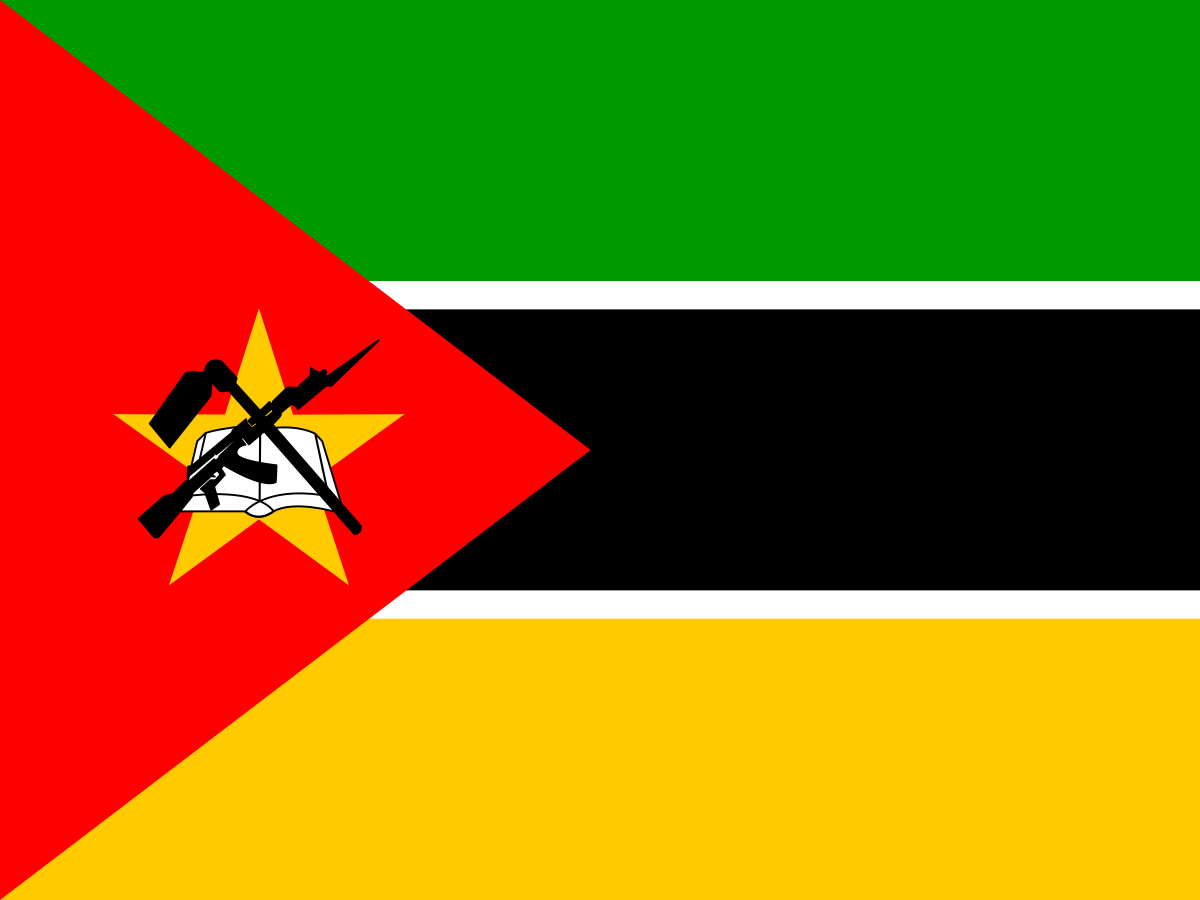
The flag of Mozambique
Mozambique's flag consists of green, black and yellow horizontal bands separated by narrow white lines, with a red triangle at the hoist containing a yellow star, hoe, book and AK-47 rifle.
The flag is one of the world's most distinctive national flags because it depicts a modern firearm.
The AK-47 is associated with defence and vigilance, while the book represents education and the hoe represents agriculture.
The current flag was adopted in 1 May 1983 and developed from the flag of the ruling FRELIMO movement and the national liberation struggle.
The green band
Green represents the country's rich land and agriculture.
Agriculture remains extremely important to livelihoods in Mozambique, particularly in rural communities.
The black band
Black represents the African continent and the people of Mozambique.
The colour is part of a broader Pan-African tradition found in the flags of many African states.
The yellow bands
Yellow represents Mozambique's mineral wealth.
Mozambique possesses important mineral and energy resources, including coal, natural gas, graphite and other minerals.
The white stripes
The narrow white stripes represent peace.
They separate the green, black and yellow fields and create the distinctive striped appearance of the flag.
The red triangle
The red triangle represents the struggle for independence and the sacrifices made during the liberation struggle.
It contains the country's most recognisable national symbols: the star, book, hoe and rifle.
The AK-47
The AK-47 rifle is the most controversial and unusual element of Mozambique's flag. It represents defence and vigilance.
The rifle reflects the country's armed struggle against Portuguese colonial rule and the importance of military resistance in the history of the independence movement.
The book
The open book represents education.
Education was an important part of the post-independence vision of building a modern state, and the book remains a symbol of learning and literacy.
The hoe
The hoe represents agriculture and the importance of farming.
Large numbers of Mozambicans depend directly or indirectly on agriculture, particularly subsistence and smallholder farming.
The star
The yellow star is associated with Marxism and internationalism in the historical symbolism of FRELIMO.
Its presence reflects the political ideology of the independence movement and the People's Republic period.
A short history of Mozambique
Mozambique's history stretches from ancient Bantu-speaking communities and Indian Ocean trading networks to Portuguese colonial rule, armed independence, civil war and democratic politics.
The country's long coastline made it part of Indian Ocean commerce centuries before European colonial expansion.
History timeline
Ancient era — Bantu-speaking societiesBantu-speaking communities settled across Mozambique and developed farming, fishing, ironworking and regional trade networks.
1st millennium — Indian Ocean tradeCoastal communities traded with merchants from Arabia, Persia, India and other parts of the Indian Ocean world.
11th–15th centuries — Swahili trading townsCoastal settlements became part of the wider Swahili trading network, linking East Africa with the Indian Ocean.
1498 — Vasco da Gama arrivesPortuguese navigator Vasco da Gama reached the Mozambican coast during his voyage to India.
16th century — Portuguese expansionPortugal established forts, trading posts and settlements along the coast and the Zambezi Valley.
17th–19th centuries — Portuguese influence growsPortuguese authority expanded unevenly inland, interacting with African kingdoms, traders and local rulers.
1884–1885 — Berlin ConferenceEuropean powers formalised competing claims in Africa, accelerating the partition and colonial occupation of the continent.
Late 19th century — Colonial consolidationPortugal intensified its efforts to control Mozambique and established a more formal colonial administration.
1962 — FRELIMO foundedThe Mozambique Liberation Front, known as FRELIMO, was formed to campaign for independence from Portugal.
1964 — War of independence beginsFRELIMO launched an armed struggle against Portuguese colonial rule.
1974 — Portuguese RevolutionThe Carnation Revolution in Portugal ended the dictatorship and opened the way for decolonisation.
1975 — IndependenceMozambique became independent on 25 June 1975, with Samora Machel becoming the country's first president.
1975–1992 — Civil warFRELIMO's government fought RENAMO in a devastating civil war that caused enormous loss of life and displacement.
1983 — Current flag adoptedMozambique adopted the flag featuring the distinctive rifle, book and hoe symbolism.
1990 — New constitutionA new constitution introduced multiparty politics and moved Mozambique away from its one-party Marxist-Leninist system.
1992 — Peace agreementThe Rome General Peace Accords ended the civil war and established a framework for multiparty democracy.
1994 — First multiparty electionsMozambique held its first multiparty general elections.
2000 — Major floodsSevere flooding caused a major humanitarian disaster and highlighted Mozambique's vulnerability to extreme weather.
2010s — Gas discoveriesLarge offshore natural-gas discoveries created expectations of major future investment and economic growth.
2017 onward — Cabo Delgado insurgencyAn Islamist insurgency in northern Mozambique caused widespread displacement and insecurity, particularly in Cabo Delgado province.
TodayMozambique is a multiparty republic with major natural resources and tourism potential, but it continues to face poverty, inequality, climate risks and security challenges.
The Swahili coast
Mozambique's northern and central coast formed part of the Swahili world, a network of African and Indian Ocean trading communities.
Islam, trade, architecture and language were shaped by centuries of contact between African communities and merchants from Arabia, Persia and India.
Portuguese colonial rule
Portugal gradually established control over Mozambique from the sixteenth century, but effective control over the interior remained limited for centuries.
By the late nineteenth century, European competition and the Scramble for Africa led Portugal to intensify colonial occupation.
FRELIMO
FRELIMO was founded in 1962 and became the principal movement fighting Portuguese rule.
After independence in 1975, FRELIMO became the governing political movement and remains Mozambique's dominant political party.
The War of Independence
The Mozambican War of Independence lasted from 1964 to 1974. FRELIMO forces fought Portuguese troops in northern and central Mozambique.
The conflict ended after political change in Portugal made the rapid decolonisation of Mozambique possible.
Samora Machel
Samora Machel became Mozambique's first president at independence in 1975. His government initially followed a socialist and Marxist-Leninist political model.
Machel remained president until his death in a plane crash in 1986.
The Mozambican Civil War
The Mozambican Civil War lasted from 1977 to 1992. The government fought RENAMO, while the conflict was influenced by the Cold War and regional politics.
The war caused huge civilian suffering, displacement and economic destruction before peace negotiations finally produced a settlement in 1992.
The 1992 peace agreement
The Rome General Peace Accords ended Mozambique's civil war and paved the way for multiparty elections.
The agreement remains a major turning point in the country's modern history.
Maputo
Maputo is Mozambique's capital and largest city. It sits on the southern coast beside Maputo Bay.
The city has a mixture of Portuguese colonial architecture, modern buildings, markets and wide avenues and is the country's principal political and commercial centre.
Mozambique Island
Mozambique Island is a historic island off the northern coast. Its location made it an important Portuguese and Indian Ocean trading centre.
The island's historic buildings reflect African, Arab, Indian and Portuguese influences and are recognised as a UNESCO World Heritage site.
The Zambezi River
The Zambezi River is one of Africa's great rivers and crosses central Mozambique before reaching the Indian Ocean.
Its basin supports agriculture, fisheries, wildlife and major hydroelectric infrastructure.
Cahora Bassa
The Cahora Bassa Dam on the Zambezi is one of Africa's largest hydroelectric projects.
Its electricity production is strategically important to Mozambique and has also supplied neighbouring countries.
Mozambique's coastline
Mozambique has a long Indian Ocean coastline with coral reefs, mangroves, sandy beaches and offshore islands.
The coast supports fishing, tourism and important marine ecosystems.
The Bazaruto Archipelago
The Bazaruto Archipelago is a group of islands off southern Mozambique known for beaches, coral reefs and marine wildlife.
The surrounding protected area is famous for dugongs, dolphins, turtles and tropical fish.
Gorongosa National Park
Gorongosa National Park is one of Mozambique's best-known wildlife areas. Decades of war severely damaged its wildlife populations, but major conservation programmes have helped many species recover.
The park is an important example of large-scale ecological restoration.
Mozambique's climate
Mozambique has mainly a tropical and subtropical climate, with wetter conditions in much of the country and drier areas inland and in the south.
Cyclones and floods can cause severe damage, particularly along the coast and major river valleys.
Cyclones and flooding
Mozambique is highly exposed to tropical cyclones, coastal storms and flooding. Its long coastline and low-lying river valleys increase vulnerability.
Climate change is expected to increase risks from extreme weather and sea-level rise.
Mozambique's wildlife
Mozambique supports elephants, lions, hippos, crocodiles, wild dogs, marine turtles, dugongs and many bird species.
Conservation has become increasingly important as protected areas recover from the effects of past conflict and habitat pressure.
Mozambican culture
Mozambican culture combines African traditions with Portuguese, Arab and Indian Ocean influences.
Music, dance, sculpture, food and language vary considerably between the north, centre and south of the country.
Portuguese and local languages
Portuguese is the official language and is especially important in government, education and national communication.
Mozambique is highly multilingual, with numerous Bantu languages including Makhuwa, Tsonga, Sena, Chichewa and others spoken by communities across the country.
Mozambican music
Mozambique has rich musical traditions including marrabenta, traditional drumming, dance and regional musical styles.
Marrabenta developed particularly around Maputo and became one of the country's best-known modern musical traditions.
Mozambican food
Mozambican cuisine is strongly influenced by the Indian Ocean, Portuguese cooking and African ingredients.
Piri-piri prawns, matapa, xima, coconut-based dishes and seafood are among the foods associated with the country.
Tourism
Tourism is an important source of potential growth. Visitors are attracted by beaches, islands, coral reefs, wildlife reserves and historic sites.
The country's long coastline gives it significant potential for marine and coastal tourism.
Mozambique's economy
Mozambique's economy includes agriculture, mining, energy, manufacturing, services and tourism.
Large natural-gas reserves and other mineral resources have attracted major investment, although the benefits of resource development remain uneven.
Natural gas
Mozambique has some of the world's significant offshore natural-gas reserves, particularly in the Rovuma Basin in the north.
Liquefied natural gas projects have the potential to transform government revenues and exports, although security problems and project delays have complicated development.
Mozambique's mineral resources
Mozambique has important deposits of coal, graphite, titanium minerals, gemstones and other resources.
Mining is increasingly important to exports, while also creating debates about environmental impacts and local economic benefits.
Mozambique today
Modern Mozambique is a young, multilingual country with enormous natural and cultural resources. It has made major progress since the end of the civil war but remains one of the world's poorer countries.
Key challenges include poverty, infrastructure gaps, extreme weather, regional inequality and the security situation in the north.
Why is Mozambique's flag interesting?
Mozambique's flag is one of the most unusual national flags in the world because it includes a recognisable modern rifle alongside a book and agricultural hoe.
The design tells a concise story about Mozambique's liberation struggle, defence, education and agriculture.
Explore Mozambique on FlagAtlas
Continue exploring Mozambique and the world's flags with these FlagAtlas resources.