About Myanmar
Myanmar, also known historically as Burma, is a large country in mainland Southeast Asia. It borders India, Bangladesh, China, Laos and Thailand and has a long coastline on the Bay of Bengal and Andaman Sea.
Naypyidaw is the capital, while Yangon remains the largest city and an important commercial and cultural centre. Myanmar has enormous ethnic, linguistic and geographical diversity, from Himalayan foothills and central plains to tropical coastlines.
CapitalNaypyidaw
RegionSoutheast Asia
PopulationAbout 54 million
CurrencyKyat
Official languageBurmese
Independence4 January 1948
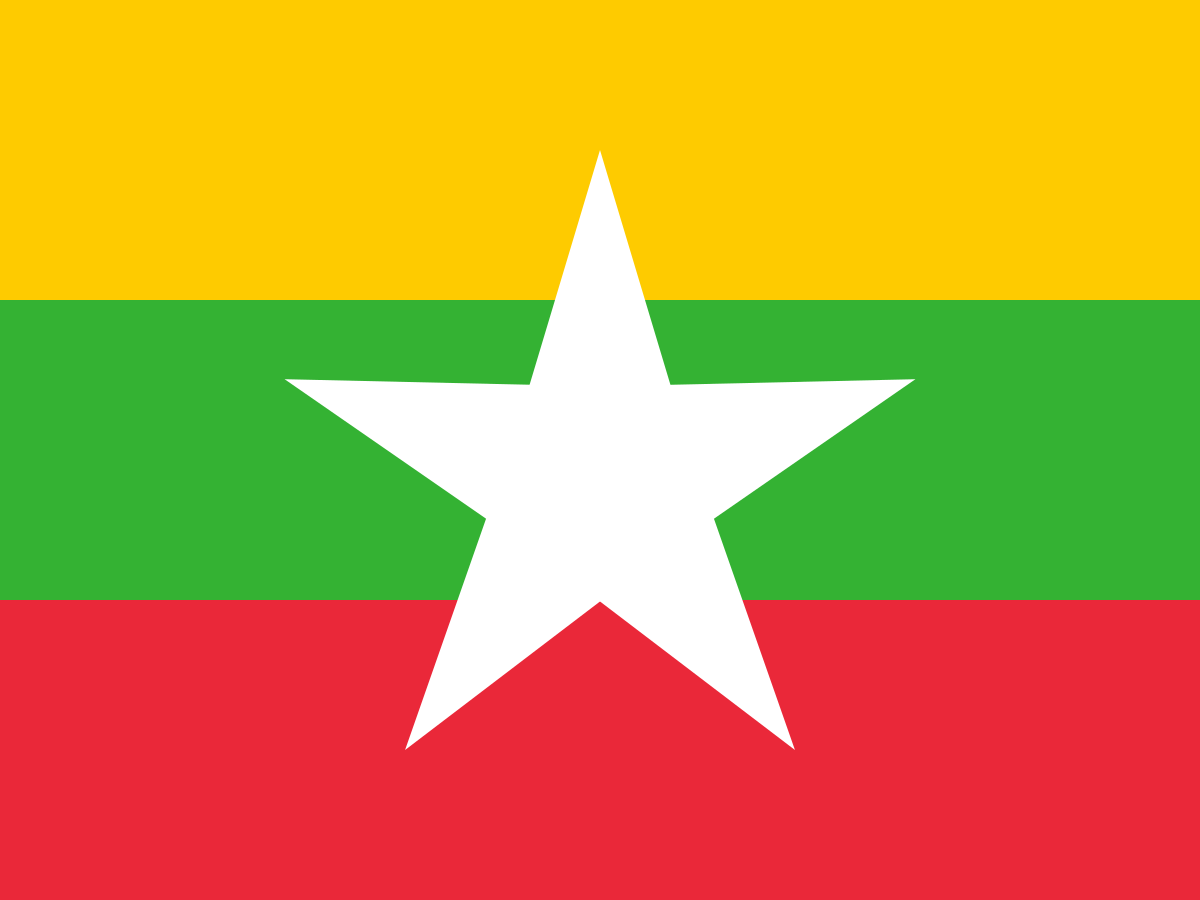
The flag of Myanmar
Myanmar's national flag has three equal horizontal bands of yellow, green and red, with a large white five-pointed star in the centre.
The three colours represent solidarity, peace and tranquillity, and courage.
The large white star represents the union of the country and its people.
The current flag was adopted on 21 October 2010, replacing the previous flag used during the State Peace and Development Council period.
The yellow band
Yellow represents solidarity among the people of Myanmar.
The colour forms the upper band of the flag and is part of the modern national symbolism adopted in 2010.
The green band
Green symbolises peace and tranquillity.
It is also visually associated with Myanmar's extensive agricultural landscapes and forests, although the official symbolism focuses on peace and tranquillity.
The red band
Red stands for courage.
The colour forms the bottom band and gives the flag a strong contrast with the central white star.
The white star
The large white five-pointed star represents the union of Myanmar.
Its position at the centre of the three coloured bands makes it the dominant feature of the flag.
A short history of Myanmar
Myanmar's history includes ancient Pyu and Mon civilisations, the great Bagan kingdom, successive Burmese dynasties, British colonial rule, independence in 1948 and decades of military influence.
The country has experienced repeated political upheaval and ethnic conflicts, making its modern history particularly complex.
History timeline
1st millennium — Pyu and Mon civilisationsPyu city-states developed in central Myanmar while Mon kingdoms flourished in the south and along important trade routes.
849 — Bagan establishedThe city of Bagan developed into the centre of a powerful kingdom that would dominate much of Myanmar.
11th century — AnawrahtaKing Anawrahta consolidated the Bagan kingdom and helped establish Theravada Buddhism as a major religious force.
11th–13th centuries — Bagan KingdomBagan became a major political and religious centre, famous for thousands of Buddhist temples and monuments.
1287 — Mongol invasionThe Bagan kingdom declined following internal problems and conflict with the Mongol Yuan Empire.
14th–16th centuries — Regional kingdomsSeveral states, including Ava, Hanthawaddy and Shan polities, competed for power across the region.
1531 — Toungoo reunificationKing Tabinshwehti reunified much of Myanmar under the Toungoo dynasty.
16th century — Toungoo EmpireBayinnaung built one of the largest empires in mainland Southeast Asia, extending Burmese influence over neighbouring regions.
1752 — Konbaung dynastyThe Konbaung dynasty emerged and reunited the Burmese kingdom after the fall of the Toungoo dynasty.
1824–1885 — Anglo-Burmese warsBritain defeated the Burmese kingdom through three major wars and gradually incorporated Burma into British India.
1885 — British annexationKing Thibaw was deposed and Burma was fully annexed by the British.
1937 — Separate colonyBurma became a separately administered British colony rather than remaining part of British India.
1942–1945 — Japanese occupationJapanese forces occupied Burma during the Second World War. Burmese nationalists initially cooperated with Japan before turning against the occupation.
1947 — Panglong AgreementGeneral Aung San and representatives of several ethnic groups agreed on principles for a future independent union.
1948 — IndependenceBurma became independent from Britain on 4 January 1948.
1962 — Military coupGeneral Ne Win seized power and established military rule under the Burma Socialist Programme Party.
1988 — 8888 uprisingLarge pro-democracy demonstrations were brutally suppressed. A new military government took power.
1989 — Burma becomes MyanmarThe military government changed the country's English name from Burma to Myanmar and renamed several major places.
1990 — ElectionThe National League for Democracy won a large electoral victory, but the military did not allow it to form a government.
2005 — NaypyidawThe military government moved the administrative capital from Yangon to Naypyidaw.
2008 — ConstitutionA new constitution created a political system that reserved a significant number of parliamentary seats for the military.
2011 — Civilian-led governmentA nominally civilian government replaced direct military rule, beginning a period of political and economic opening.
2015 — NLD election victoryThe National League for Democracy won a major electoral victory and formed a government under Aung San Suu Kyi's leadership.
2020 — Another NLD victoryThe NLD won another general election, but the military disputed the result.
2021 — Military coupThe military seized power on 1 February 2021, detaining civilian leaders and triggering widespread protests and armed resistance.
TodayMyanmar remains affected by armed conflict, political instability, humanitarian pressures and severe economic challenges.
The Pyu and Mon
The Pyu and Mon were among the earliest major civilisations of Myanmar.
Pyu city-states developed sophisticated urban and irrigation systems, while Mon kingdoms played an important role in trade, Buddhism and culture in southern Myanmar.
The Bagan Kingdom
The Bagan Kingdom was one of the most important early Burmese states. Under King Anawrahta, much of central Myanmar was unified in the eleventh century.
Bagan became a major centre of Theravada Buddhism and is famous for its enormous landscape of temples and pagodas.
Bagan's temples
The archaeological zone of Bagan contains thousands of surviving Buddhist monuments built mainly between the eleventh and thirteenth centuries.
The temples are among Myanmar's most famous cultural landmarks and demonstrate the wealth and religious importance of the medieval kingdom.
The Toungoo dynasty
The Toungoo dynasty reunified Myanmar in the sixteenth century. King Bayinnaung created an exceptionally large empire across mainland Southeast Asia.
The dynasty helped establish Burmese political dominance over a wide region, although much of the empire later fragmented.
The Konbaung dynasty
The Konbaung dynasty ruled Myanmar from 1752 until the British conquest in 1885.
It was the last Burmese royal dynasty and fought repeated wars against Britain as European influence expanded in the region.
The Anglo-Burmese wars
Britain fought three Anglo-Burmese wars between 1824 and 1885. Each conflict reduced Burmese territory and independence.
After the final war, King Thibaw was exiled and the entire kingdom was incorporated into British India.
British Burma
Under British rule, Burma became an important producer of rice, teak and other commodities. Large numbers of workers migrated into the country from British India.
Colonial economic changes transformed cities and agriculture but also created social and political tensions.
Aung San and independence
General Aung San became the leading figure in Burma's independence movement. He negotiated the Panglong Agreement and worked toward a federal union.
Aung San and several colleagues were assassinated in July 1947, only months before independence.
The Panglong Agreement
The Panglong Agreement of 1947 brought Aung San together with representatives of several ethnic communities.
It became an important symbol of the idea that Burma's diverse peoples could form a union with autonomy and political cooperation.
Military rule
Military rule became central to Myanmar's political history after the 1962 coup. General Ne Win established a socialist military government that lasted for decades.
The armed forces, known as the Tatmadaw, have remained a powerful political institution.
The 8888 uprising
The 1988 pro-democracy uprising brought hundreds of thousands of people onto the streets. The military responded with a violent crackdown.
The protests helped create the modern National League for Democracy and transformed Myanmar's political opposition.
Aung San Suu Kyi
Aung San Suu Kyi became the most internationally recognised figure in Myanmar's pro-democracy movement and led the National League for Democracy.
She spent long periods under house arrest before becoming a leading civilian political figure after the 2015 election victory. Her international reputation was later severely damaged by criticism of her government's handling of the Rohingya crisis.
The 2021 military coup
On 1 February 2021, Myanmar's military seized power and detained senior civilian leaders.
The coup triggered mass protests, a civil disobedience movement and the rapid expansion of armed conflict involving the military, ethnic armed organisations and newer resistance groups.
Myanmar's ethnic diversity
Myanmar is home to many ethnic groups, including the Bamar, Shan, Karen, Rakhine, Kachin, Chin, Mon and others.
Relations between the central state and ethnic minority regions have been a major issue throughout modern Myanmar's history.
The Rohingya crisis
The Rohingya are a Muslim minority concentrated mainly in Rakhine State. Their status, citizenship and treatment have been the subject of severe conflict and international concern.
Large numbers of Rohingya fled to neighbouring Bangladesh following military operations in 2017, creating a major refugee crisis.
Naypyidaw
Naypyidaw became Myanmar's administrative capital in 2005. It is known for its enormous roads, government zones and planned layout.
The city is very different from the crowded commercial environment of Yangon and was deliberately developed as a new administrative centre.
Yangon
Yangon is Myanmar's largest city and former capital. It is famous for colonial architecture, busy markets and the enormous Shwedagon Pagoda.
Although no longer the capital, Yangon remains the country's most important commercial and cultural city.
Shwedagon Pagoda
The Shwedagon Pagoda in Yangon is one of Myanmar's most important Buddhist monuments. Its large golden stupa dominates the city's skyline.
The site has deep religious and cultural significance and attracts pilgrims from across Myanmar.
The Irrawaddy River
The Irrawaddy River is Myanmar's great river and runs through the centre of the country before reaching the Andaman Sea.
Its basin supports agriculture, transport, fisheries and some of the country's largest population centres.
Inle Lake
Inle Lake in Shan State is famous for floating gardens, stilt villages and the distinctive leg-rowing technique used by local fishermen.
The lake is an important cultural and tourism destination but faces environmental pressures.
Myanmar's climate
Myanmar has a predominantly tropical monsoon climate, with a wet season influenced by the southwest monsoon and a drier period during the cooler months.
The central Dry Zone is considerably drier than the forested mountains and tropical coastal regions.
Cyclone Nargis
In 2008, Cyclone Nargis struck the Irrawaddy Delta and became one of Myanmar's deadliest natural disasters.
The storm caused enormous loss of life and demonstrated the country's vulnerability to tropical cyclones and flooding.
Myanmar's wildlife
Myanmar's forests and mountains support Asian elephants, tigers, leopards, bears, gibbons and many bird species.
Habitat loss, illegal wildlife trade and conflict create major conservation challenges.
Buddhism in Myanmar
Theravada Buddhism is the dominant religion in Myanmar and has profoundly influenced architecture, festivals, art and daily life.
Monasteries and pagodas are found throughout the country, and monks play an important role in many communities.
Myanmar's culture
Myanmar's culture reflects Bamar, ethnic minority, Buddhist, Indian, Chinese and Southeast Asian influences.
Traditional dance, puppetry, lacquerware, textiles and religious festivals are important parts of cultural life.
Myanmar's languages
Burmese is the official language, but Myanmar is highly multilingual.
Many ethnic communities speak their own languages, including Shan, Karen languages, Kachin, Chin and Mon.
Myanmar's food
Myanmar cuisine includes dishes such as mohinga, tea-leaf salad, curries, noodles and Shan-style rice dishes.
Fish, fermented ingredients, rice, chilli, herbs and tea leaves are common features of Burmese cooking.
Myanmar's economy
Myanmar's economy includes agriculture, natural gas, mining, manufacturing, forestry and services.
Political instability, conflict, sanctions and infrastructure problems have significantly affected economic development.
Rubies and gemstones
Myanmar is famous for its rubies, jade and other gemstones. Mogok in northern Myanmar is particularly renowned for high-quality rubies.
The country's gemstone industry has significant economic value but has also been associated with environmental and human-rights concerns.
Natural gas and resources
Myanmar has significant natural-gas reserves and produces petroleum, jade, timber and other natural resources.
Resource extraction has been an important source of revenue but has also generated disputes over environmental damage and the distribution of wealth.
Myanmar today
Myanmar today is facing one of the most serious political and humanitarian crises in its modern history. The 2021 coup triggered widespread resistance and intensified conflicts that had already affected many ethnic regions.
The country remains culturally rich and geographically diverse, but instability, displacement, poverty and disrupted public services continue to affect millions of people.
Why is Myanmar's flag interesting?
Myanmar's flag is distinctive because the large white star dominates three bold horizontal colours.
The design deliberately combines national unity with the values of solidarity, peace and courage and represents a clear break from the country's earlier flag designs.
Explore Myanmar on FlagAtlas
Continue exploring Myanmar and the world's flags with these FlagAtlas resources.