About Nauru
Nauru is a tiny Pacific island republic in Micronesia, northeast of Australia. It is one of the world's smallest countries by land area and population, and it has no official capital city; government offices are concentrated in the Yaren District.
Nauru's modern history has been dominated by phosphate mining, which once made the island exceptionally wealthy but also caused severe environmental damage. Today the country is working to diversify its economy while dealing with the long-term effects of mining and climate change.
Government centreYaren District
RegionMicronesia
PopulationAbout 10,000
CurrencyAustralian dollar
Official languagesNauruan & English
Independence31 January 1968
The flag of Nauru
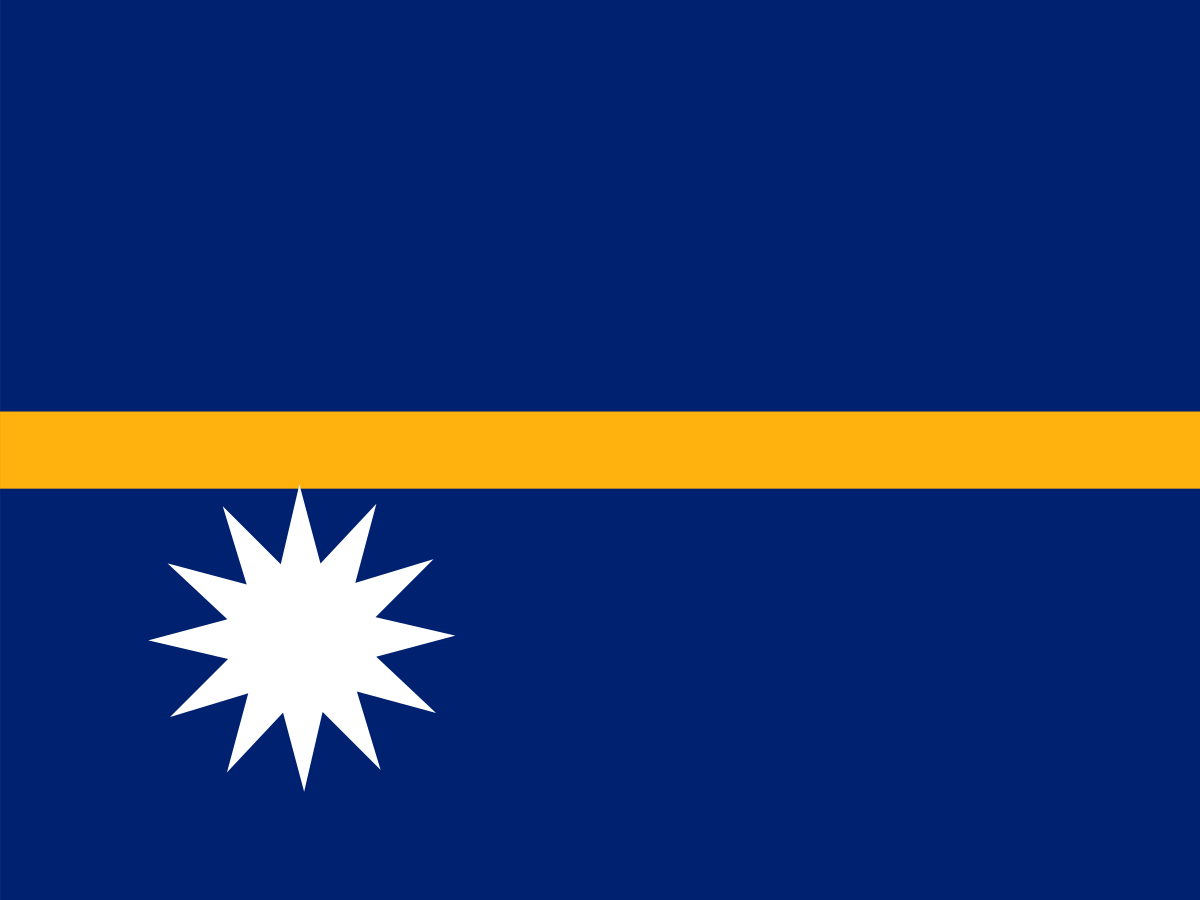
Nauru's flag has a dark blue field, a narrow horizontal golden-yellow stripe and a white twelve-pointed star positioned below the stripe towards the hoist.
The flag is a simple visual map of Nauru's place in the Pacific.
Blue represents the Pacific Ocean, the yellow stripe represents the Equator, and the white star represents Nauru and its twelve traditional tribal divisions.
The flag was adopted on 31 January 1968, the day Nauru became independent.
The blue field
The blue field represents the Pacific Ocean surrounding Nauru.
The colour also gives the flag a strong sense of the island nation's geographical isolation in the central Pacific.
The golden stripe
The golden-yellow horizontal stripe represents the Equator, which passes just south of Nauru.
The stripe is deliberately narrow and positioned across the centre of the flag to reflect Nauru's location close to the Equator.
The twelve-pointed star
The white star has twelve points, representing the twelve original tribes of Nauru.
Its white colour represents the island itself and the star's position below the golden stripe places Nauru just south of the Equator.
A short history of Nauru
Nauru was settled by Pacific peoples long before European contact. German rule began in the nineteenth century, followed by Australian administration after the First World War and Japanese occupation during the Second World War.
After the war, Nauru became a UN Trust Territory administered by Australia, New Zealand and the United Kingdom before achieving independence in 1968.
History timeline
Ancient era — Pacific settlementNauru was settled by Micronesian and Polynesian peoples who developed communities based on fishing, coconut cultivation and other island resources.
1798 — European contactBritish naval officer John Fearn is generally credited with recording European contact with Nauru during a voyage through the Pacific.
19th century — Inter-island conflictTraditional rivalries and the arrival of firearms contributed to a period of conflict between Nauruan communities.
1888 — German annexationGermany incorporated Nauru into its colonial empire as part of the Marshall Islands protectorate.
1900 — Phosphate discoveredHigh-grade phosphate deposits were identified, beginning a mining industry that would transform the island's economy and landscape.
1914 — Australian occupationAustralian forces took control of Nauru during the First World War.
1919 — Mandate administrationNauru became a League of Nations mandate administered jointly by Australia, New Zealand and the United Kingdom, with Australia exercising day-to-day control.
1942–1945 — Japanese occupationJapan occupied Nauru during the Second World War. Many Nauruans were forcibly deported to Truk and other locations.
1947 — UN Trust TerritoryNauru became a United Nations Trust Territory under Australian administration, with New Zealand and the United Kingdom as co-administering powers.
1966 — Self-governmentNauru achieved internal self-government as the final stages towards independence began.
1968 — IndependenceNauru became an independent republic on 31 January 1968.
1970s–1980s — Phosphate wealthPhosphate exports generated exceptionally high revenues and made Nauru one of the world's wealthiest countries on a per-person basis for a period.
1990s — Environmental and financial problemsPhosphate reserves declined while the environmental consequences of mining became increasingly severe. Nauru also experienced serious financial difficulties.
2001 — Regional processingNauru became involved in Australia's Pacific Solution, hosting regional immigration detention facilities.
2010s — Economic diversificationNauru continued limited phosphate mining while relying on fisheries, aid and service-related activities.
2020s — Climate vulnerabilityRising sea levels, coastal erosion, freshwater pressures and the legacy of mining remain major long-term challenges.
TodayNauru remains a sovereign Pacific republic and a member of the United Nations and Pacific regional organisations.
Traditional Nauruan society
Before European contact, Nauru was divided into twelve traditional tribal districts, reflected by the twelve points of the national star.
Communities relied on fishing, coconut, pandanus and other island resources. Traditional land and family relationships remain important to Nauruan identity.
European contact
European ships began visiting Nauru in the late eighteenth and nineteenth centuries. Contact brought new goods, weapons, Christianity and outside political influence.
The island's small size meant that foreign involvement could have a particularly dramatic effect on local society.
German rule
Germany annexed Nauru in 1888. German administration was relatively brief but established the island within the European colonial system.
The discovery of phosphate soon became far more economically significant than the island's other resources.
Phosphate mining
Nauru's phosphate deposits formed from seabird guano accumulated over extremely long periods. Commercial mining began around the start of the twentieth century.
Phosphate became the foundation of Nauru's economy and generated enormous revenues after independence, but open-cast mining destroyed much of the island's original central landscape.
The phosphate boom
During the 1970s and early 1980s, phosphate revenues made Nauru exceptionally wealthy on a per-capita basis.
The government invested overseas and developed generous public services, but the economy became heavily dependent on a finite resource whose reserves were eventually depleted.
Environmental damage
Decades of phosphate mining left large parts of Nauru's interior as a landscape of exposed limestone pinnacles and mined-out land.
Restoring the central plateau is difficult and expensive, and the loss of fertile land has increased the importance of the narrow coastal settlement zone.
World War II
Japan occupied Nauru during the Second World War from 1942 to 1945. The occupation brought bombing, shortages and forced deportations.
Hundreds of Nauruans were transported to Truk in the Caroline Islands, where many died from disease, malnutrition and harsh conditions.
Nauru's independence
Nauru became independent on 31 January 1968. Its independence followed decades of political campaigning for greater control over the island and its phosphate resources.
The new republic became one of the world's smallest independent states.
Nauru's government
Nauru is a parliamentary republic. The country has a unicameral parliament and a president who serves as both head of state and head of government.
Because Nauru is so small, political and community relationships are often closely connected.
Yaren District
Yaren is the main administrative area and contains Nauru's parliament, government offices and airport.
Nauru does not have a constitutionally designated capital city, so Yaren is commonly described as the de facto capital.
Nauru's coastline
Almost all settlement on Nauru is concentrated around the coastal fringe. The interior plateau was heavily affected by phosphate mining.
The coastline is therefore especially important for housing, transport, infrastructure and everyday life.
Buada Lagoon
Buada Lagoon is a freshwater inland lagoon surrounded by vegetation and settlement. It is one of the island's best-known natural features.
Freshwater resources are limited on Nauru, making the lagoon and groundwater particularly important.
Nauru's climate
Nauru has a hot, humid tropical climate throughout the year.
Rainfall is variable and the island can experience periods of drought despite its tropical location. Freshwater security is a major concern.
Climate change
Nauru is highly vulnerable to sea-level rise, coastal erosion, saltwater intrusion and changing rainfall.
As a very low-lying island, even relatively small changes in sea level and storm intensity can have significant effects on infrastructure and freshwater supplies.
Marine environment
Nauru's surrounding waters contain coral reefs and pelagic marine ecosystems. Fishing, particularly tuna fishing, is economically important.
Marine resources are especially valuable because the island's terrestrial land area is so limited.
Nauruan culture
Nauruan culture reflects Micronesian traditions, Christianity and more recent influences from Australia and other Pacific countries.
Family, community, music, dance and traditional ceremonies remain important elements of cultural identity.
Nauruan language
Nauruan is the indigenous language of Nauru and is closely associated with national identity. English is also widely used in government, education and business.
The small population makes preserving language and cultural traditions particularly important.
Nauruan food
Traditional food has included fish, coconut and locally grown produce. Modern diets also rely heavily on imported foods.
Limited agricultural land and freshwater mean that Nauru imports a large proportion of what its population consumes.
Sport in Nauru
Australian rules football is particularly popular in Nauru and is an important part of sporting culture.
Nauru has also developed a strong international reputation in weightlifting, despite its very small population.
Nauru's economy
Nauru's economy is based on a combination of phosphate mining, fisheries, government services, external assistance and other service activities.
The country remains heavily dependent on external economic relationships because its domestic market and land area are extremely small.
Fisheries
Fishing rights, especially for tuna in the Pacific, are an important source of income.
Nauru participates in regional fisheries arrangements designed to manage valuable Pacific tuna stocks.
Nauru and Australia
Australia has played a major role in Nauru's modern history, from administration during the mandate period to contemporary aid, migration arrangements and economic cooperation.
The two countries remain closely connected through transport, education, healthcare and government services.
Nauru today
Modern Nauru remains one of the world's smallest states. Its people have built a distinct national identity despite the island's tiny size and difficult economic history.
The country's major long-term issues include environmental restoration, economic diversification, health, freshwater security and climate change.
Why is Nauru's flag interesting?
Nauru's flag is unusually precise: the gold line marks the Equator and the twelve-pointed star places the island just south of it while representing the twelve traditional tribes.
It is a simple design that communicates Nauru's geography and identity without using a complicated emblem.
Explore Nauru on FlagAtlas
Continue exploring Nauru and the world's flags with these FlagAtlas resources.