About the Netherlands
The Netherlands is a country in northwestern Europe famous for its canals, cycling, tulips, windmills, water engineering and dense network of cities.
Amsterdam is the constitutional capital, while The Hague is the seat of government. The Netherlands is one of the world's most densely populated countries and much of its land is low-lying or reclaimed from the sea.
CapitalAmsterdam
Government seatThe Hague
PopulationAbout 18 million
CurrencyEuro (€)
Official languageDutch
RegionWestern Europe
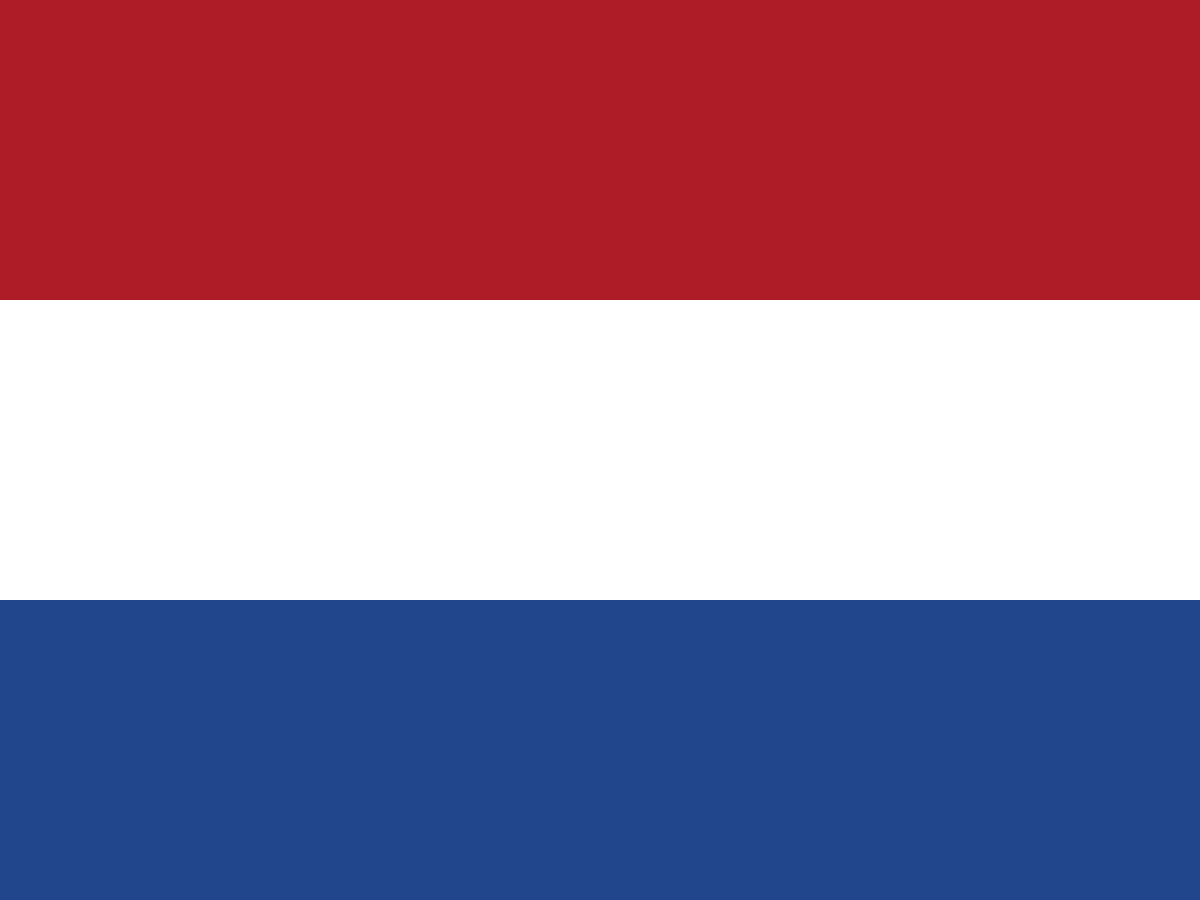
The flag of the Netherlands
The Dutch national flag consists of three equal horizontal bands of red, white and blue.
It is one of the world's oldest tricolour national flags.
The original seventeenth-century flag used orange instead of red, but red gradually became standard. The colours became closely associated with the Dutch state and the House of Orange-Nassau.
The modern red-white-blue design was formally recognised in the twentieth century, although it had been widely used for centuries.
The red band
The red band developed from the original orange colour used in the early Dutch flag.
Orange was closely connected with William of Orange and the House of Orange-Nassau. Over time, red became the standard colour in the national flag, partly because it was more visible and more stable as a dye.
The white band
The white band forms the centre of the Dutch tricolour.
The colours of the flag originated as a combination associated with the Dutch Revolt and the Prince's Flag, although modern official symbolism does not assign a simple separate meaning to each colour.
The blue band
The blue band forms the lower stripe and comes from the historic Prince's Flag tradition.
The Dutch tricolour became an influential model for later flags around Europe and beyond.
Orange and the House of Orange
Orange remains an important national colour in the Netherlands even though the national flag uses red.
Orange is associated with the House of Orange-Nassau and appears prominently during King's Day, sporting events and national celebrations.
A short history of the Netherlands
The history of the Netherlands is closely connected to trade, maritime power, religious conflict, urbanisation and the struggle to control water.
The Dutch Revolt against Spain led to the Dutch Republic, whose seventeenth-century Golden Age produced major achievements in commerce, science, art and global trade.
History timeline
Roman period — Rhine frontierThe Rhine formed part of the northern frontier of the Roman Empire, with Roman settlements and forts in the region.
Early Middle AgesFrisian, Frankish and Saxon communities shaped the political and cultural landscape of the Low Countries.
10th–14th centuries — Medieval counties and townsHolland, Zeeland, Utrecht and other territories developed powerful local institutions and increasingly wealthy towns.
15th century — Burgundian NetherlandsThe Burgundian dukes brought many of the Low Countries under a stronger political framework.
16th century — Habsburg ruleThe Netherlands came under Habsburg rule and were eventually inherited by Philip II of Spain.
1568 — Dutch Revolt beginsRebellion against Spanish rule began, driven by political, economic and religious grievances.
1579 — Union of UtrechtSeveral northern provinces formed the Union of Utrecht, an important step towards political unity.
1581 — Act of AbjurationThe rebellious provinces formally rejected Philip II as their ruler.
1588 — Dutch RepublicThe United Provinces developed into the Dutch Republic, a powerful commercial and maritime state.
1602 — Dutch East India CompanyThe VOC was established and became one of the world's most powerful trading companies.
17th century — Dutch Golden AgeTrade, shipping, finance, science and art flourished. Amsterdam became one of Europe's leading commercial centres.
1648 — Peace of MünsterSpain formally recognised the independence of the Dutch Republic as part of the Peace of Westphalia.
1795 — French occupationFrench revolutionary forces entered the Netherlands and the Batavian Republic was established.
1815 — Kingdom of the NetherlandsThe modern Kingdom of the Netherlands was established after the Napoleonic Wars, initially including present-day Belgium.
1830 — Belgian independenceThe southern provinces revolted and Belgium became an independent country.
19th century — IndustrialisationRailways, ports, manufacturing and urban growth transformed Dutch society and the economy.
1919 — Women's suffrageWomen gained full voting rights after a long campaign for political equality.
1940–1945 — German occupationNazi Germany occupied the Netherlands during the Second World War. The occupation included persecution and deportation of Dutch Jews.
1944–1945 — LiberationAllied forces gradually liberated the Netherlands, with the south freed earlier and the north liberated in 1945.
1945 onward — ReconstructionThe Netherlands rebuilt its economy and developed an increasingly prosperous welfare state.
1952 — European integrationThe Netherlands became a founding member of the European Coal and Steel Community and played a major role in European integration.
1953 — North Sea floodA catastrophic storm surge killed more than 1,800 people and led to a huge expansion of Dutch flood-defence infrastructure.
1958 onward — Delta WorksThe Netherlands began constructing the Delta Works, one of the world's largest water-management projects.
1980s–1990s — ModernisationThe Dutch economy continued to modernise, with major growth in services, logistics, finance and technology.
2002 — Euro introducedThe euro replaced the Dutch guilder as physical currency.
TodayThe Netherlands is a highly developed constitutional monarchy and a major European trading and logistics hub.
The Dutch Revolt
The Dutch Revolt began in the sixteenth century against the rule of Philip II of Spain.
Religious conflict, taxation, political freedoms and opposition to centralised rule all contributed. The revolt eventually produced the independent Dutch Republic.
The Dutch Republic
The Dutch Republic existed from the late sixteenth century until the end of the eighteenth century.
It was a decentralised state of provinces that became one of Europe's richest and most powerful commercial and naval powers.
The Dutch Golden Age
The seventeenth century is often called the Dutch Golden Age. Dutch merchants built global trading networks while artists such as Rembrandt and Vermeer produced internationally famous works.
Amsterdam developed into a major centre of banking, shipping, publishing and trade.
The Dutch East India Company
The Dutch East India Company (VOC) was founded in 1602 and became one of the world's earliest major multinational corporations.
It controlled trading posts and territories across Asia and played a central role in the Dutch Republic's global commercial power.
The Dutch colonial empire
The Netherlands established colonies and trading possessions in Asia, Africa, the Caribbean and the Americas.
Dutch colonial history included major commercial achievements but also systems of coercion, slavery, forced labour and exploitation. Indonesia was the most important Dutch colony in Asia.
The abolition of slavery
The Netherlands formally abolished slavery in most of its colonies in 1863, although formerly enslaved people in Suriname were subject to a period of state-imposed labour afterwards.
The history of slavery and colonialism remains an important part of modern Dutch historical debate.
World War II and occupation
Germany invaded the Netherlands in May 1940. The country remained under Nazi occupation until 1945.
The occupation brought repression, resistance, food shortages and the persecution and murder of a large proportion of the Dutch Jewish population.
Anne Frank
Anne Frank was a Jewish teenager who hid with her family and others in Amsterdam during the Nazi occupation. Her diary later became one of the world's best-known accounts of life during the Holocaust.
The Anne Frank House in Amsterdam preserves the hiding place where the family lived.
The North Sea flood of 1953
The North Sea flood of 1953 was one of the worst natural disasters in modern Dutch history. Storm-driven seawater breached coastal defences and killed more than 1,800 people.
The disaster led directly to the Delta Works and a much stronger national focus on flood protection.
The Delta Works
The Delta Works are a huge system of dams, barriers, dikes, sluices and storm-surge barriers designed to protect the southwestern Netherlands.
They are considered one of the greatest engineering projects of the twentieth century and have become a symbol of Dutch water management.
Living below sea level
A significant part of the Netherlands lies at or below sea level. The country has reclaimed land from lakes, rivers and the sea using dikes, pumps and drainage systems.
This constant relationship with water has shaped Dutch engineering, settlement patterns and national identity.
Polders
A polder is land that has been reclaimed from water and kept dry by a system of dikes and drainage.
Flevoland is one of the world's largest areas of land created by large-scale reclamation and forms a modern Dutch province.
Amsterdam
Amsterdam is the constitutional capital and the Netherlands' largest city. It grew into a major commercial centre during the Dutch Golden Age.
The city's historic canal ring, narrow houses, museums and cultural institutions make it one of Europe's best-known cities.
The Hague
The Hague is the seat of the Dutch government, parliament, Supreme Court and many international organisations.
It is also home to institutions including the International Court of Justice and the International Criminal Court.
Rotterdam
Rotterdam has one of Europe's largest ports and is a major centre for shipping, logistics and industry.
The city was heavily bombed during the Second World War and was subsequently rebuilt with a strikingly modern architectural character.
The Dutch landscape
The Netherlands is famous for flat landscapes, canals, dikes, polders, rivers and reclaimed land.
Despite its small size, the country contains densely populated urban areas, productive farmland, wetlands, dunes and extensive waterways.
Tulips and flowers
The Netherlands is internationally associated with tulips and flower cultivation. The country's horticultural industry is a major global exporter.
Keukenhof and the bulb-growing region around Lisse attract large numbers of visitors each spring.
Windmills
Traditional Dutch windmills were used for pumping water, grinding grain and other industrial tasks.
Modern wind turbines now form part of the country's renewable-energy infrastructure, creating a striking link between old and new Dutch technology.
Cycling culture
Cycling is a major part of everyday life in the Netherlands. The country has an extensive network of cycle paths and cycling infrastructure.
Flat terrain, compact cities and deliberate transport planning have helped make bicycles one of the country's most practical forms of transport.
Dutch climate
The Netherlands has a temperate oceanic climate with relatively mild winters, cool summers and rainfall spread through the year.
The North Sea strongly influences temperatures and weather patterns, while storms and heavy rainfall can create flood-management challenges.
Dutch wildlife and nature
The Netherlands contains wetlands, dunes, forests, heathlands and marine habitats supporting seals, waterbirds, deer and many other species.
Large areas of land are intensively farmed, so nature reserves and wetland restoration are particularly important for biodiversity.
Dutch culture
Dutch culture is strongly associated with painting, design, architecture, literature, trade and liberal civic traditions.
Major cultural figures include Rembrandt, Vermeer, Van Gogh and Mondrian.
The Dutch language
Dutch is the principal language of the Netherlands. Frisian also has official status in the province of Friesland.
English is widely spoken, particularly in education, tourism and business.
Dutch food
Dutch food includes stroopwafels, herring, cheese, poffertjes, bitterballen and stamppot.
The country's colonial and trading history has also influenced modern Dutch cuisine, particularly through Indonesian-Surinamese food traditions.
Dutch cheese
The Netherlands is famous for cheeses such as Gouda, Edam and Maasdam.
Cheese production and trade have been important parts of Dutch agriculture and commerce for centuries.
The Netherlands and Europe
The Netherlands has played an important role in European integration and is a founding member of the European Union's predecessor organisations.
It is also a member of NATO, the euro area and the Schengen Area.
The Dutch economy
The Netherlands has a highly developed economy based on services, trade, manufacturing, agriculture, logistics, finance and technology.
The Port of Rotterdam, Schiphol Airport, high-value horticulture and international financial and business services are especially important.
The Port of Rotterdam
The Port of Rotterdam is one of Europe's most important ports and a major gateway for goods entering and leaving the continent.
Its location on the North Sea and its connections to inland waterways, railways and roads make it a key European logistics hub.
Schiphol Airport
Amsterdam Airport Schiphol is one of Europe's major international airports.
Its location and extensive connections help support the Netherlands' role as a global centre for business, tourism and logistics.
The Netherlands today
The modern Netherlands is a prosperous, highly urbanised constitutional monarchy with a strong international role in trade, diplomacy, water engineering and European politics.
Its major challenges include housing pressure, climate adaptation, nitrogen pollution, energy transition and maintaining a safe relationship with rising sea levels.
Why is the Netherlands flag interesting?
The Dutch flag is historically important because it is one of the oldest tricolour flags still in use and helped influence later national flags.
The change from orange to red is particularly interesting because orange remains one of the country's most recognisable national colours even though it is absent from the national flag.
Explore the Netherlands on FlagAtlas
Continue exploring the Netherlands and the world's flags with these FlagAtlas resources.