About Nigeria
Nigeria is Africa's most populous country and one of its most culturally and economically important states. It lies on the Gulf of Guinea and stretches from the tropical coast through savanna and woodland into the drier Sahel.
Nigeria contains hundreds of ethnic groups and languages and has major cities including Lagos, Abuja, Kano and Ibadan. Its economy is based on services, manufacturing, agriculture and energy, particularly oil and gas.
CapitalAbuja
Largest cityLagos
PopulationAbout 218 million
CurrencyNaira
Official languageEnglish
RegionWest Africa
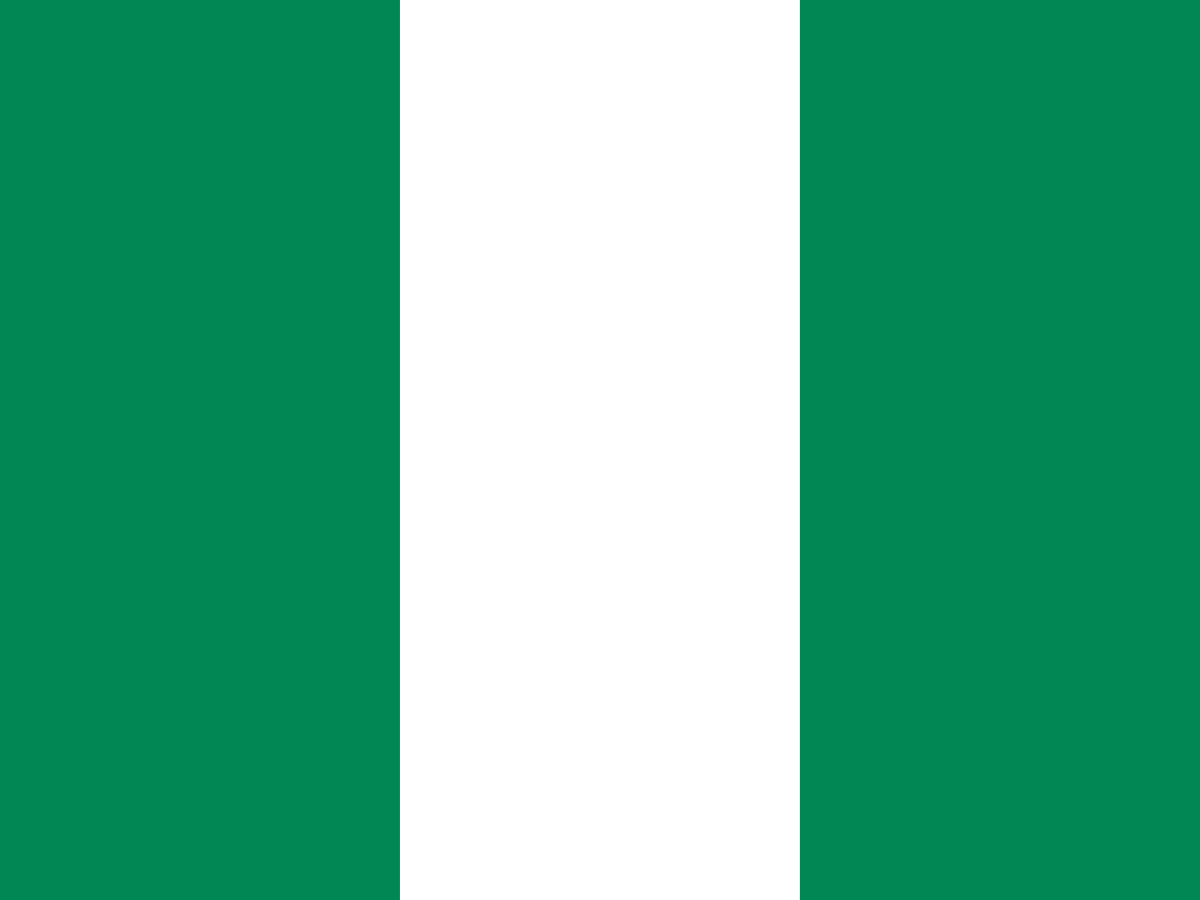
The flag of Nigeria
Nigeria's national flag has three vertical bands of green, white and green.
The design was selected in a national competition in 1959.
Green is commonly associated with Nigeria's agricultural wealth and vegetation, while white represents peace and unity.
The flag was first officially used on 1 October 1960, the day Nigeria became independent from Britain. The original competition-winning design also included a red quartered sun, but this was removed before independence.
The green bands
The two green bands represent Nigeria's vegetation and agricultural wealth.
Green is especially appropriate for a country with extensive farmland, forests and tropical vegetation, although Nigeria's landscapes vary considerably from south to north.
The white band
The central white band represents peace and unity.
Its position between the two green panels gives the flag a simple, balanced appearance and makes the design highly recognisable.
Michael Taiwo Akinkunmi
The Nigerian flag was designed by Michael Taiwo Akinkunmi, a Nigerian student studying in London who entered the 1959 national flag competition.
His design was selected from hundreds of entries. The original proposal contained a red sunburst, but the central symbol was removed, leaving the green-white-green design used today.
A short history of Nigeria
Nigeria's history includes powerful West African kingdoms and trading states, the growth of Islam and Christianity, European trade, British colonial rule, independence, military coups, the Biafran War and the development of modern democratic government.
The modern country brought together many distinct societies whose histories stretch back centuries.
History timeline
Ancient times — Early West African societiesArchaeological evidence shows long-established farming, metalworking and trading communities across the territory that is now Nigeria.
c. 500 BCE–200 CE — Nok cultureThe Nok culture became famous for sophisticated terracotta sculptures and early ironworking traditions in central Nigeria.
Medieval period — Hausa city-statesPowerful Hausa trading cities developed in northern Nigeria, connecting the region with trans-Saharan commerce.
11th–15th centuries — Kanem-Bornu influenceThe Kanem-Bornu state became a major political and Islamic power around Lake Chad and influenced northeastern Nigeria.
12th–19th centuries — Yoruba kingdomsYoruba states including Ife and Oyo developed sophisticated political, artistic and trading traditions in southwestern Nigeria.
15th–19th centuries — Benin KingdomThe Kingdom of Benin became famous for its court, trade networks and extraordinary bronze and brass artworks.
15th century onward — European coastal tradePortuguese and later other European traders established commercial links with coastal West Africa.
17th–19th centuries — Atlantic slave tradeCoastal and inland trading networks became involved in the Atlantic slave trade, which had profound demographic and political consequences.
19th century — Sokoto CaliphateThe Sokoto Caliphate became one of the largest states in nineteenth-century West Africa following the jihad led by Usman dan Fodio.
1861 — Lagos annexedBritain formally annexed Lagos, beginning a new phase of direct British political control.
1880s–1900s — British expansionBritain expanded its control across southern and northern territories, meeting resistance from numerous local states and communities.
1914 — Colony and Protectorate of NigeriaBritain amalgamated the Northern and Southern Protectorates into the Colony and Protectorate of Nigeria.
1940s–1950s — Nationalist movementNigerian political parties and nationalist leaders increasingly demanded self-government and independence.
1954 — Federal systemNigeria adopted a federal constitutional structure with regional governments.
1960 — IndependenceNigeria became independent from Britain on 1 October 1960.
1963 — RepublicNigeria became a republic, replacing the British monarch with a Nigerian head of state.
1966 — Military coupsPolitical instability led to military coups and the beginning of a long period in which the armed forces played a major role in government.
1967–1970 — Nigerian Civil WarThe secession of Biafra led to a devastating civil war. Millions died, many from starvation and disease, before Biafra surrendered in 1970.
1970s — Oil boomRapid growth in petroleum production transformed Nigeria's economy and increased government revenues.
1976 — Abuja selected as capital siteThe federal government chose Abuja as the site for a new capital in the centre of the country.
1991 — Abuja becomes capitalAbuja officially replaced Lagos as Nigeria's capital.
1993–1998 — Military rulePolitical crises followed the annulment of the 1993 presidential election and the subsequent years of military government.
1998 — Abacha diesThe death of General Sani Abacha opened the way for a transition back to civilian government.
1999 — Democracy restoredOlusegun Obasanjo became president after elections, beginning the current continuous period of civilian democratic government.
2000s — Economic growthOil revenues supported rapid economic growth while Nigeria also expanded telecommunications, banking, entertainment and services.
2010s — Boko Haram insurgencyViolence by Boko Haram and associated groups caused major loss of life and displacement, particularly in northeastern Nigeria.
2015 — Peaceful change of governing partyMuhammadu Buhari defeated incumbent Goodluck Jonathan, marking the first democratic transfer of power between major political parties in Nigeria's history.
2023 — Bola Tinubu electedBola Ahmed Tinubu won the presidential election and became president later that year.
TodayNigeria is a federal democratic republic and one of Africa's most influential political, cultural and economic powers.
The Nok culture
The Nok culture flourished in central Nigeria more than two thousand years ago and is famous for terracotta human and animal figures.
Nok communities also had knowledge of ironworking, making them an important part of West African archaeological history.
The Kingdom of Benin
The historic Kingdom of Benin was centred in present-day southern Nigeria. It became renowned for its court culture, political organisation and remarkable bronze and brass artworks.
British forces invaded Benin City in 1897 and many artworks were taken as war loot. The Benin Bronzes are now at the centre of major international debates over restitution and museum collections.
The Yoruba kingdoms
The Yoruba peoples developed major states and cities including Ife and Oyo.
Ife became especially famous for naturalistic sculpture and artistic traditions, while the Oyo Empire became a major political and military power in the region.
The Sokoto Caliphate
The Sokoto Caliphate was established following the early nineteenth-century jihad led by Usman dan Fodio.
It became a major Islamic state spanning large parts of northern Nigeria and neighbouring territories and remained influential until British conquest.
British colonial rule
Britain gradually established control over Nigerian territory during the late nineteenth and early twentieth centuries. In 1914, the Northern and Southern territories were amalgamated.
Colonial rule introduced new administrative structures and infrastructure but also imposed foreign political authority and transformed existing economic systems.
Independence in 1960
Nigeria became independent on 1 October 1960. The new country adopted a federal political structure intended to accommodate its regional and cultural diversity.
Independence did not end political tensions, however, and Nigeria experienced coups and military government only a few years later.
The Biafran War
The Nigerian Civil War lasted from 1967 to 1970 after the eastern region declared itself the independent state of Biafra.
The conflict caused enormous human suffering, with large numbers of civilians dying from hunger and disease. Biafra surrendered in January 1970.
Nigeria's oil industry
Petroleum became central to Nigeria's economy during the second half of the twentieth century. Large oil reserves are concentrated in the Niger Delta.
Oil has generated substantial export earnings but has also contributed to environmental damage, pollution, political conflict and debates over how resource wealth should be shared.
The Niger Delta
The Niger Delta is a vast network of rivers, wetlands, mangroves and communities in southern Nigeria.
It is one of the world's major petroleum-producing regions and also an environmentally sensitive ecosystem.
Abuja
Abuja became Nigeria's capital in 1991. It was planned as a centrally located federal capital partly to reduce the regional imbalance associated with Lagos.
The city is known for wide avenues, modern government buildings and the distinctive Aso Rock landmark.
Lagos
Lagos is Nigeria's largest city and a major financial, commercial and cultural centre.
It grew from a coastal settlement into one of Africa's largest metropolitan areas and remains a major hub for business, music, film and technology.
The Niger and Benue rivers
The Niger and Benue rivers are Nigeria's two great river systems. They meet at Lokoja before the Niger continues south towards the Niger Delta.
The rivers support agriculture, fishing, transport, wetlands and major ecosystems.
Nigeria's climate
Nigeria has a varied climate ranging from humid tropical conditions in the south to drier savanna and Sahel conditions in the north.
The wet and dry seasons become more pronounced farther north, while the southern coast receives heavy rainfall and supports tropical vegetation.
Wildlife and national parks
Nigeria has diverse wildlife including forest elephants, chimpanzees, gorillas, antelope, hippos and many bird species.
Protected areas such as Yankari National Park are important for conservation, although habitat loss and hunting remain significant challenges.
Nigerian culture
Nigeria has extraordinary cultural diversity, with hundreds of ethnic groups and languages. Major cultural traditions include Hausa, Yoruba, Igbo, Fulani, Kanuri, Ijaw and many others.
Music, literature, fashion, religion, food and festivals vary widely across the country.
Nigerian languages
Nigeria is one of the world's most linguistically diverse countries. English is the official language, while Hausa, Yoruba, Igbo, Fulfulde, Kanuri, Ijaw and hundreds of other languages are spoken.
Pidgin English is also widely used in informal communication and popular culture.
Nigerian food
Nigerian cuisine includes jollof rice, pounded yam, egusi soup, suya, moi moi, akara and many regional dishes.
Food traditions differ substantially between the north, south, east and west, reflecting Nigeria's enormous cultural diversity.
Afrobeats
Nigeria is one of the world's leading centres of contemporary African music. Afrobeats has developed into a global genre influenced by West African highlife, fuji, hip-hop, R&B and other styles.
Nigerian artists have helped make the country's music industry a major international cultural export.
Nollywood
Nollywood is the informal name for Nigeria's enormous film industry.
Nigerian films are produced in large numbers and are watched throughout Africa and by audiences around the world. The industry is an important part of Nigeria's creative economy.
Football
Football is Nigeria's most popular sport. The men's national team is known as the Super Eagles, while the women's national team, the Super Falcons, has been highly successful in African football.
Nigeria has also produced internationally recognised players who have played for major European clubs.
Nigeria's economy
Nigeria has one of Africa's largest economies, with important sectors including services, oil and gas, manufacturing, agriculture, telecommunications and finance.
The country has a huge domestic market and a rapidly growing technology and startup sector.
Agriculture
Agriculture remains important to Nigerian employment and food production. Major crops include cassava, yams, rice, maize, cocoa, oil palm and groundnuts.
The country's varied climate allows a wide range of crops to be grown.
Technology and fintech
Nigeria has become a major African centre for technology, fintech and startups.
Lagos in particular has developed a strong technology ecosystem, while digital payments and mobile services have expanded rapidly.
Nigeria today
Modern Nigeria is a young, diverse and influential country facing major opportunities alongside serious challenges.
Population growth, infrastructure, electricity supply, security, inequality, environmental pressures and economic diversification remain important issues, while Nigeria's huge population and creative industries give it considerable regional and global influence.
Why is Nigeria's flag interesting?
Nigeria's flag is striking because its simple green-white-green design represents a country of enormous geographical and cultural diversity.
It also has a fascinating story: the design came from a 1959 competition won by Michael Taiwo Akinkunmi and was adopted for independence in 1960.
Explore Nigeria on FlagAtlas
Continue exploring Nigeria and the world's flags with these FlagAtlas resources.