About North Korea
North Korea, officially the Democratic People's Republic of Korea (DPRK), occupies the northern part of the Korean Peninsula in East Asia.
Its modern history has been shaped by Japanese colonial rule, the division of Korea after the Second World War, the Korean War, the Cold War and the development of a highly centralised political system. Pyongyang is the capital and largest city.
Official nameDPRK
CapitalPyongyang
PopulationAbout 25.7 million
CurrencyNorth Korean won
LanguageKorean
RegionEast Asia
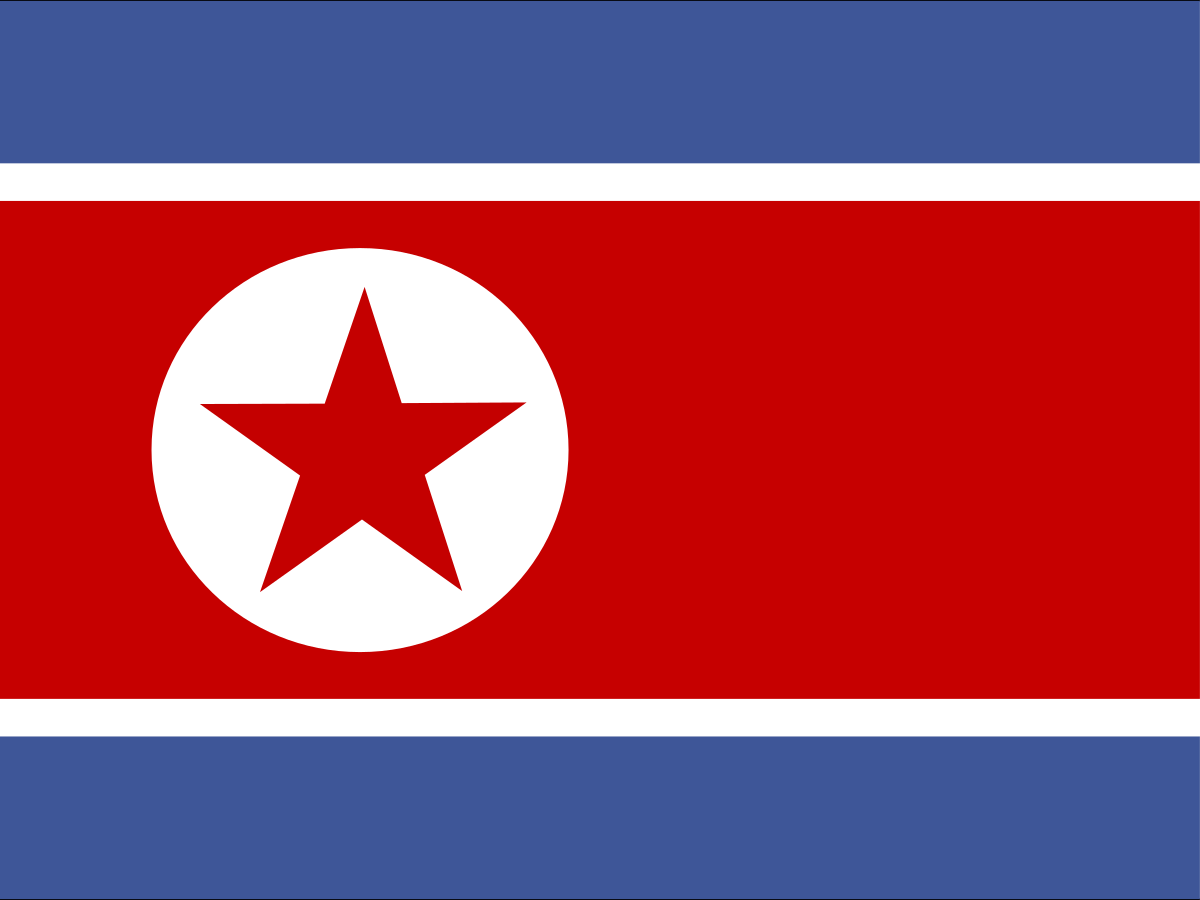
The flag of North Korea
The North Korean flag consists of a broad red central band, narrow white stripes and wider blue bands at the top and bottom. A red five-pointed star sits inside a white circle near the hoist.
The flag was adopted in 1948, replacing symbols associated with the older Korean monarchy and the period of Japanese rule.
The colours and star are closely connected with the country's revolutionary and political symbolism.
The red band
The broad red band is associated with revolutionary spirit and the struggle for national independence.
Red is the dominant colour of the flag and gives the design a strong visual connection with revolutionary symbolism.
The white stripes
The narrow white stripes are commonly associated with purity and the unity of the Korean people.
White also has a long cultural association with Korea, historically giving rise to descriptions such as the 'white-clad people'.
The blue bands
The blue bands are associated with sovereignty, peace and friendship with other peoples.
They also create a strong contrast with the central red field.
The red star
The red five-pointed star is a major revolutionary symbol and is associated with communism and the country's political ideology.
It sits inside a white circle close to the hoist rather than in the centre of the flag.
A short history of Korea
Korea has a long history of kingdoms, dynasties, cultural development and interaction with neighbouring China and Japan. The peninsula was ruled by the Joseon dynasty for more than five centuries before Japanese annexation in 1910.
After Japan's defeat in 1945, Korea was divided into Soviet and American occupation zones. Two separate Korean states were established in 1948, creating the division that continues today.
History timeline
57 BCE–668 CE — Three KingdomsGoguryeo, Baekje and Silla became the three major Korean kingdoms.
668 — Silla unificationSilla brought much of the Korean Peninsula under its control.
918 — Goryeo foundedWang Geon founded the Goryeo dynasty, from whose name the modern word 'Korea' derives.
1392 — Joseon dynastyYi Seong-gye founded Joseon, beginning a dynasty that ruled Korea for more than 500 years.
1443–1446 — HangulKing Sejong's scholars developed and promulgated the Korean alphabet.
1592–1598 — Japanese invasionsJapan invaded Korea; Korean resistance included Admiral Yi Sun-sin and his naval forces.
1897 — Korean EmpireKing Gojong proclaimed the Korean Empire in an attempt to assert Korean sovereignty.
1910 — Japanese annexationJapan formally annexed Korea, beginning 35 years of colonial rule.
1919 — March First MovementLarge demonstrations called for Korean independence and became a major symbol of the independence struggle.
1945 — Liberation from JapanJapan surrendered at the end of the Second World War. Korea was then divided into Soviet and American occupation zones.
1948 — Two Korean statesThe Republic of Korea was established in the south and the DPRK in the north.
1948 — DPRK foundedKim Il-sung became the first leader of the newly established North Korean state.
1950 — Korean War beginsNorth Korean forces crossed the 38th parallel and invaded South Korea.
1950–1953 — Korean WarThe conflict involved North Korea, South Korea, China, the United States and other UN forces, causing enormous loss of life.
1953 — ArmisticeFighting ended with an armistice rather than a peace treaty.
1950s–1970s — ReconstructionNorth Korea rebuilt its cities and industries while political power became increasingly concentrated around Kim Il-sung.
1972 — New constitutionA new constitution strengthened the political system centred on Kim Il-sung.
1994 — Kim Il-sung diesKim Il-sung died and was succeeded by his son Kim Jong-il.
1990s — Economic crisis and famineSevere economic difficulties, floods and disruption of foreign support contributed to a devastating famine.
2000s — Nuclear programmeNorth Korea's nuclear programme became a major international security issue.
2011 — Kim Jong-il diesKim Jong-un became the country's leader.
2017 — Heightened nuclear tensionsFurther nuclear and missile tests produced severe international tensions.
2018 — Diplomatic summitsKim Jong-un met South Korean President Moon Jae-in and US President Donald Trump.
2020 — Border restrictionsNorth Korea introduced exceptionally strict border controls during the COVID-19 pandemic.
2022–2024 — Missile testingNorth Korea continued developing and testing ballistic missile systems.
TodayNorth Korea remains a highly centralised state with a large military and nuclear weapons programme.
The division of Korea
The division of Korea followed Japan's defeat in 1945. The peninsula was divided roughly along the 38th parallel, with Soviet forces occupying the north and US forces occupying the south.
The temporary division became permanent when separate governments were established in 1948.
The founding of North Korea
The DPRK was established in 1948, with Kim Il-sung becoming its first leader.
The new government was closely aligned with the Soviet Union and developed a socialist political and economic system.
Kim Il-sung
Kim Il-sung led North Korea from its founding in 1948 until his death in 1994.
He developed a highly personalised political system and became the central figure in the country's official historical narrative and ideology.
The Korean War
The Korean War began in June 1950 when North Korean forces invaded South Korea. United Nations forces led by the United States intervened on the South Korean side, while China entered the war in support of North Korea.
Fighting ended with an armistice in 1953. No comprehensive peace treaty followed.
The Korean Demilitarized Zone
The Demilitarized Zone (DMZ) runs across the Korean Peninsula near the military line established by the 1953 armistice.
Despite its name, the surrounding area is one of the most heavily militarised borders in the world. The zone itself has also become an important refuge for wildlife.
Juche
Juche is the political ideology developed under Kim Il-sung and officially associated with national independence, self-reliance and sovereignty.
In practice, the North Korean political system combines Juche ideas with highly centralised leadership and a powerful state apparatus.
Kim Jong-il
Kim Jong-il succeeded Kim Il-sung in 1994 and led North Korea until his death in 2011.
His rule coincided with severe economic difficulties and famine as well as the expansion of North Korea's nuclear and missile programmes.
Kim Jong-un
Kim Jong-un became leader in 2011 following the death of his father, Kim Jong-il.
His government has continued the country's nuclear and missile programmes while also pursuing periods of diplomacy with South Korea and the United States.
North Korea's nuclear programme
North Korea has developed a nuclear weapons programme and ballistic missile technology. It conducted its first announced nuclear test in 2006.
The programme is a major source of international tension and has resulted in extensive United Nations and national sanctions.
Pyongyang
Pyongyang is North Korea's capital and largest city. It contains many of the country's most prominent government buildings, monuments and museums.
The city was extensively rebuilt after the Korean War and is known for broad avenues, monumental architecture and large public spaces.
Mount Paektu
Mount Paektu is a volcanic mountain on the North Korea–China border and is one of the country's most important natural and symbolic landmarks.
Its crater lake, known as Heaven Lake, is surrounded by dramatic volcanic scenery.
North Korea's climate
North Korea has a largely temperate continental climate, with cold winters and warm summers.
Rainfall is concentrated during the summer months, while winter can bring very cold conditions, especially in the north and mountainous areas.
North Korean culture
Korean cultural traditions remain important in North Korea, including music, dance, literature, calligraphy, cuisine and traditional festivals.
Modern cultural production is also strongly shaped by the state's political ideology and official themes.
The Korean language
North and South Korea share the Korean language, although vocabulary, spelling conventions and pronunciation have developed differently over decades of separation.
North Korea generally refers to its standard language as Munhwaŏ, while South Korea uses a different standard based on Seoul speech.
North Korean food
Traditional Korean foods such as kimchi, rice, noodles, dumplings and fermented foods are eaten in North Korea.
Pyongyang has its own culinary traditions, including cold buckwheat noodles known as naengmyeon.
The North Korean economy
North Korea has a largely state-controlled economy, although markets and informal economic activity have become more important over time.
Important sectors include mining, manufacturing, agriculture, energy and military-related industries. International sanctions significantly constrain foreign trade.
Agriculture and food security
North Korea has limited arable land because of its mountainous terrain and harsh climate. Agriculture includes rice, maize, wheat, potatoes and vegetables.
Food security has been a recurring challenge, particularly during periods of drought, flooding, economic disruption and limited access to imported inputs.
International sanctions
North Korea is subject to extensive United Nations sanctions because of its nuclear weapons and ballistic missile programmes.
The sanctions restrict areas of trade, finance, investment and access to certain technologies, while humanitarian assistance is treated separately under international rules.
Relations with South Korea
Relations between North and South Korea have alternated between periods of tension and diplomacy.
The two sides remain separated by the DMZ and have periodically held summits, family reunions and military negotiations, but a lasting peace agreement has not been reached.
North Korea and China
China is North Korea's most important economic partner and a major source of trade and support.
The two countries share a border along the Yalu and Tumen rivers. Their relationship is close but not without periods of disagreement.
Life in North Korea
Everyday life varies considerably by location, occupation and access to resources. Most people live within a system where the state has a major role in employment, education, media and access to information.
Independent reporting from inside the country is extremely limited, so detailed information about ordinary life can be difficult to verify.
Media and the internet
North Korea has a highly restricted media environment. Most domestic television, radio and newspapers are state controlled, and ordinary internet access is extremely limited.
A separate internal network provides some domestic online services, while access to the global internet is heavily restricted.
North Korea today
North Korea remains one of the world's most isolated and tightly controlled states. Its government continues to prioritise political stability, military capability and its nuclear deterrent.
The country also faces economic pressures, sanctions, food-security concerns and diplomatic tensions, while maintaining complex relationships with China, Russia, South Korea and the United States.
Why is North Korea's flag interesting?
North Korea's flag is distinctive because it combines a large red revolutionary field with traditional Korean associations of white and the blue of peace and sovereignty.
The red star makes its political symbolism particularly clear, while the flag's adoption in 1948 marks the creation of the modern DPRK.
Explore North Korea on FlagAtlas
Continue exploring North Korea and the world's flags with these FlagAtlas resources.