About North Macedonia
North Macedonia is a small landlocked country in southeastern Europe, in the central Balkans. It borders Albania, Kosovo, Serbia, Bulgaria and Greece.
The country is known for mountain landscapes, Lake Ohrid, Orthodox Christian heritage, Ottoman-era architecture and the capital Skopje. It became independent from Yugoslavia in 1991.
CapitalSkopje
ContinentEurope
PopulationAbout 2.1 million
CurrencyMacedonian denar
Official languageMacedonian
RegionBalkans
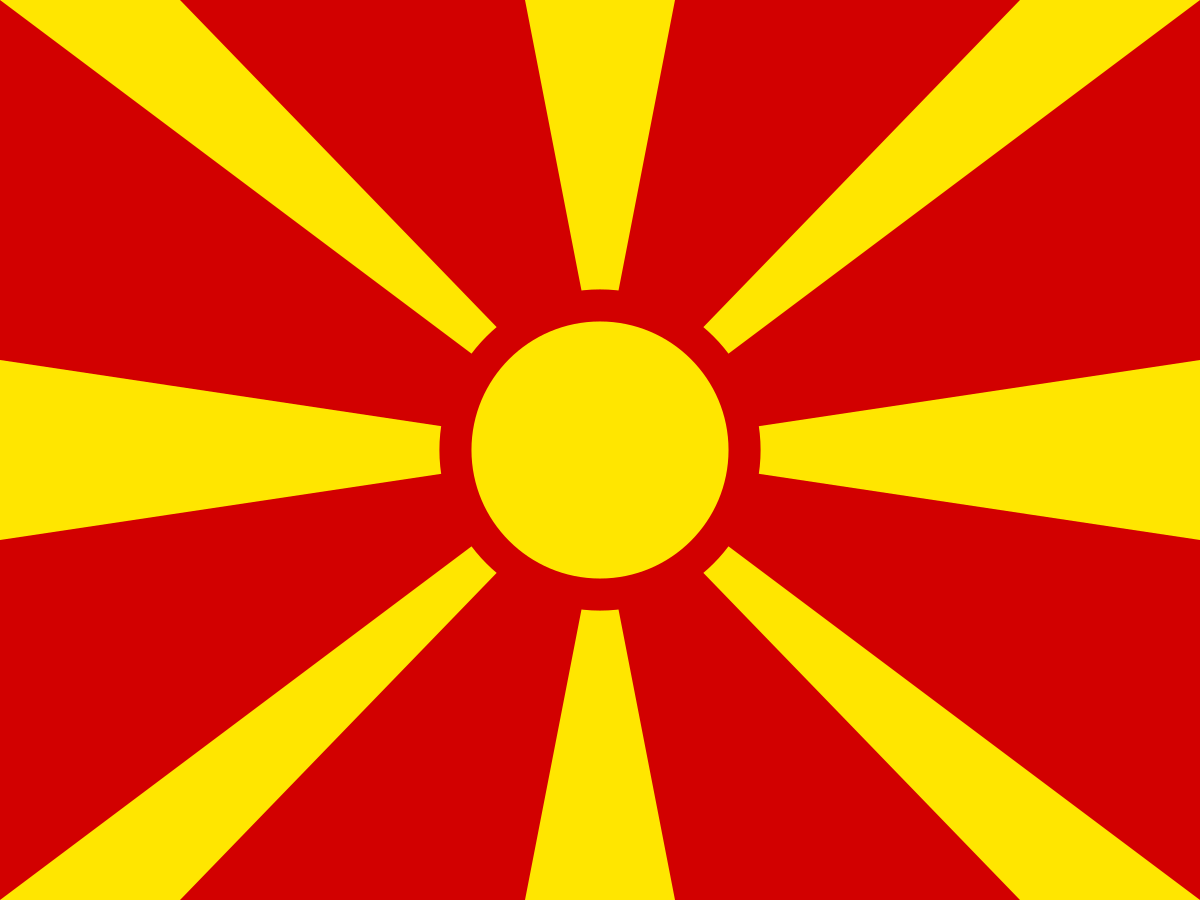
The flag of North Macedonia
The flag has a red field with a large yellow sun in the centre. Eight broad yellow rays extend from the sun towards the edges of the flag.
The eight rays are associated with the 'new sun of liberty', a phrase connected with Macedonian revolutionary and national traditions.
The modern flag was adopted in 1995, replacing the earlier 1992–1995 design that featured the Vergina Sun.
The red field
The red background is a traditional colour of Macedonian national symbolism and is strongly associated with the country's modern flag.
It provides a bold contrast with the yellow sun and rays.
The yellow sun
The central yellow sun is the most recognisable feature of the flag. Its rays spread outward across the red field.
The design represents a new beginning and liberty and is linked to the imagery of the 'new sun of liberty'.
The eight rays
The flag's eight rays extend from the central sun towards the edges of the flag.
The rays make the design visually distinctive and are often described as representing the new sun of liberty.
The Vergina Sun and the flag dispute
North Macedonia's first post-independence flag used the Vergina Sun, an ancient symbol discovered at a royal tomb site near Vergina in northern Greece.
Greece strongly objected to its use, and the symbol became part of a wider dispute over history, identity and the name 'Macedonia'. North Macedonia adopted the present flag in 1995 as part of efforts to ease the dispute.
A short history of the region
The territory of modern North Macedonia has been influenced by ancient Macedonian, Roman, Byzantine, Slavic, Bulgarian, Serbian and Ottoman states and cultures.
The modern Macedonian national movement developed particularly strongly in the nineteenth and early twentieth centuries before the region became part of Yugoslavia.
History timeline
Ancient period — Paeonians and MacedoniansThe region was inhabited by several ancient peoples and later became closely connected with the ancient Kingdom of Macedon.
4th century BCE — Alexander the GreatAlexander III of Macedon built one of the ancient world's largest empires, although the historical relationship between ancient Macedonian identity and modern national identities remains complex.
168 BCE — Roman conquestRome defeated the Macedonian kingdom and incorporated the region into the Roman world.
4th–6th centuries — Byzantine periodThe region became part of the Eastern Roman/Byzantine world and Christianity became deeply established.
6th–7th centuries — Slavic settlementSlavic-speaking groups settled extensively across the Balkans, influencing the region's later languages and cultures.
9th century — Cyril and Methodius traditionThe Christianisation and literary traditions associated with Saints Cyril and Methodius and their followers had a major influence across the Slavic world.
10th–11th centuries — Medieval Bulgarian and Byzantine ruleThe region changed hands between major medieval Balkan powers, including the Bulgarian Empire and Byzantium.
14th century — Serbian EmpireMuch of the region came under the expanding Serbian Empire before Ottoman conquest.
Late 14th century — Ottoman conquestOttoman forces incorporated the region into the Ottoman Empire, beginning centuries of Ottoman rule.
19th century — National movementsModern national movements developed across the Balkans, including competing Bulgarian, Greek, Serbian, Albanian and Macedonian identities.
1893 — IMRO foundedThe Internal Macedonian Revolutionary Organization was established and became an important force in the struggle over Macedonia.
1903 — Ilinden UprisingThe Ilinden uprising challenged Ottoman rule and became a major symbol in Macedonian historical memory.
1912–1913 — Balkan WarsThe Ottoman Empire lost most of its remaining European territory. Macedonia was divided among neighbouring states.
1918 — Kingdom of Serbs, Croats and SlovenesThe territory of today's North Macedonia became part of the new South Slav kingdom, later known as Yugoslavia.
1941 — Second World WarYugoslavia was invaded and the region was occupied, mainly by Bulgaria and other Axis forces.
1944 — People's Republic of MacedoniaA Macedonian republic was established within socialist Yugoslavia after the partisan victory.
1945 — Socialist YugoslaviaMacedonia became one of the six constituent republics of the Socialist Federal Republic of Yugoslavia.
1963 — Skopje earthquakeA devastating earthquake destroyed much of Skopje. International assistance helped rebuild the city.
1991 — IndependenceFollowing a referendum, Macedonia declared independence from Yugoslavia and became a sovereign state.
1993 — UN membershipThe country joined the United Nations under the provisional reference 'the former Yugoslav Republic of Macedonia'.
1995 — Present flag adoptedThe current red-and-yellow sun flag replaced the disputed Vergina Sun design.
2001 — Armed conflictAn armed conflict involving ethnic Albanian insurgents and Macedonian security forces ended with the Ohrid Framework Agreement.
2018 — Prespa AgreementNorth Macedonia and Greece agreed to resolve their long-running name dispute.
2019 — Name changedThe country's constitutional name became the Republic of North Macedonia.
2020 — NATO membershipNorth Macedonia became a member of NATO.
2022 — EU accession negotiationsThe country formally moved into the European Union accession negotiation process.
TodayNorth Macedonia is a parliamentary republic working towards closer integration with the European Union.
Ancient Macedonia
The ancient Kingdom of Macedon became a major power under Philip II and his son Alexander the Great.
Alexander's conquests spread Greek language and culture across a vast area. Modern North Macedonia contains important archaeological sites from the wider ancient Macedonian and Roman world, but modern Macedonian identity is a distinct modern national identity.
The Roman and Byzantine periods
After Roman conquest, the region became part of the Roman Empire and later the Byzantine Empire.
Christianity became deeply rooted, and Byzantine churches and monasteries remain an important part of the country's cultural heritage.
Slavic culture and language
Slavic settlement during the early medieval period had a lasting influence on the region. The development of Old Church Slavonic literary traditions is closely associated with the wider region.
Modern Macedonian belongs to the South Slavic language family.
Ottoman rule
North Macedonia was under Ottoman rule for roughly five centuries. Ottoman influence remains visible in historic bazaars, mosques, bridges, baths and urban architecture.
Skopje and other towns developed as important centres within the Ottoman administrative and trading system.
The Ilinden Uprising
The Ilinden Uprising of 1903 was an attempt by revolutionary groups to challenge Ottoman rule.
It is one of the most important events in Macedonian national historical memory and is commemorated as a symbol of resistance.
Yugoslavia
After the Balkan Wars and the First World War, the region became part of Yugoslavia. After the Second World War, Macedonia was one of the six republics of socialist Yugoslavia.
Within Yugoslavia, Macedonian was standardised as a literary language and the Macedonian republic developed its own institutions.
Independence in 1991
North Macedonia declared independence from Yugoslavia following a September 1991 referendum.
Unlike several other Yugoslav republics, the country achieved independence relatively peacefully, although it faced international disputes over its name and flag.
The name dispute with Greece
Greece objected to the name 'Republic of Macedonia', arguing that it implied territorial and historical claims relating to the Greek region of Macedonia.
The dispute affected international recognition, symbols and the country's path towards NATO and EU integration for many years.
The Prespa Agreement
In 2018, North Macedonia and Greece signed the Prespa Agreement. The agreement provided for the country's constitutional name to become the Republic of North Macedonia.
The change took effect in 2019 and removed a major obstacle to improved relations with Greece.
Skopje
Skopje is the capital and largest city. It sits on the Vardar River and has been inhabited for thousands of years.
The city combines Ottoman-era Old Bazaar buildings, Byzantine and modern architecture, Yugoslav-era reconstruction and the highly monumental redevelopment associated with the 'Skopje 2014' project.
Lake Ohrid
Lake Ohrid, shared by North Macedonia and Albania, is one of Europe's oldest and deepest lakes.
It is famous for its clear water, endemic species and historic churches and monasteries around its shores. The Ohrid region is a UNESCO World Heritage site.
The Vardar River
The Vardar is North Macedonia's principal river. It flows through Skopje before continuing south into Greece and eventually reaching the Aegean Sea.
The river valley has historically been an important transport and settlement corridor.
Mountains and nature
North Macedonia is highly mountainous, with ranges including the Šar Mountains, Korab and Baba Mountains.
Mount Korab reaches 2,764 metres and is the country's highest peak. Mountain landscapes support hiking, skiing, forests and diverse wildlife.
North Macedonia's climate
North Macedonia has a varied climate influenced by its mountainous terrain. Much of the country experiences a continental climate, while the south has some Mediterranean influence.
Summers can be hot and dry, while winters are colder in the mountains and northern areas.
Wildlife
The country's mountains and forests support wildlife including brown bears, wolves, lynx, wild boar, deer and many bird species.
Protected areas and national parks help conserve the country's mountain ecosystems.
Macedonian culture
North Macedonian culture reflects a mixture of Slavic, Balkan, Ottoman, Orthodox Christian and modern European influences.
Traditional music, dance, embroidery, religious festivals and village architecture are important parts of cultural heritage.
Religion
Eastern Orthodox Christianity is the largest religious tradition, particularly through the Macedonian Orthodox Church. A significant Muslim population, including many ethnic Albanians, also forms an important part of society.
Historic mosques and Orthodox churches coexist across the country.
Macedonian language
Macedonian is a South Slavic language closely related to Bulgarian and other Balkan Slavic languages.
It is written using the Cyrillic alphabet. Albanian is also an official language in areas where the Albanian-speaking population meets constitutional thresholds.
North Macedonian food
Popular foods include tavče gravče, ajvar, shopska salad, burek, kebapi and grilled meats.
The cuisine reflects Balkan and Ottoman influences and makes extensive use of peppers, beans, vegetables, cheese and grilled foods.
Wine and agriculture
North Macedonia has a long tradition of viticulture and wine production. The Tikveš region is particularly famous for vineyards.
Agriculture also includes tobacco, fruit, vegetables and livestock.
The economy
North Macedonia has an open, upper-middle-income economy with important sectors including manufacturing, services, trade, agriculture and tourism.
Its location in the Balkans gives it an important position on regional transport routes.
Tourism
Tourism is centred on Lake Ohrid, Skopje, mountain resorts, monasteries, archaeological sites and historic towns.
Ohrid is particularly popular for its lake, churches, old town and summer cultural events.
NATO and the European Union
North Macedonia joined NATO in 2020. It is also an EU candidate country and has begun accession negotiations.
European integration remains an important long-term political objective, although progress has been affected by bilateral disputes and domestic political disagreements.
North Macedonia today
North Macedonia is a parliamentary democracy and a multi-ethnic state. Macedonians and ethnic Albanians make up the largest population groups, alongside smaller communities.
The country continues to balance its national identity, relations with neighbouring states, economic development and its long-term goal of EU membership.
Why is North Macedonia's flag interesting?
North Macedonia's flag is unusual because the sun and its eight rays reach almost to every edge of the red field.
It also reflects a fascinating modern story: the flag changed after independence, became part of a dispute with Greece, and was eventually replaced in 1995 by the design used today.
Explore North Macedonia on FlagAtlas
Continue exploring North Macedonia and the world's flags with these FlagAtlas resources.