About Norway
Norway is a long, mountainous country in northern Europe occupying the western part of the Scandinavian Peninsula. It is famous for fjords, mountains, forests, Arctic landscapes and a long coastline.
Norway is a constitutional monarchy with a high standard of living. Oslo is the capital, while cities such as Bergen, Trondheim and Stavanger are important cultural and economic centres.
CapitalOslo
ContinentEurope
PopulationAbout 5.4 million
CurrencyNorwegian krone
Official languageNorwegian
RegionScandinavia
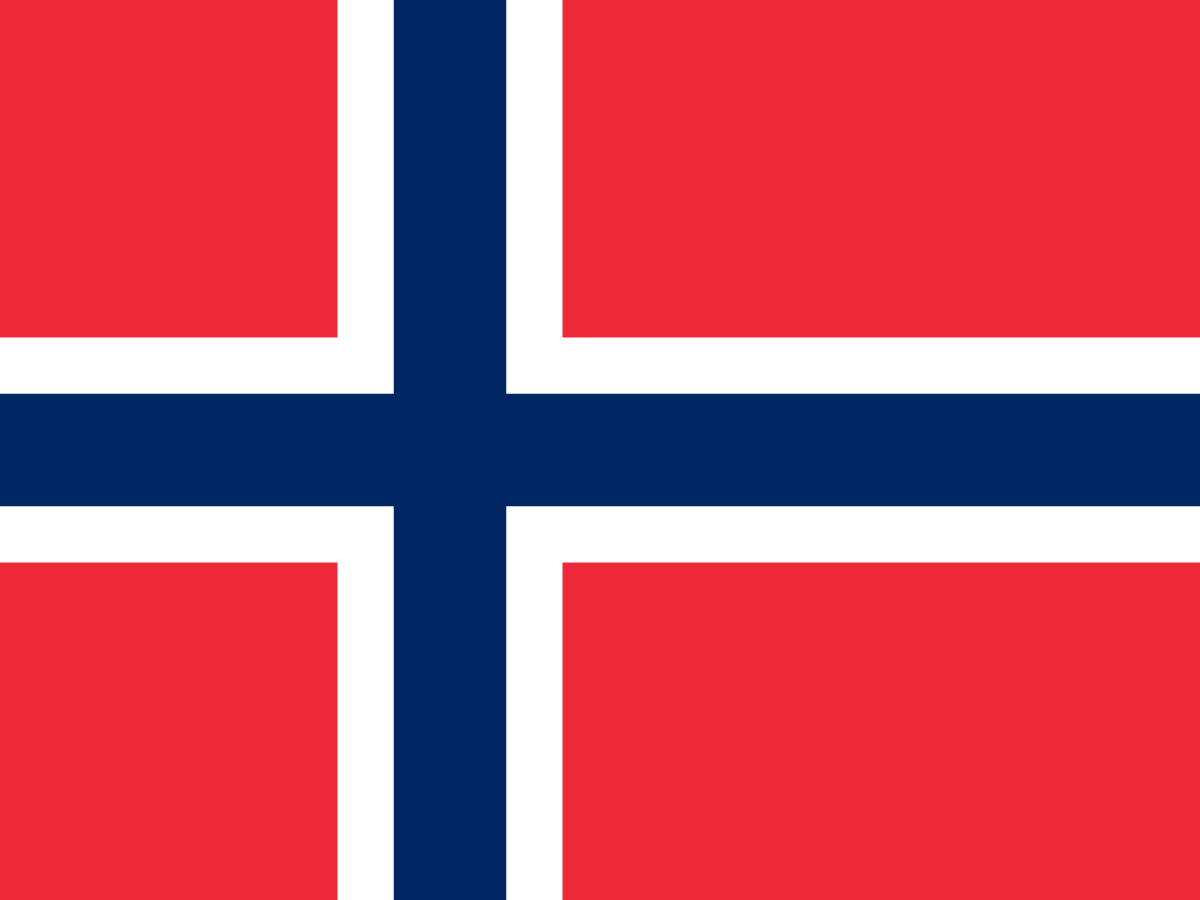
The flag of Norway
Norway's flag has a red field with a blue Nordic cross outlined in white.
The Nordic cross links Norway with the other Scandinavian countries.
The red, white and blue colours also connect Norway's flag with the revolutionary and democratic symbolism of other Atlantic nations, particularly France and the United States.
The modern Norwegian flag was designed by Fredrik Meltzer and adopted in 1821.
The red field
The red background forms most of the Norwegian flag.
Red was already familiar in Norwegian and Scandinavian heraldic traditions. The colour also helped create a distinctive design when combined with the blue-and-white cross.
The white cross
The white outline around the blue cross gives the flag its distinctive three-colour appearance.
White was included partly to separate the blue cross from the red field and create a strong visual contrast.
The blue cross
The blue Nordic cross is positioned towards the hoist, following the traditional Scandinavian cross pattern.
The blue was chosen partly because blue and red were seen as colours representing Norway, while the combination also echoed other European national flags.
The Nordic cross
The Nordic cross is a defining feature of the flags of the Scandinavian and Nordic countries. Its vertical arm is shifted towards the hoist.
Norway shares this basic design tradition with Denmark, Sweden, Finland and Iceland, although each country uses different colours.
Fredrik Meltzer
Fredrik Meltzer, a Norwegian politician and merchant, is credited with designing the Norwegian flag.
His proposal was approved by the Storting in 1821. The design combined Norwegian colours with the established Nordic cross format.
A short history of Norway
Norway's history stretches from prehistoric settlement through the Viking Age, medieval kingdom, centuries of union with Denmark, the union with Sweden and finally independence in 1905.
The discovery and development of North Sea petroleum transformed the Norwegian economy during the late twentieth century, while the country has retained a strong maritime, industrial and welfare tradition.
History timeline
Prehistory — Early settlementPeople have lived in Norway since the retreat of the last Ice Age, adapting to forests, mountains, rivers and coastal environments.
c. 800–1050 — Viking AgeNorwegian seafarers travelled widely across the North Atlantic, establishing settlements in places including Iceland and Greenland and reaching North America.
872 — Traditional date of Harald Fairhair's unificationLater medieval sources associated Harald Fairhair with the unification of much of Norway, although the process was probably gradual.
995–1030 — Olaf Tryggvason and Olaf HaraldssonChristianisation accelerated under Norwegian kings, particularly Olaf Haraldsson, later known as Saint Olaf.
1030 — Battle of StiklestadOlaf Haraldsson was killed at Stiklestad and later became Norway's patron saint.
11th–13th centuries — Medieval kingdomNorway developed into a more centralised Christian kingdom with expanding overseas connections.
1266 — Treaty of PerthNorway ceded the Hebrides and Isle of Man to Scotland, marking a major change in its western overseas possessions.
1349 — Black DeathThe plague devastated Norway's population and weakened the country's economy and political institutions.
1380 — Union with DenmarkNorway entered a dynastic union with Denmark following the death of King Haakon VI.
1397 — Kalmar UnionDenmark, Norway and Sweden were brought together under a single monarch in the Kalmar Union.
1523 — Sweden leaves the Kalmar UnionSweden broke away, while Norway remained closely tied to Denmark.
1536–1537 — ReformationThe Protestant Reformation reached Norway and the country became Lutheran under Danish rule.
1660 — Absolute monarchyDenmark-Norway became an absolute monarchy under the Danish crown.
1814 — Constitution at EidsvollAfter Denmark's defeat in the Napoleonic Wars, Norway declared independence and adopted its constitution on 17 May.
1814 — Union with SwedenNorway entered a personal union with Sweden while retaining its constitution and considerable domestic autonomy.
1821 — Present flag adoptedThe Storting approved Fredrik Meltzer's red, white and blue Nordic cross design.
19th century — National romanticismNorwegian language, folklore, art and rural traditions became central to a growing national identity.
1905 — IndependenceThe union with Sweden was peacefully dissolved after a referendum. Prince Carl of Denmark became King Haakon VII.
1940 — German invasionNazi Germany invaded Norway during the Second World War. The royal family and government continued the war from exile.
1945 — LiberationGerman occupation ended in May 1945 and Norway rebuilt as a democratic state.
1949 — NATO memberNorway became one of the founding members of NATO.
1969 — North Sea oil discoveredThe discovery of the Ekofisk oil field marked the beginning of Norway's transformation into a major petroleum producer.
1970s — Petroleum expansionOil and gas production became increasingly important to the Norwegian economy.
1994 — EU referendumNorwegian voters rejected membership of the European Union, although Norway remains closely integrated with the European economy through the EEA.
2000s — Sovereign wealth fund growsNorway's Government Pension Fund Global became one of the world's largest sovereign wealth funds, investing petroleum revenues for future generations.
2011 — Terrorist attacksNorway suffered deadly attacks in Oslo and at Utøya on 22 July.
2022 — NATO and European securityRussia's invasion of Ukraine changed Norway's security environment and increased attention on the country's strategic position in the Arctic and North Atlantic.
TodayNorway remains a wealthy parliamentary democracy and constitutional monarchy with a major maritime, energy and technology economy.
The Viking Age
Norway was one of the major centres of the Viking Age. Norwegian sailors explored and settled across the North Atlantic.
Viking voyages reached Iceland, Greenland and, according to archaeological evidence, North America. Trade, raiding, farming and seafaring were all important parts of Viking society.
The Christianisation of Norway
Christianity became established in Norway during the late Viking and early medieval periods. Kings including Olaf Tryggvason and Olaf Haraldsson played important roles.
Saint Olaf became a central figure in Norwegian medieval Christianity and remains an important historical symbol.
The Black Death
The Black Death reached Norway in 1349 and caused enormous population loss.
The demographic shock affected farms, towns, churches and government institutions and contributed to Norway's reduced political strength during the late medieval period.
The union with Denmark
For several centuries Norway was linked closely to Denmark. From 1536–1537 it was governed as part of the Danish-Norwegian state and experienced the Protestant Reformation.
This period had a lasting influence on Norwegian language, administration and political development.
The Constitution of 1814
Norway's constitution was adopted at Eidsvoll on 17 May 1814.
The constitution established important principles of representative government and remains the foundation of Norway's political system. Norway later entered a union with Sweden but retained its constitution.
Independence in 1905
Norway peacefully ended its union with Sweden in 1905.
A referendum strongly supported dissolution, and Prince Carl of Denmark became King Haakon VII. Norway's independence was established without a major war.
Norway in the Second World War
Germany invaded Norway on 9 April 1940. Fighting continued for several months before German occupation was established.
King Haakon VII and the Norwegian government escaped to Britain, where they continued to represent the Norwegian state and support the resistance.
The Norwegian resistance
Norwegian resistance groups opposed German occupation through intelligence gathering, sabotage, escape routes and other forms of resistance.
The merchant fleet also played a major role for the Allied war effort under Norwegian control outside occupied Norway.
North Sea oil
The discovery of the Ekofisk field in 1969 transformed Norway's economic prospects.
Petroleum revenues helped fund infrastructure and public services, while Norway developed strict regulation and state participation in the industry.
The sovereign wealth fund
Norway created the Government Pension Fund Global to invest petroleum wealth outside the domestic economy.
The fund is designed to help preserve national wealth for future generations and has become one of the world's largest investors.
Norwegian fjords
Norway is famous for its deep, steep-sided fjords, carved by glaciers over thousands of years.
Geirangerfjord and Nærøyfjord are UNESCO World Heritage sites. Fjords are also important for tourism, fisheries, transport and local communities.
The Norwegian Arctic
Northern Norway extends deep into the Arctic Circle. The region experiences the midnight sun in summer and polar night in winter.
Svalbard, a Norwegian Arctic archipelago, lies far north in the Arctic Ocean and is home to polar bears, glaciers and scientific research stations.
The midnight sun
Above the Arctic Circle, Norway experiences the midnight sun during part of the summer, when the sun remains above the horizon for 24 hours or more.
In winter the same areas can experience polar night, when the sun does not rise above the horizon for a period.
Norway's climate
Norway's climate varies greatly from south to north and between the coast and interior. The Atlantic Ocean gives coastal areas relatively mild conditions for their latitude.
Mountain and northern regions are much colder, while western coastal areas can receive substantial rainfall.
Norwegian wildlife
Norway's forests, mountains, coastline and Arctic regions support moose, reindeer, brown bears, lynx, wolves, whales, seals and seabirds.
The Arctic Svalbard archipelago is particularly associated with polar bears and other cold-adapted wildlife.
Norwegian culture
Norwegian culture includes strong traditions of outdoor recreation, literature, music, design, skiing and maritime life.
National romanticism in the nineteenth century helped shape modern ideas of Norwegian identity through folk music, costumes, stories and rural traditions.
Norwegian language
Norway has two official written standards of Norwegian: Bokmål and Nynorsk.
Norwegian is a North Germanic language closely related to Danish and Swedish. Sámi languages also have official status in parts of northern Norway.
The Sámi people
The Sámi are the Indigenous people of northern parts of Norway, Sweden, Finland and Russia.
Sámi communities have traditions including reindeer herding, fishing, handicrafts, music and distinctive languages. Norway has taken steps to strengthen Sámi political and cultural rights.
Norwegian food
Traditional Norwegian food includes salmon, cod, herring, potatoes, brown cheese, lamb and reindeer.
Seafood has always been important because of Norway's long coastline, while preserved and dried foods reflect the country's historic climate and geography.
Winter sports
Norway is one of the world's leading winter-sports nations. Cross-country skiing, biathlon, ski jumping and alpine skiing are especially popular.
Norway has also produced many successful Olympic and world championship athletes.
The Norwegian economy
Norway has a wealthy, diversified economy based on petroleum, maritime industries, fisheries, manufacturing, services, hydropower and technology.
Oil and gas remain major exports, while the country is also investing in renewable energy and lower-carbon technologies.
Hydropower
Norway generates most of its domestic electricity from hydropower, taking advantage of mountainous terrain, rivers and abundant rainfall.
Large reservoirs and hydroelectric stations have been central to Norwegian industrial development.
Norway and the European Union
Norway is not a member of the European Union, having rejected membership in referendums in 1972 and 1994.
However, it participates in the European Economic Area, giving it access to much of the EU single market.
Norway and NATO
Norway was a founding member of NATO in 1949.
Its location bordering Russia in the Arctic and its position in the North Atlantic make Norway strategically important to European security.
Oslo
Oslo is Norway's capital and largest city. It sits at the head of the Oslofjord and combines modern architecture with extensive forests and outdoor areas.
The city is the country's political, financial and cultural centre.
Bergen
Bergen is Norway's second-largest city and a historic centre of trade and shipping.
Its colourful Bryggen waterfront is a UNESCO World Heritage site and reflects the city's importance within the medieval Hanseatic trading network.
Norway today
Modern Norway combines a high-income economy with an extensive welfare state, democratic institutions and strong environmental awareness.
The country faces questions over petroleum dependence, climate policy, an ageing population and the future of its relationship with Europe, while its Arctic and North Atlantic position has become increasingly important.
Why is Norway's flag interesting?
Norway's flag is a classic example of the Nordic cross, but its red, white and blue combination gives it a distinctive identity.
Its history also reflects Norway's changing political status: the flag was created during the union with Sweden and became the enduring symbol of an independent Norway after 1905.
Explore Norway on FlagAtlas
Continue exploring Norway and the world's flags with these FlagAtlas resources.