About Pakistan
Pakistan is a large country in South Asia, stretching from the Arabian Sea in the south to the high mountains of the Hindu Kush and Karakoram in the north. It borders India, Afghanistan, Iran and China.
The country is home to a remarkable mixture of languages, ethnic groups, landscapes and cultures. Islamabad is the capital, while Karachi is the largest city and a major commercial port.
CapitalIslamabad
ContinentAsia
PopulationOver 240 million
CurrencyPakistani rupee
National languageUrdu
RegionSouth Asia
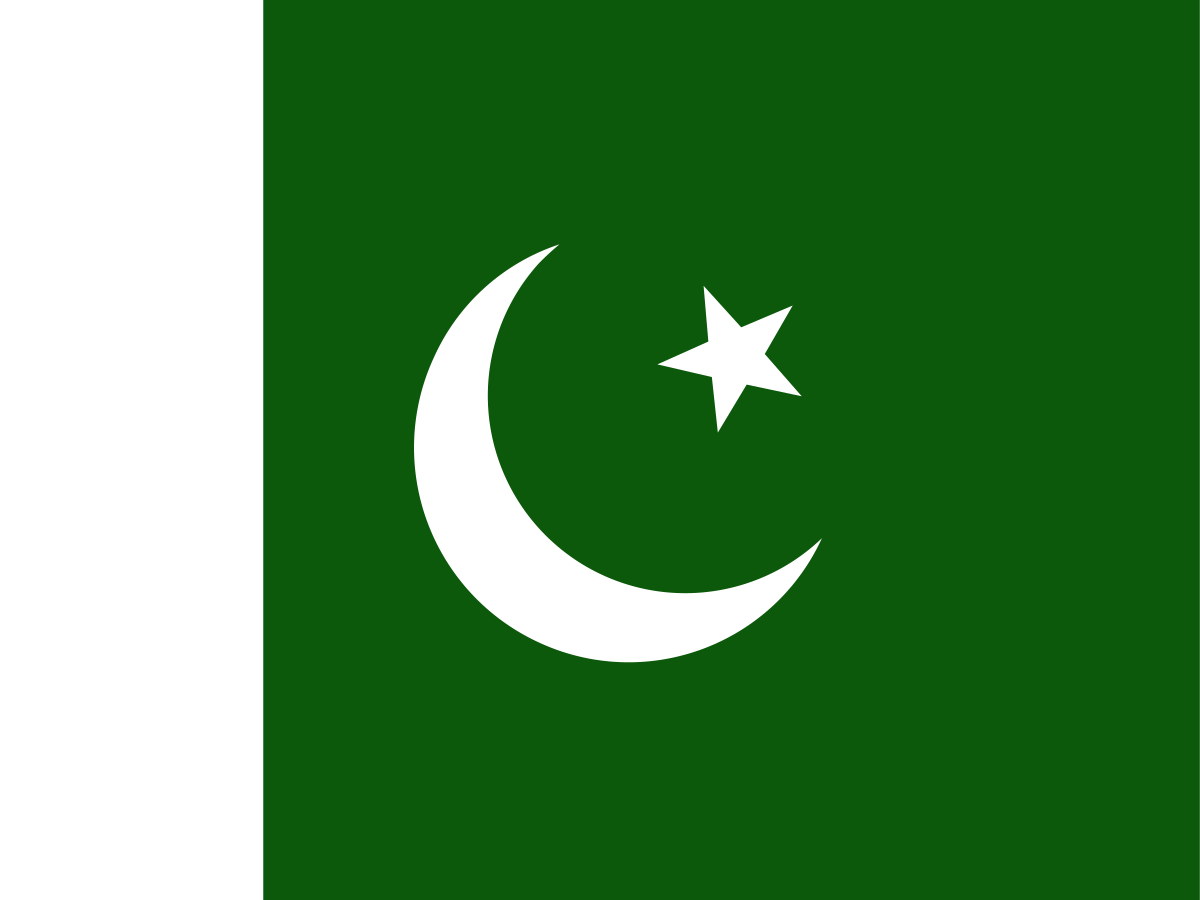
The flag of Pakistan
Pakistan's flag has a large dark green field with a vertical white stripe at the hoist. A white crescent and five-pointed star appear on the green field.
The flag was adopted on 11 August 1947, shortly before Pakistan became independent on 14 August. Its design was based on the flag of the All-India Muslim League.
The green field represents the Muslim majority, while the white stripe represents religious minorities. The crescent and star are traditional Islamic symbols.
The green field
The large green field represents the Muslim majority of Pakistan and is closely associated with Islam.
Green has long been an important colour in Islamic tradition and became a major part of the visual identity of the Pakistan Movement.
The white stripe
The vertical white stripe at the hoist represents Pakistan's religious minorities.
Its position beside the green field is intended to show the place of minorities within the national community.
The crescent
The white crescent is a traditional symbol associated with Islam and is also commonly interpreted as representing progress.
It is one of the most recognisable features of Pakistan's flag.
The five-pointed star
The white five-pointed star is another traditional Islamic symbol and is commonly associated with light and knowledge.
The crescent and star together give the flag its unmistakable Pakistani identity.
A short history of the region
The territory of modern Pakistan has been home to some of the world's earliest urban civilisations. It later came under the influence of Persian, Greek, Mauryan, Kushan, Islamic, Mughal, Sikh and British powers.
The modern state emerged from the Pakistan Movement and the partition of British India in 1947.
History timeline
c. 2500–1900 BCE — Indus Valley CivilisationMajor cities including Mohenjo-daro and Harappa developed sophisticated urban systems, drainage and long-distance trade.
c. 1500–500 BCE — Vedic and later culturesThe wider Indus and northern South Asian region experienced major cultural and linguistic developments.
6th–5th centuries BCE — Persian influenceParts of present-day Pakistan came under the Achaemenid Persian Empire.
326 BCE — Alexander the GreatAlexander invaded the northwestern Indian subcontinent and fought the famous Battle of the Hydaspes against King Porus.
3rd century BCE — Mauryan EmpireThe region became part of the Mauryan Empire under rulers including Ashoka, whose reign helped spread Buddhism.
1st–3rd centuries CE — Kushan EmpireThe Kushans controlled much of the region and helped connect South Asia with Central Asia and the Silk Roads.
8th century — Arab conquest of SindhMuhammad bin Qasim conquered Sindh in 711–712 CE, establishing an early permanent Muslim political presence in the region.
11th century — Ghaznavid expansionMahmud of Ghazni and his successors controlled parts of the region and expanded Muslim political influence.
13th–16th centuries — Delhi SultanatesSeveral Muslim dynasties based in Delhi ruled large parts of northern South Asia.
16th–18th centuries — Mughal EmpireThe Mughals built a powerful empire across much of South Asia. Lahore became an important imperial centre.
18th century — Regional powersMughal authority declined while Afghan, Sikh and other regional powers competed for control.
1799–1849 — Sikh EmpireRanjit Singh established a powerful Sikh state centred on Lahore that controlled much of present-day Punjab.
1849 — British annexation of PunjabFollowing the Anglo-Sikh Wars, the British East India Company annexed Punjab.
1858 — British Crown ruleAfter the Indian Rebellion of 1857, authority passed from the East India Company to the British Crown.
1906 — All-India Muslim League foundedThe Muslim League was established in Dhaka and later became the principal political organisation behind the demand for Pakistan.
1930 — Allahabad AddressMuhammad Iqbal outlined the idea of a consolidated Muslim-majority political unit in northwestern India.
1940 — Lahore ResolutionThe Muslim League adopted a resolution calling for independent states in Muslim-majority areas of British India.
1947 — Pakistan becomes independentBritish India was partitioned and Pakistan became independent on 14 August, initially consisting of West and East Pakistan.
1947–1948 — First Indo-Pakistani WarIndia and Pakistan fought over the princely state of Jammu and Kashmir after partition.
1956 — First constitutionPakistan became an Islamic republic under its first constitution.
1958 — Military rule beginsGeneral Ayub Khan came to power after a military coup and later became president.
1965 — Second Indo-Pakistani WarIndia and Pakistan fought another major conflict, largely centred on Kashmir.
1971 — Bangladesh independencePolitical and military conflict in East Pakistan led to the creation of Bangladesh after intervention by India.
1971 — Zulfikar Ali BhuttoBhutto became president and later prime minister, overseeing Pakistan's political reconstruction after the 1971 crisis.
1973 — ConstitutionPakistan adopted its current constitution, establishing a federal parliamentary republic.
1977 — Zia-ul-Haq takes powerA military coup brought General Zia-ul-Haq to power.
1979 — Soviet invasion of AfghanistanPakistan became a major base and partner for the Afghan resistance, with millions of refugees crossing the border.
1988 — Return to civilian governmentFollowing Zia-ul-Haq's death, Benazir Bhutto became prime minister.
1998 — Nuclear testsPakistan conducted nuclear weapons tests after India's tests earlier that year.
1999 — Military coupGeneral Pervez Musharraf took power following a military coup.
2001 — War in AfghanistanPakistan became a key partner of the United States after the September 11 attacks, while facing significant domestic security pressures.
2008 — Civilian government returnsPakistan returned to civilian-led government after elections.
2010 — 18th Constitutional AmendmentA major constitutional reform strengthened parliamentary government and provincial autonomy.
2013 — Democratic transfer of powerFor the first time in Pakistan's history, one elected civilian government completed a full term and transferred power to another elected government.
2018 — General electionImran Khan and the Pakistan Tehreek-e-Insaf party formed the federal government.
2022 — Imran Khan removedA parliamentary vote of no confidence removed Imran Khan as prime minister and Shehbaz Sharif became prime minister.
2022 — Devastating floodsExceptional monsoon flooding affected millions of people and caused enormous damage across Pakistan.
2023 — Economic and political pressurePakistan faced severe inflation, foreign-exchange pressures and political uncertainty.
2024 — General electionA national election was held amid intense political competition and controversy. Shehbaz Sharif returned as prime minister.
TodayPakistan remains a large federal republic facing economic, political, environmental and security challenges while retaining major strategic importance in South Asia.
The Indus Valley Civilisation
The Indus Valley Civilisation was one of the world's earliest urban civilisations. Major sites such as Mohenjo-daro and Harappa contained planned streets, sophisticated drainage and evidence of long-distance trade.
Mohenjo-daro is now a UNESCO World Heritage site and remains one of Pakistan's most important archaeological landmarks.
Muhammad Ali Jinnah
Muhammad Ali Jinnah was the principal leader of the Pakistan Movement and became Pakistan's first Governor-General in 1947.
Known as Quaid-e-Azam, meaning 'Great Leader', Jinnah played the central political role in negotiating the creation of Pakistan.
The Pakistan Movement
The Pakistan Movement was the political campaign that sought a separate homeland for Muslims in British India.
The All-India Muslim League, led by Muhammad Ali Jinnah, became the movement's dominant political organisation. The Lahore Resolution of 1940 was a major turning point.
The Lahore Resolution
The Lahore Resolution of 1940 was adopted by the Muslim League at its annual session in Lahore.
It called for independent states in Muslim-majority areas of northwestern and eastern British India. It later became closely associated with the demand for Pakistan.
Partition and independence
British India was partitioned in August 1947, creating India and Pakistan. Partition triggered one of the largest mass migrations in modern history.
Millions of Muslims, Hindus and Sikhs moved across the new borders, while widespread communal violence caused enormous loss of life.
East and West Pakistan
At independence, Pakistan consisted of two geographically separated wings: West Pakistan and East Pakistan, with India between them.
Political, economic and linguistic tensions between the two wings eventually contributed to the 1971 crisis and the creation of Bangladesh.
The creation of Bangladesh
In 1971, conflict between the Pakistani government and Bengali political forces in East Pakistan escalated into war. India intervened militarily, and East Pakistan became independent Bangladesh.
The loss of East Pakistan was a defining event in Pakistan's history and led to major political change in the remaining country.
Pakistan and Kashmir
The status of Jammu and Kashmir has been disputed between India and Pakistan since partition in 1947.
The two countries have fought several wars and major military confrontations over the region. Kashmir remains one of the most sensitive issues in South Asian politics.
Pakistan's nuclear programme
Pakistan developed nuclear weapons partly in response to regional security concerns and India's nuclear programme. Pakistan conducted nuclear tests in May 1998.
Pakistan is now one of the world's nuclear-armed states and maintains a significant military capability.
Pakistan and Afghanistan
Pakistan shares a long and strategically important border with Afghanistan.
The relationship has been shaped by the Soviet-Afghan War, refugee movements, militant groups, trade, border disputes and the security situation following the Taliban's return to power in 2021.
The Karakoram
The Karakoram mountain range runs through northern Pakistan and contains some of the world's highest peaks.
K2, at 8,611 metres, is the world's second-highest mountain after Mount Everest. Pakistan's northern mountains attract climbers and trekkers from around the world.
The Himalayas and Hindu Kush
Pakistan contains parts of the Himalayas, Hindu Kush and Karakoram mountain systems.
The mountains provide glaciers and rivers that are vital to agriculture and water supplies across the country.
The Indus River
The Indus River is the geographical and economic backbone of Pakistan. It rises in the Tibetan Plateau and flows through Pakistan before reaching the Arabian Sea.
Its irrigation system supports one of the world's largest agricultural areas and is crucial to food production.
Pakistan's climate
Pakistan has a highly varied climate, ranging from high-altitude mountain climates to hot deserts and humid coastal conditions.
Most of the country is affected by the summer monsoon, while northern and western areas can be much drier. Flooding and drought are recurring risks.
The monsoon
The South Asian monsoon provides a large share of Pakistan's annual rainfall.
Good monsoon rains are essential for agriculture, but exceptionally heavy rainfall can produce catastrophic flooding, as seen in 2022.
Pakistan's wildlife
Pakistan's varied landscapes support snow leopards, Himalayan brown bears, markhor, ibex, Indus river dolphins, crocodiles and many bird species.
The markhor, a wild goat with distinctive spiral horns, is Pakistan's national animal.
The markhor
The markhor is Pakistan's national animal and is found in mountainous areas.
Its name comes from Persian and is commonly interpreted as relating to a snake or serpent, reflecting the animal's distinctive spiral horns.
Pakistan's culture
Pakistan has a diverse culture shaped by South Asian, Islamic, Persian, Central Asian and regional traditions.
Music, poetry, literature, cricket, film, architecture, embroidery and regional festivals all contribute to the country's cultural identity.
The languages of Pakistan
Pakistan is linguistically diverse. Urdu is the national language and English is widely used in government, law and higher education.
Major regional languages include Punjabi, Sindhi, Pashto, Balochi and Saraiki, alongside many smaller languages.
Pakistani food
Pakistani cuisine includes biryani, nihari, karahi, kebabs, haleem, chapati, naan and a huge variety of regional dishes.
Food traditions vary considerably between Punjab, Sindh, Balochistan, Khyber Pakhtunkhwa and the northern mountain regions.
Cricket in Pakistan
Cricket is Pakistan's most popular sport and a major part of national culture.
Pakistan won the Cricket World Cup in 1992 and the T20 World Cup in 2009. The national team has produced internationally famous players and fast bowlers.
The Pakistani economy
Pakistan has a large and diverse economy with major sectors including agriculture, textiles, manufacturing, services, construction and telecommunications.
Remittances from Pakistanis working overseas are also an important source of foreign exchange.
Agriculture
Agriculture remains important to Pakistan's economy and rural population. Major products include wheat, rice, cotton, sugarcane, maize and fruit.
The Indus irrigation system is essential to farming but also leaves the country vulnerable to water shortages and flood damage.
Textiles
Pakistan has a major textile and clothing industry, with cotton production providing an important raw material.
Textiles are among the country's leading export industries and employ large numbers of workers.
Islamabad
Islamabad became Pakistan's capital in the 1960s, replacing Rawalpindi as the temporary capital.
The city was purpose-built with extensive green spaces and lies beneath the Margalla Hills. The Faisal Mosque is one of its best-known landmarks.
Karachi
Karachi is Pakistan's largest city and its principal commercial and financial centre.
Its port, industrial base and location on the Arabian Sea make it vital to the national economy.
Lahore
Lahore is one of Pakistan's major cultural and historic centres. It was an important Mughal city and contains landmarks including the Lahore Fort and Badshahi Mosque.
The city is also famous for literature, food, gardens, education and the Lahore Resolution of 1940.
Pakistan today
Pakistan is a federal parliamentary republic with a population of more than 240 million. It has a strategically important position between South Asia, Central Asia, China and the Middle East.
The country faces major challenges including economic stability, political polarisation, climate change, water security, energy needs and internal security, while also possessing significant human, agricultural and industrial resources.
Why is Pakistan's flag interesting?
Pakistan's flag is particularly distinctive because the white crescent and star sit on a dark green field beside a separate white stripe.
It tells a compact story about Pakistan's founding: Islam, the Muslim majority, religious minorities and the political movement that led to independence in 1947.
Explore Pakistan on FlagAtlas
Continue exploring Pakistan and the world's flags with these FlagAtlas resources.