About Palau
Palau is a small island country in Micronesia, in the western Pacific Ocean. It is famous for its extraordinary marine environment, limestone islands, coral reefs and the Rock Islands.
Ngerulmud is the national capital, while Koror is the country's main population and commercial centre.
CapitalNgerulmud
ContinentOceania
PopulationAbout 18,000
CurrencyUS dollar
Official languagesPalauan & English
RegionMicronesia
The flag of Palau
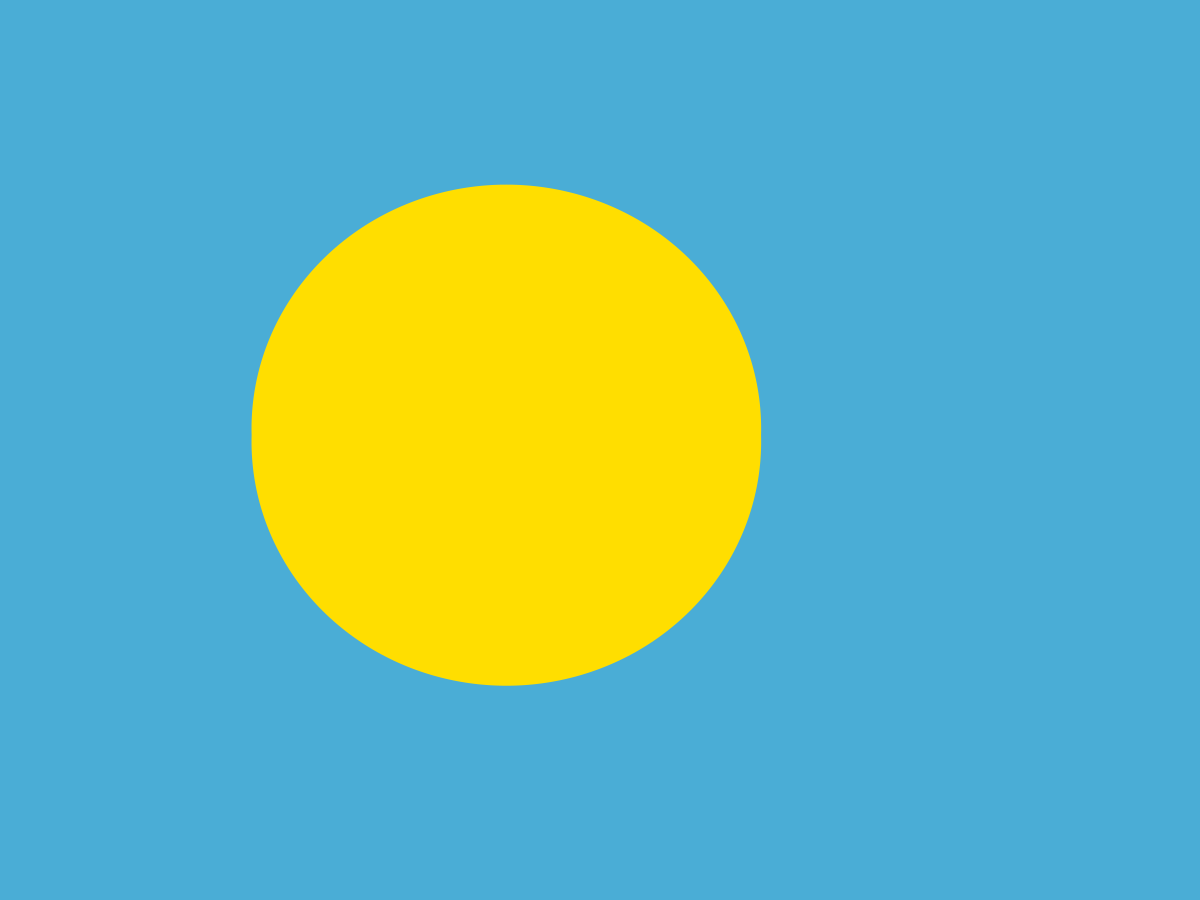
Palau's flag has a light blue field with a large golden-yellow disc slightly left of centre.
The flag was adopted in 1981.
Its design is deliberately simple and reflects Palau's relationship with the Pacific Ocean and the importance of the moon in traditional culture.
The disc is not a literal sun: it represents the full moon.
The blue field
The light blue field represents the ocean surrounding Palau and the country's peaceful character.
For an island nation whose communities have depended on the sea for generations, the ocean is central to both identity and daily life.
The golden disc
The golden-yellow disc represents the full moon. In Palauan culture the full moon has important associations with traditional activities, agriculture and the timing of community life.
The warm colour also gives the flag a strong visual identity against the blue field.
Why is the moon off-centre?
The moon is deliberately positioned slightly toward the hoist rather than exactly in the centre.
The unusual placement is part of the flag's distinctive design and helps distinguish it from other blue-and-yellow national flags.
A short history of Palau
Palau has been inhabited for thousands of years by Austronesian peoples who developed distinctive island societies and maritime traditions.
European contact was followed by Spanish, German and Japanese administration. After the Second World War, Palau became part of the United States-administered Trust Territory of the Pacific Islands before becoming an independent republic in 1994.
History timeline
Ancient settlement — thousands of years agoPalau was settled by Austronesian peoples whose descendants developed distinctive island communities and seafaring traditions.
Pre-European Palau — traditional societyPalauan communities developed complex clan systems, traditional chiefs, stone monuments and extensive relationships between islands.
16th century — Spanish contactEuropean navigators reached the Palau islands and Spain later established a colonial claim over the islands.
1885 — Spanish administrationSpain's control of the Caroline Islands was internationally recognised, although its direct presence in Palau remained limited.
1899 — Germany acquires PalauFollowing Spain's defeat in the Spanish-American War, Spain sold the Caroline Islands, including Palau, to Germany.
1900s — German administrationGerman authorities developed commercial activities and introduced new forms of administration.
1914 — Japan takes controlJapan occupied Palau during the First World War and later received a League of Nations mandate over the islands.
1920s–1930s — Japanese administrationJapan developed Koror into a regional administrative and commercial centre and established infrastructure and industries.
1944 — Battle of PeleliuOne of the fiercest battles of the Pacific War was fought on Peleliu between US and Japanese forces. The battle caused enormous casualties.
1945 — Japanese rule endsAfter Japan's defeat in the Second World War, Palau came under American administration.
1947 — Trust Territory of the Pacific IslandsPalau became part of the United Nations Trust Territory of the Pacific Islands administered by the United States.
1979 — Federated States of Micronesia developsPalau chose not to join the emerging Federated States of Micronesia and instead pursued its own political future.
1981 — Republic of Palau establishedPalau adopted its constitution and became a self-governing republic while remaining in free association negotiations with the United States.
1981 — Flag adoptedThe modern blue-and-gold Palauan flag was adopted.
1994 — IndependencePalau became an independent sovereign state in free association with the United States under the Compact of Free Association.
2006 — Capital moves to NgerulmudPalau's national government moved from Koror to Ngerulmud in Melekeok State.
2015 — Marine sanctuary commitmentPalau continued to build its international reputation as a leader in marine conservation.
2017 — Palau PledgeVisitors began taking a pledge to protect Palau's environment and culture as part of the country's sustainable tourism approach.
2020 — National Marine SanctuaryPalau implemented a large marine sanctuary framework protecting the country's ocean resources.
TodayPalau is an independent Pacific republic whose economy depends heavily on tourism, services, fishing and its relationship with the United States.
Traditional Palauan culture
Palauan culture places strong importance on family, clans, chiefs, community and the sea.
Traditional meeting houses, known as bai, are decorated with carved and painted designs depicting stories, animals and important cultural themes.
The bai
A bai is a traditional Palauan meeting house used for community and ceremonial purposes.
The buildings are known for elaborate decoration and storytelling through carved and painted imagery. They remain an important symbol of Palauan heritage.
The Rock Islands
The Rock Islands Southern Lagoon is one of Palau's most famous landscapes, containing hundreds of mushroom-shaped limestone islands and a remarkable network of reefs and lagoons.
The area is a UNESCO World Heritage site and is central to Palau's tourism and conservation identity.
Jellyfish Lake
Jellyfish Lake on Eil Malk is famous for its population of golden jellyfish. The isolated marine lake has a unique ecosystem that developed after geological changes separated it from the surrounding sea.
Conditions and jellyfish numbers can change naturally, so access and swimming rules may vary.
Palau's marine life
Palau's waters support extraordinary biodiversity, including coral reefs, reef fish, sharks, manta rays, sea turtles and many other marine species.
Its reefs are among the country's most valuable natural assets and support tourism, fisheries and coastal communities.
Marine conservation
Palau has become internationally known for marine conservation. The country has established large protected ocean areas and promotes sustainable fishing and tourism.
Its approach reflects the importance of protecting the marine ecosystems on which island communities depend.
Palau and the United States
Palau is an independent country in free association with the United States under the Compact of Free Association.
The relationship provides economic and security links while Palau retains sovereignty and its own government.
The Battle of Peleliu
The Battle of Peleliu in 1944 was one of the bloodiest battles of the Pacific campaign.
US Marines and Army forces fought heavily fortified Japanese positions. The island's caves and rugged terrain made the battle exceptionally difficult and costly.
Palau and Japan
Japan's historical influence remains visible in Palau through language, infrastructure, cultural connections and memories of the Japanese period and Second World War.
Japan is also an important contemporary partner and tourism market.
Palau's geography
Palau consists of hundreds of islands spread across the western Pacific, although only a small proportion are permanently inhabited.
The islands include volcanic islands, limestone formations, coral atolls and the dramatic Rock Islands.
Palau's climate
Palau has a hot, humid tropical climate with abundant rainfall throughout the year.
Temperatures vary relatively little compared with temperate climates. Tropical storms can affect the wider region, although Palau's position means exposure varies from year to year.
Palau's wildlife
Palau's isolated islands and surrounding seas support many distinctive species, particularly marine life and birds.
Its coral reefs, mangroves, seagrass beds and forests form interconnected ecosystems that are important for biodiversity.
Palauan language
Palauan is the main indigenous language and is an official language alongside English.
Japanese and other languages have also influenced Palauan vocabulary and culture because of the islands' historical connections.
Palauan food
Traditional Palauan food makes extensive use of fish, seafood, taro, cassava, breadfruit, coconut and tropical fruits.
Modern cuisine also reflects Japanese, American and other Pacific influences.
Palau's economy
Palau's economy is heavily influenced by tourism, services, fisheries and external assistance.
Its small population and remote location create challenges for economic diversification, infrastructure and the cost of importing goods.
Tourism
Tourism is one of Palau's most important industries. Visitors are attracted by scuba diving, snorkelling, kayaking, beaches, marine wildlife and the Rock Islands.
Palau has deliberately promoted responsible tourism to reduce environmental pressure.
Ngerulmud and Koror
Ngerulmud is Palau's official capital and seat of the national government. It is located in Melekeok State on Babeldaob, the country's largest island.
Koror remains the main population, business and tourism centre and is far more built-up than Ngerulmud.
Palau today
Palau is a small but strategically and environmentally significant Pacific state. Its greatest assets are its marine ecosystems, cultural heritage and natural landscapes.
The country faces familiar island-state challenges including climate change, sea-level rise, dependence on tourism and the high cost of living and infrastructure in a remote location.
Why is Palau's flag interesting?
Palau's flag is one of the world's simplest national designs, but its symbolism is unusually specific: the blue field represents the surrounding Pacific and the golden disc represents the full moon.
Its design also reflects Palau's emphasis on peace and its distinctive island culture.
Explore Palau on FlagAtlas
Continue exploring Palau and the world's flags with these FlagAtlas resources.