Americas
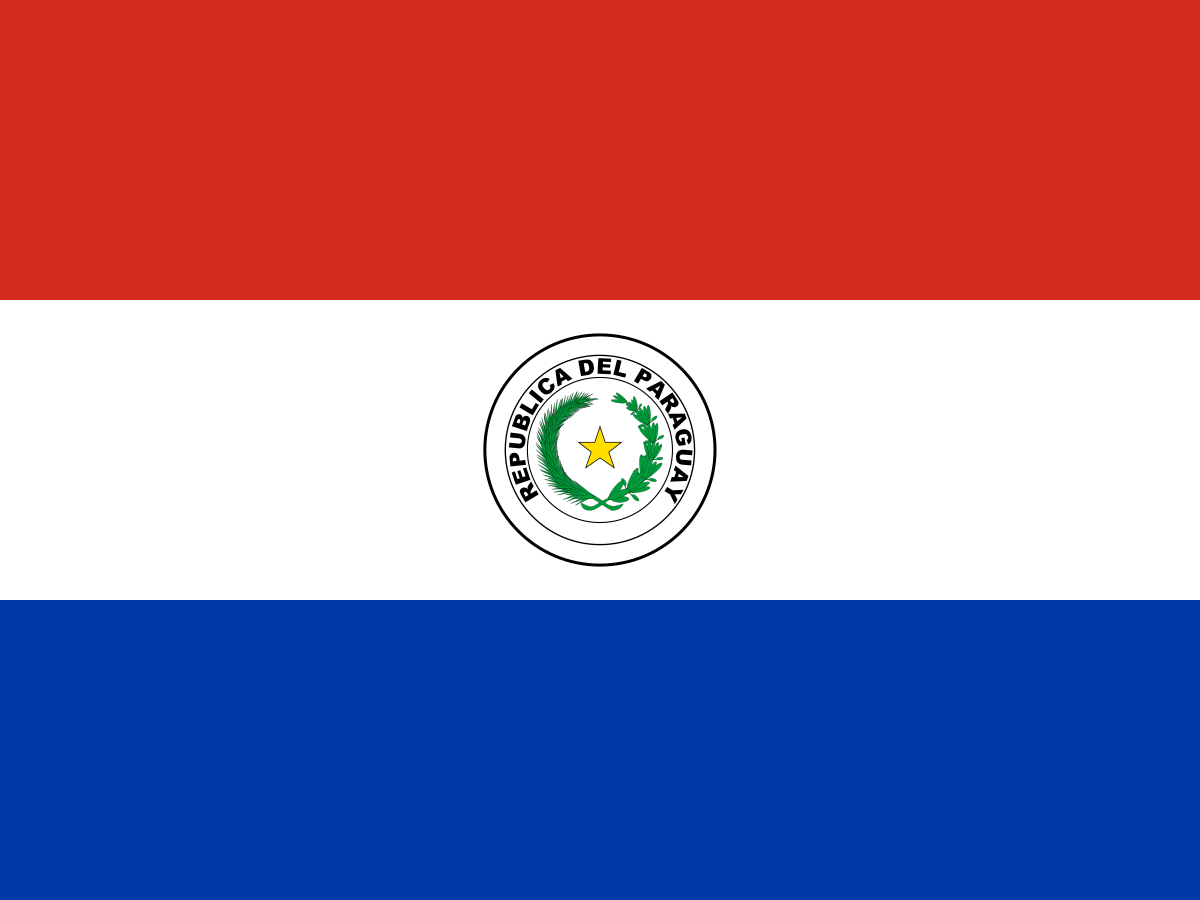
Paraguay Flag
The only flag in the world with different symbols on each side! The front shows the national coat of arms, the back shows the treasury seal. Red, white, and blue were inspired by France.
Capital
Asunción
Continent
Americas
Population
7.4 million
Development indicators
GDP per capita
$5,780
USD per year (approx. 2023)
Human Development Index
0.752
High development
World Bank income classification
Upper-Middle Income (UMIC)
UMIC
🌡️ Climate: Subtropical / Savanna
Flag symbolism
The only flag in the world with different symbols on each side! The front shows the national coat of arms, the back shows the treasury seal. Red, white, and blue were inspired by France.
uniquecoat of arms
Did you know?
Paraguay is one of only two landlocked countries in South America.
Test your knowledge
Think you know your world flags? Try the FlagAtlas daily challenge, speed quiz, or explore all Americas flags.
📚 Revising for GCSE Geography? Visit our free revision page →
About Paraguay
Paraguay is a landlocked country in the heart of South America, bordered by Argentina, Brazil and Bolivia. The Paraguay River divides much of the country into eastern and western regions.
Asunción is the capital and largest city. Paraguay is known for its Guaraní heritage, bilingual culture, vast Chaco region and distinctive red, white and blue flag.
CapitalAsunción
RegionSouth America
PopulationAbout 7 million
CurrencyGuaraní
Official languagesSpanish & Guaraní
Independence1811
The flag of Paraguay
Paraguay's flag has three horizontal stripes of red, white and blue. It is especially unusual because the two sides of the flag carry different emblems.
Paraguay adopted the present tricolour design in 1842.
The obverse traditionally bears the national coat of arms with the lion and liberty cap, while the reverse bears the Treasury seal with a lion and the words Paz y Justicia — Peace and Justice.
The red stripe
The red stripe is traditionally associated with courage, bravery and patriotism. Red forms the upper band of the Paraguayan tricolour.
The white stripe
The central white stripe is associated with peace and unity. It separates the red and blue fields and provides the background for Paraguay's seals.
The blue stripe
The blue stripe is traditionally linked with liberty and justice. Together, the three colours form a design strongly associated with the country's independence and republican identity.
The two sides of the flag
Paraguay's flag is one of the world's most unusual national flags because its front and back are officially different.
The obverse displays the national coat of arms. The reverse displays the Treasury seal. This means that simply turning the flag over changes the central emblem.
The national coat of arms
The obverse features a circular emblem containing a yellow five-pointed star surrounded by the words República del Paraguay. The star is commonly associated with independence and the founding of the republic.
The Treasury seal
The reverse bears a lion guarding a staff topped by a liberty cap, surrounded by the words Paz y Justicia, meaning Peace and Justice.
A short history of Paraguay
Paraguay's history combines Indigenous Guaraní civilisation, Spanish colonisation, independence, devastating 19th-century wars, long periods of political instability and the return to democracy in the late 20th century.
The country has retained an unusually strong Indigenous linguistic and cultural influence, with Guaraní spoken alongside Spanish by much of the population.
History timeline
Before European arrival — Guaraní societiesThe region was inhabited by Guaraní-speaking peoples and other Indigenous communities with established farming, hunting, trading and cultural traditions.
1524 — Alejo García reaches the regionOne of the earliest Europeans known to enter the interior of South America reached the Paraguay region during an expedition from the Atlantic coast.
1537 — Asunción foundedSpanish explorer Juan de Salazar y Espinosa founded Asunción, which became an important centre of Spanish settlement.
16th–17th centuries — Spanish colonial periodParaguay became part of the Spanish colonial world. Jesuit missions developed communities among many Guaraní-speaking peoples.
1609 onward — Jesuit missionsJesuits established a network of settlements known as the reductions. They became important centres of agriculture, education, music and crafts.
1767 — Jesuits expelledThe Spanish Crown expelled the Jesuits from its American territories, ending their direct administration of the Paraguayan missions.
1811 — IndependenceParaguay peacefully broke away from Spanish colonial rule and established itself as an independent republic.
1814–1840 — José Gaspar Rodríguez de FranciaDr Francia ruled Paraguay as a highly centralised state, pursuing isolation and political independence from neighbouring powers.
1844 — Carlos Antonio LópezCarlos Antonio López became president and promoted infrastructure, industry, education and international trade.
1864–1870 — War of the Triple AllianceParaguay fought Brazil, Argentina and Uruguay in a catastrophic war that caused enormous loss of life and devastated the country.
1870 — Post-war ParaguayThe country faced severe population loss, economic damage and territorial concessions after the war.
1932–1935 — Chaco WarParaguay fought Bolivia over the Gran Chaco. Paraguay won most of the disputed territory.
1954–1989 — Stroessner dictatorshipAlfredo Stroessner ruled Paraguay for more than three decades, combining authoritarian government with the long dominance of the Colorado Party.
1989 — Stroessner overthrownA military coup removed Stroessner and began a transition toward democratic government.
1992 — New constitutionParaguay adopted a democratic constitution establishing stronger civil and political rights.
1991 — Mercosur foundedParaguay became a founding member of the Southern Common Market alongside Argentina, Brazil and Uruguay.
2000s — Economic developmentAgriculture, energy production and international trade became increasingly important to the economy.
TodayParaguay is a democratic republic with a mixed economy, strong Guaraní cultural identity and major agricultural and hydroelectric exports.
The Guaraní people
The Guaraní are central to Paraguay's identity. Their language and cultural traditions survived Spanish colonisation and remain deeply embedded in modern Paraguayan life.
Guaraní is an official language alongside Spanish, making Paraguay unusual in the Americas.
The Guaraní language
Guaraní is spoken widely throughout Paraguay and is used in homes, communities, media, music and politics. Many Paraguayans use both Guaraní and Spanish in everyday life.
The survival of Guaraní as a national language is one of Paraguay's most distinctive cultural features.
Paraguayan culture
Paraguayan culture combines Guaraní, Spanish and other immigrant influences. Music, crafts, food, festivals and family traditions reflect this mixture.
Traditional harp music and the dance style known as Paraguayan polka are especially well known.
Paraguayan harp
The Paraguayan harp is one of the country's best-known musical symbols. It is used in traditional music and has a distinctive sound and construction.
Ñandutí lace
Ñandutí is a traditional Paraguayan lace-making art whose name comes from Guaraní and is often translated as "spider web". Intricate circular patterns are created by hand and are an important part of Paraguay's textile heritage.
Paraguayan food
Paraguayan cuisine combines Indigenous ingredients with Spanish influences. Popular foods include sopa paraguaya, chipa, mbejú, vorí vorí and asado.
Despite its name, sopa paraguaya is a firm corn-based bread rather than a liquid soup.
Tereré
Tereré is a cold infusion made from yerba mate and water, often flavoured with herbs. It is a major part of Paraguayan social life and is recognised as an important element of the country's cultural heritage.
Paraguay's geography
Paraguay is divided geographically by the Paraguay River. The eastern region is greener, more densely populated and agriculturally productive, while the western Gran Chaco is much drier and more sparsely populated.
The Gran Chaco
The Gran Chaco covers much of western Paraguay. It contains dry forests, thorn scrub, wetlands and grasslands and supports wildlife adapted to difficult seasonal conditions.
The Paraguay River
The Paraguay River runs north to south through the country and is an important transport route. It also forms part of Paraguay's natural geography and helps divide the eastern and western regions.
Climate
Paraguay has a predominantly subtropical to tropical climate. Summers are generally hot and can be very humid, while winters are milder but can occasionally bring strong cold fronts from the south.
Paraguay's wildlife
Paraguay supports diverse wildlife including jaguars, pumas, giant anteaters, armadillos, capybaras, tapirs, marsh deer and hundreds of bird species.
The jaguar
The jaguar is one of Paraguay's most iconic predators. It survives mainly in remote forests and wetlands, although habitat loss and human conflict remain significant threats.
The giant anteater
The giant anteater is found in Paraguay's grasslands, savannahs and dry forests. It uses its long snout and sticky tongue to feed on ants and termites.
Paraguay's economy
Paraguay has a strongly agricultural economy. Major exports include soybeans, beef, corn and other agricultural products.
Hydroelectricity is another major economic asset, giving Paraguay substantial energy resources.
Itaipú Dam
The enormous Itaipú Dam on the Paraná River is shared by Paraguay and Brazil. Its hydroelectric plant is one of the largest power-generating facilities in the world and is central to Paraguay's energy economy.
Yacyretá Dam
The Yacyretá hydroelectric project is shared by Paraguay and Argentina on the Paraná River. It provides another major source of electricity for the two countries.
Asunción
Asunción is Paraguay's capital and one of South America's oldest continuously inhabited cities founded by Europeans. It is the country's political, cultural and economic centre.
The War of the Triple Alliance
The War of the Triple Alliance (1864–1870) was one of the most destructive conflicts in South American history. Paraguay fought Brazil, Argentina and Uruguay and suffered catastrophic population and economic losses.
The Chaco War
The Chaco War between Paraguay and Bolivia from 1932 to 1935 was fought over the Gran Chaco. Paraguay won most of the disputed territory, although both countries suffered heavy casualties.
Paraguay and Mercosur
Paraguay is a founding member of Mercosur, the South American regional trade bloc. Its membership links the country closely with Argentina, Brazil and Uruguay.
Why is Paraguay's flag interesting?
Paraguay's flag is exceptionally unusual because it has different official emblems on its front and back. Few national flags share this characteristic.
The red, white and blue tricolour also links the flag to Paraguay's republican history, while the seals reflect ideals of independence, peace and justice.
Explore Paraguay on FlagAtlas
Continue exploring Paraguay and the world's flags with these FlagAtlas resources.