About Peru
Peru is a country on the western side of South America, stretching from the Pacific coast across the Andes to the Amazon rainforest. It is one of the most geographically diverse countries in the world.
Lima is the capital and largest city. Peru is famous for the Inca civilisation, Machu Picchu, the Andes, the Amazon Basin and a rich blend of Indigenous, Spanish, African and Asian cultural influences.
CapitalLima
RegionSouth America
PopulationAbout 34 million
CurrencySol
Official languagesSpanish, Quechua & Aymara
Independence1821
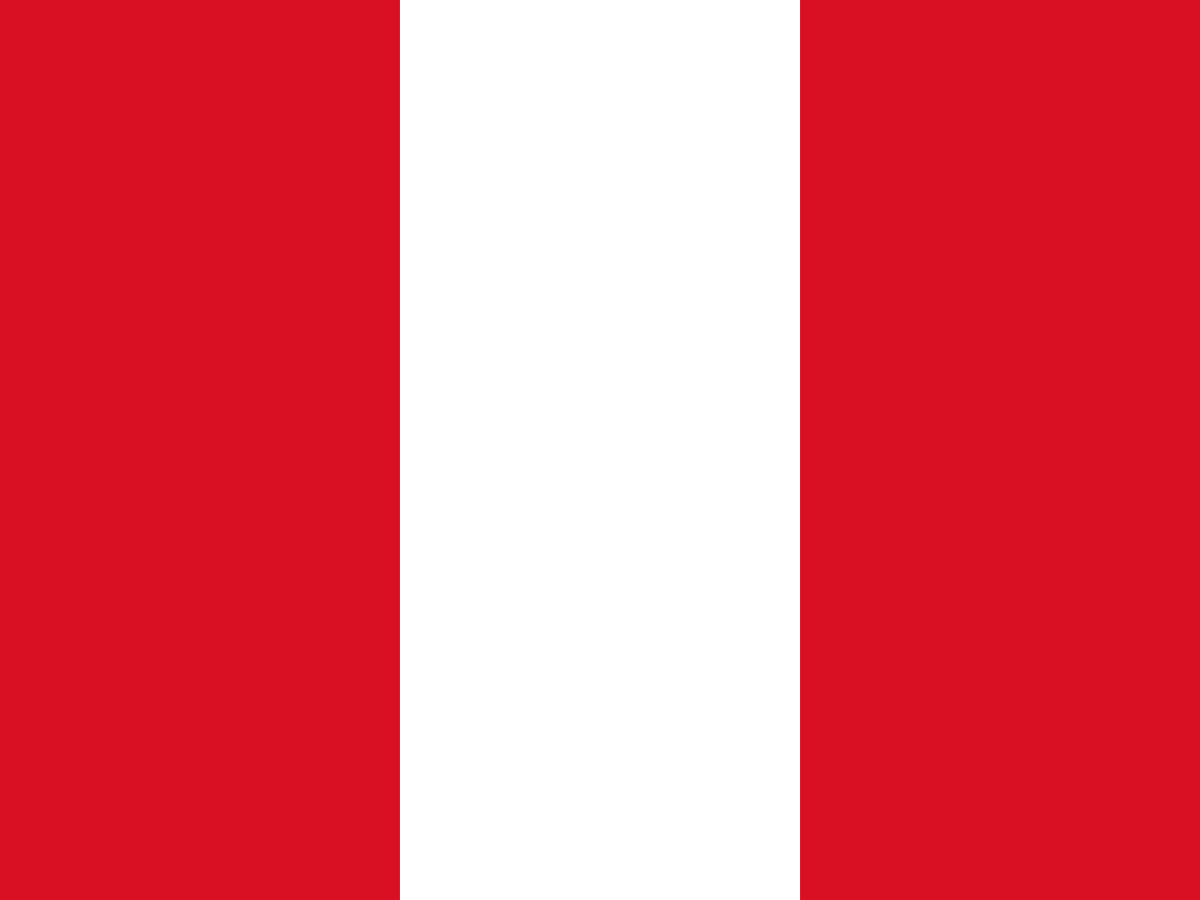
The flag of Peru
Peru's national flag consists of three equal vertical bands of red, white and red.
The plain civil flag is widely used by the public. The state flag adds the national coat of arms in the centre of the white band.
The current basic red-and-white design dates from Peru's independence period.
Several stories have been told about why red and white were chosen, but the popular flamingo story is generally treated as a legend rather than a firmly established historical explanation.
The red stripes
The two red stripes are the most prominent feature of the Peruvian flag. Red is commonly associated with the sacrifices and courage connected with Peru's struggle for independence.
The white stripe
The central white stripe is commonly associated with peace, purity and justice. It also provides the background for the coat of arms on the state version of the flag.
The coat of arms
Peru's state flag carries the national coat of arms in the centre. It contains the vicuña, cinchona tree and cornucopia, representing Peru's fauna, flora and mineral wealth.
The vicuña
The vicuña on the coat of arms represents Peru's wildlife. It is a small wild relative of the llama and alpaca that lives in the high Andes and is famous for its exceptionally fine wool.
The cinchona tree
The cinchona tree represents Peru's plant life. Its bark was historically important as a source of quinine, a treatment for malaria, and became an important export from the region.
The cornucopia
The cornucopia, or horn of plenty, spills out gold coins and represents Peru's mineral wealth and natural resources.
A short history of Peru
Peru has one of the richest archaeological histories in the Americas. Civilisations including the Chavín, Nazca, Moche, Wari and Inca developed complex societies before Spanish conquest.
Spanish rule lasted for almost three centuries before Peru became independent in the early 19th century.
History timeline
c. 3000 BCE — Caral civilisationThe ancient settlement of Caral in the Supe Valley is one of the oldest known urban centres in the Americas.
c. 900–200 BCE — Chavín cultureThe Chavín civilisation developed influential religious, artistic and architectural traditions in the Andes.
c. 100–800 CE — Nazca cultureThe Nazca people are famous for their ceramics, textiles and the enormous geoglyphs now known as the Nazca Lines.
c. 100–700 CE — Moche civilisationThe Moche flourished on Peru's northern coast and built large ceremonial structures such as Huaca del Sol and Huaca de la Luna.
c. 600–1000 — Wari civilisationThe Wari developed a large Andean state with extensive roads, settlements and administrative centres.
15th century — Inca expansionThe Inca state expanded rapidly from its centre at Cusco, creating the largest empire in pre-Columbian America.
1532 — Spanish conquest beginsFrancisco Pizarro and his forces captured the Inca ruler Atahualpa, beginning the Spanish conquest of the Inca Empire.
1535 — Lima foundedPizarro founded Lima, which became the centre of Spanish colonial administration in much of South America.
1542 — Viceroyalty of PeruThe Spanish Crown established the Viceroyalty of Peru, with Lima as its capital.
1780–1781 — Túpac Amaru II rebellionJosé Gabriel Condorcanqui, known as Túpac Amaru II, led a major Indigenous uprising against Spanish colonial rule.
1821 — Independence declaredJosé de San Martín proclaimed the independence of Peru in Lima on 28 July 1821.
1824 — Battle of AyacuchoThe Battle of Ayacucho decisively defeated Spanish royalist forces and secured independence for much of South America.
19th century — Republic developsPeru experienced political instability, economic booms and conflicts with neighbouring countries while building its republican institutions.
1879–1884 — War of the PacificPeru and Bolivia fought Chile. Peru suffered military defeat and lost territory in the resulting settlement.
20th century — Political changePeru experienced periods of military government, civilian democracy, economic change and social upheaval.
1980s–1990s — Internal conflictPeru faced a violent internal conflict involving insurgent groups including Shining Path and the state. Thousands of people were killed or disappeared.
1990–2000 — Fujimori eraAlberto Fujimori's government introduced major economic reforms while also becoming increasingly authoritarian.
2000 — Democratic transitionFujimori left office amid a major political scandal, and Peru returned to a period of democratic transition.
TodayPeru is a democratic republic with a diverse economy and a cultural identity strongly shaped by its Indigenous and Spanish heritage.
The Inca Empire
The Inca Empire, or Tawantinsuyu, grew rapidly during the 15th century and controlled a huge area of western South America. Cusco was its political and cultural centre.
The Incas built an extensive road network, terraces, bridges and monumental stone architecture. Their empire was conquered by the Spanish in the 16th century.
Machu Picchu
Machu Picchu is one of the world's most famous archaeological sites. Built high in the Andes during the Inca period, it includes terraces, temples and finely fitted stone structures.
Its exact purpose remains debated, but it is widely associated with the Inca ruler Pachacuti.
Cusco
Cusco was the capital of the Inca Empire and remains one of Peru's most important historic cities. Spanish colonial buildings were constructed around and over parts of the earlier Inca city.
The Nazca Lines
The Nazca Lines are enormous ancient geoglyphs carved into the desert surface of southern Peru. They depict animals, plants, geometric shapes and other forms and were created by the Nazca culture centuries before the Inca Empire.
Lake Titicaca
Lake Titicaca lies high in the Andes on the border between Peru and Bolivia. At around 3,800 metres above sea level, it is one of the world's highest large navigable lakes.
The Andes
The Andes Mountains run through Peru from north to south and shape the country's climate, agriculture, transport and culture. The mountains include some of the highest peaks in the Americas.
The Amazon rainforest
Peru contains a huge area of the Amazon Basin. The Peruvian Amazon includes some of the country's most biodiverse ecosystems, with rivers, floodplain forests and tropical rainforest.
The Peruvian coast
Peru's Pacific coast is much drier than the mountains and rainforest. The Atacama Desert system extends into southern Peru, while coastal valleys are made fertile by rivers flowing down from the Andes.
Climate
Peru has extraordinary climatic variety. The coast is generally arid, the Andes have highland climates and the Amazon is hot and humid.
Altitude is a major influence: temperatures can change dramatically over relatively short distances.
Peru's wildlife
Peru is one of the world's most biodiverse countries. Its wildlife includes jaguars, spectacled bears, vicuñas, llamas, alpacas, giant river otters, pink river dolphins, condors and thousands of bird species.
The Andean condor
The Andean condor is one of the world's largest flying birds. It is strongly associated with the Andes and has deep cultural importance in Indigenous South American traditions.
The spectacled bear
The spectacled bear is the only bear species native to South America. It lives in a variety of habitats along the Andes, from cloud forests to high-altitude grasslands.
Peruvian culture
Peruvian culture is a rich mixture of Indigenous, Spanish, African, Chinese and Japanese influences. Music, dance, festivals, textiles, food and architecture vary enormously from region to region.
Quechua
Quechua is a family of Indigenous languages spoken across the Andes. Several Quechua varieties are official languages in Peru alongside Spanish, reflecting the country's Indigenous heritage.
Traditional textiles
Peruvian weaving traditions are famous for their intricate patterns and vivid colours. Andean communities continue to produce textiles using techniques and designs with roots extending back many centuries.
Peruvian food
Peruvian cuisine is one of the best-known in South America. Famous dishes include ceviche, lomo saltado, ají de gallina, causa and pachamanca.
Peruvian food combines Indigenous ingredients such as potatoes, maize and quinoa with Spanish, African, Chinese and Japanese influences.
Potatoes and Peru
Peru is one of the world's great centres of potato diversity. Thousands of varieties have been cultivated in the Andes, where potatoes remain a fundamental part of traditional agriculture and cuisine.
Ceviche
Ceviche is one of Peru's signature dishes. Fresh fish is traditionally marinated in citrus juice and combined with ingredients such as chilli, onion and coriander. It reflects Peru's long Pacific coastline and diverse culinary heritage.
The economy
Peru has a mixed economy with important sectors including mining, agriculture, fishing, manufacturing, tourism and services.
It is a major producer of copper, gold and other minerals, while agricultural exports include coffee, fruit and vegetables.
Mining
Mining is a major part of Peru's economy. The country is one of the world's significant producers of copper, gold, silver and zinc.
Fishing
Peru has one of the world's most productive marine fisheries. The cold Humboldt Current brings nutrient-rich water to the Pacific coast, supporting large fish populations and an important fishing industry.
Lima
Lima is Peru's capital, largest city and principal economic centre. Founded by the Spanish in 1535, it combines colonial architecture, modern districts and a major Pacific coastal metropolis.
Independence Day
Peru celebrates its national independence on 28 July, commemorating José de San Martín's proclamation of independence in Lima in 1821. National celebrations continue through the following day.
Why is Peru's flag interesting?
Peru's flag is relatively simple, but its history is closely tied to the country's independence. The state version is particularly unusual because the national coat of arms appears on the white central stripe, while the civil flag does not.
The famous story that San Martín was inspired by red-and-white flamingos is a popular legend rather than established historical fact.
Explore Peru on FlagAtlas
Continue exploring Peru and the world's flags with these FlagAtlas resources.