About Poland
Poland is a country in Central Europe on the Baltic Sea. It has a long and often turbulent history shaped by kingdoms, partitions, wars, occupation and the restoration of an independent state.
Warsaw is the capital and largest city. Poland is known for its medieval heritage, Baltic coast, Carpathian mountains, forests, scientific achievements and rich cultural traditions.
CapitalWarsaw
RegionCentral Europe
PopulationAbout 37 million
CurrencyZłoty
Official languagePolish
EU memberSince 2004
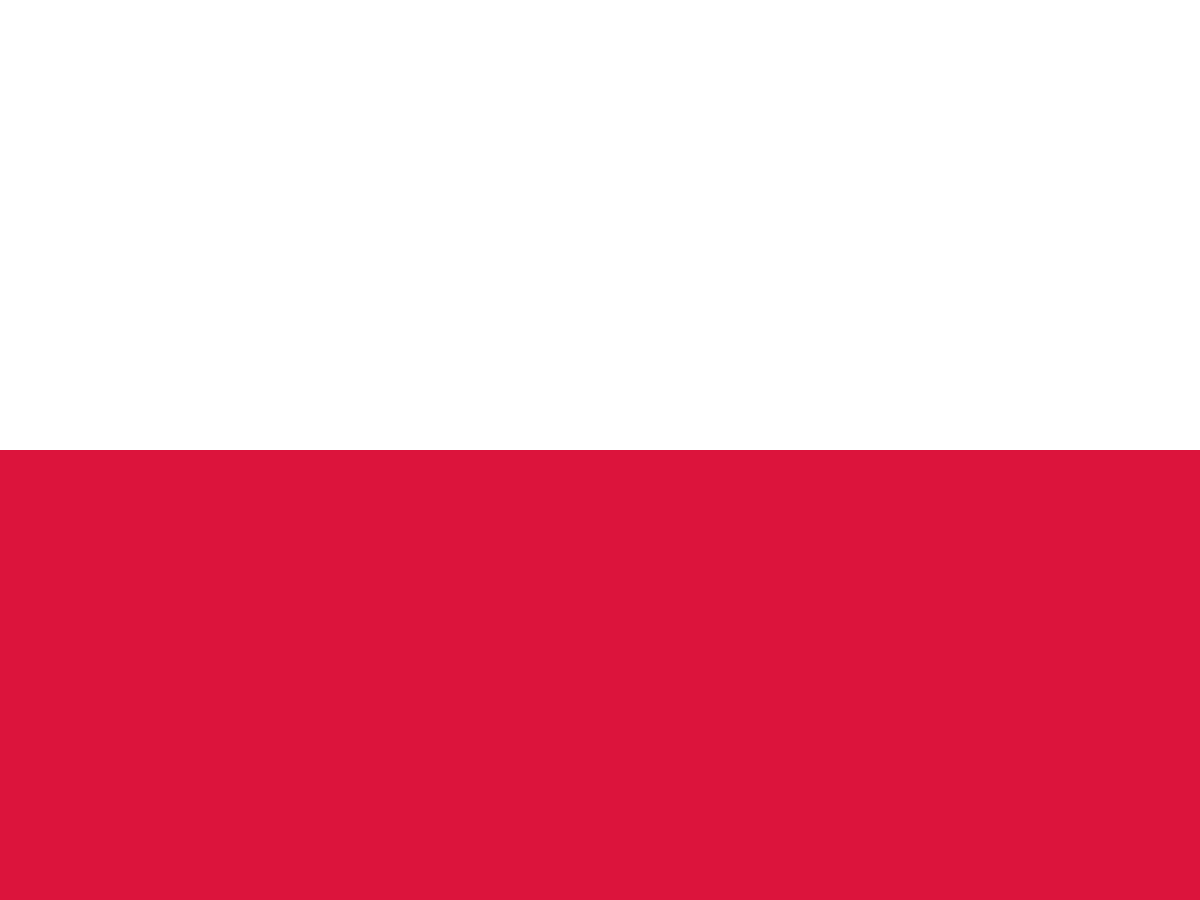
The flag of Poland
The Polish national flag consists of two equal horizontal bands: white above red.
The plain two-colour flag is the civil national flag. A version bearing the national coat of arms, a white eagle, is used by certain state institutions and on Polish diplomatic and maritime flags.
The white and red colours have been official national colours since the early 19th century.
The colours are closely connected with the Polish coat of arms, whose white eagle is shown on a red shield.
The white stripe
The white upper stripe comes from the white eagle of the Polish coat of arms. In Polish heraldic tradition, white or silver represents the eagle.
The red stripe
The red lower stripe comes from the red shield on which the Polish white eagle appears. Red became firmly established alongside white as Poland's national colour combination.
The Polish coat of arms
Poland's coat of arms features a white crowned eagle with a golden beak and talons on a red shield. The eagle has been a powerful Polish national symbol for centuries.
The white eagle
The White Eagle is one of the most important symbols of Poland. It has appeared in Polish heraldry for centuries and is associated with the country's statehood and identity.
A short history of Poland
Poland's history includes the medieval Piast dynasty, the Polish-Lithuanian Commonwealth, the partitions of the late 18th century, the struggle for independence, the devastation of the Second World War, communist rule and the democratic transformation of 1989.
History timeline
966 — Baptism of PolandMieszko I's baptism is traditionally treated as a foundational event in the Christianisation and political development of the Polish state.
1025 — Kingdom of PolandBolesław I the Brave was crowned king, strengthening Poland's status as a European kingdom.
1138 — FragmentationThe Polish realm was divided among members of the Piast dynasty, beginning a long period of political fragmentation.
1241 — Mongol invasionMongol forces invaded parts of Poland and defeated European forces at the Battle of Legnica.
1385 — Union with LithuaniaThe Union of Krewo helped create the political partnership that developed into the Polish-Lithuanian Commonwealth.
1410 — Battle of GrunwaldPolish-Lithuanian forces defeated the Teutonic Order in one of medieval Europe's major battles.
1569 — Polish-Lithuanian CommonwealthThe Union of Lublin created a powerful federation linking the Kingdom of Poland and Grand Duchy of Lithuania.
1683 — Battle of ViennaPolish king Jan III Sobieski helped lead the allied forces that defeated the Ottoman army at Vienna.
1772–1795 — Partitions of PolandRussia, Prussia and Austria partitioned Polish territory in three stages, and Poland disappeared from the political map of Europe.
1791 — Constitution of 3 MayThe Commonwealth adopted a pioneering written constitution, one of the earliest modern constitutions in the world.
1794 — Kościuszko UprisingTadeusz Kościuszko led an uprising against the partitioning powers, but the revolt was defeated.
1918 — Independence restoredAfter the First World War, Poland regained independence following 123 years of partition.
1920 — Battle of WarsawPolish forces defeated the Red Army in a major battle during the Polish-Soviet War.
1939 — Germany and Soviet Union invadeGermany invaded Poland on 1 September, followed by the Soviet invasion from the east on 17 September.
1939–1945 — German occupation and HolocaustPoland suffered catastrophic destruction and loss of life. Nazi Germany established extermination camps on occupied Polish territory, including Auschwitz-Birkenau.
1944 — Warsaw UprisingPolish resistance fighters launched an uprising against German occupation. The rebellion was eventually crushed and Warsaw was devastated.
1945 — Communist era beginsAfter the Second World War, Poland became part of the Soviet-led Eastern Bloc.
1980 — Solidarity foundedThe Solidarity trade union emerged from strikes at the Gdańsk shipyard and became a major force for political change.
1989 — Democratic transitionRound Table negotiations and elections helped end communist rule and begin Poland's transition to democracy.
1999 — NATO membershipPoland joined NATO, strengthening its integration with Western European and North American security structures.
2004 — European Union membershipPoland joined the European Union as part of the major enlargement of 2004.
TodayPoland is a parliamentary republic and a major Central European economy and member of the EU and NATO.
Polish culture
Polish culture includes a strong literary, musical, artistic and religious heritage. Folk traditions vary by region, with distinctive costumes, dances, crafts and festivals.
Poland has also produced internationally recognised figures in science, literature, music and the arts.
Polish language
Polish is a West Slavic language closely related to Czech and Slovak. It uses the Latin alphabet with additional letters and diacritical marks such as ł, ą, ę, ś and ż.
Polish food
Traditional Polish cuisine includes pierogi, bigos, żurek, barszcz, placki ziemniaczane and kiełbasa. Regional cooking varies considerably, and soups, rye, potatoes, cabbage and fermented foods feature strongly.
Pierogi
Pierogi are filled dumplings that can be savoury or sweet. Popular fillings include potato and cheese, cabbage and mushrooms, meat and fruit.
Polish music
Poland has a rich musical tradition. Frédéric Chopin is perhaps the country's most famous composer, while traditional dances such as the polonaise and mazurka have become internationally recognised.
Frédéric Chopin
Frédéric Chopin was a Polish composer and pianist of the Romantic era. His music is closely associated with Polish national identity, particularly through works inspired by Polish dances and melodies.
Polish literature
Poland has produced major writers including Adam Mickiewicz, Henryk Sienkiewicz, Wisława Szymborska and Olga Tokarczuk. Polish literature has often reflected the country's struggles with occupation, identity and political change.
The geography of Poland
Poland has a varied landscape including the Baltic Sea coast, central lowlands, lake districts, forests and the Carpathian and Sudeten mountains.
The Baltic coast
Poland has a coastline on the Baltic Sea with sandy beaches, dunes, coastal forests and historic port cities including Gdańsk, Gdynia and Szczecin.
The Tatra Mountains
The Tatra Mountains form Poland's highest mountain region. The highest Polish peak, Rysy, reaches about 2,499 metres above sea level.
Białowieża Forest
Białowieża Forest is one of Europe's last remaining large areas of primeval lowland forest. It is famous for its European bison and exceptional biodiversity.
Polish wildlife
Poland's wildlife includes European bison, wolves, lynx, brown bears, elk, beavers, otters and white-tailed eagles. Large forests and protected areas provide important habitats.
The European bison
The European bison, or żubr, is Poland's best-known large wild animal. Conservation programmes helped bring the species back from the brink of extinction.
Warsaw
Warsaw is Poland's capital and largest city. Much of its historic centre was destroyed during the Second World War and subsequently reconstructed, creating one of Europe's notable examples of post-war historic rebuilding.
Kraków
Kraków was Poland's royal capital for centuries and remains one of the country's major cultural and tourist centres. Its historic centre includes Wawel Castle and the medieval Main Market Square.
Gdańsk
Gdańsk is a major Baltic port with a long history of trade and political importance. It was also the birthplace of the Solidarity movement at the Lenin Shipyard.
The Second World War
Poland was one of the countries most devastated by the Second World War. Nazi Germany and the Soviet Union occupied the country, millions of Polish citizens were killed, and Poland's Jewish population suffered the Holocaust.
Auschwitz-Birkenau
Auschwitz-Birkenau was the largest Nazi German concentration and extermination camp complex. It has become one of the world's most important memorial sites to the Holocaust and the victims of Nazi persecution.
The Warsaw Uprising
The Warsaw Uprising of 1944 was an attempt by the Polish underground to liberate the capital from German occupation before Soviet forces took control. The uprising lasted 63 days and ended in defeat, followed by the systematic destruction of much of the city.
Solidarity
Solidarity began as an independent trade union in 1980 and grew into a huge social movement challenging communist rule. Its success helped inspire democratic change across Central and Eastern Europe.
The economy
Poland has one of Central Europe's largest economies, with major sectors including manufacturing, services, information technology, automotive production, food processing and finance.
Polish science
Poland has made major contributions to science. Marie Curie, born Maria Skłodowska in Warsaw, became a pioneering physicist and chemist and the first person to receive Nobel Prizes in two different sciences.
Marie Curie
Marie Curie was born in Warsaw and later worked in France. Her research into radioactivity led to Nobel Prizes in Physics and Chemistry and helped transform modern science and medicine.
Poland and the European Union
Poland joined the European Union in 2004 and has become one of the EU's largest member states by population and territory. It also plays a significant role in Central European politics and security.
Why is Poland's flag interesting?
Poland's flag is simple but deeply connected to the country's coat of arms and long history. The white eagle on red has been a powerful Polish symbol for centuries, while the white-and-red national colours became especially important during the struggle to restore independence.
The flag is also a useful example of how a national colour scheme can be derived directly from heraldry.
Explore Poland on FlagAtlas
Continue exploring Poland and the world's flags with these FlagAtlas resources.