About Qatar
Qatar is a small peninsula in the Arabian Gulf. Its modern economy has been transformed by oil and, particularly, natural gas, while Doha has developed into a major regional business, cultural and sporting centre.
Qatar is also known for its desert landscape, traditional dhow boats, pearl-diving heritage, modern architecture and rapid infrastructure development.
CapitalDoha
RegionArabian Peninsula
PopulationAbout 3 million
CurrencyQatari riyal
Official languageArabic
Independence1971
The Qatar flag
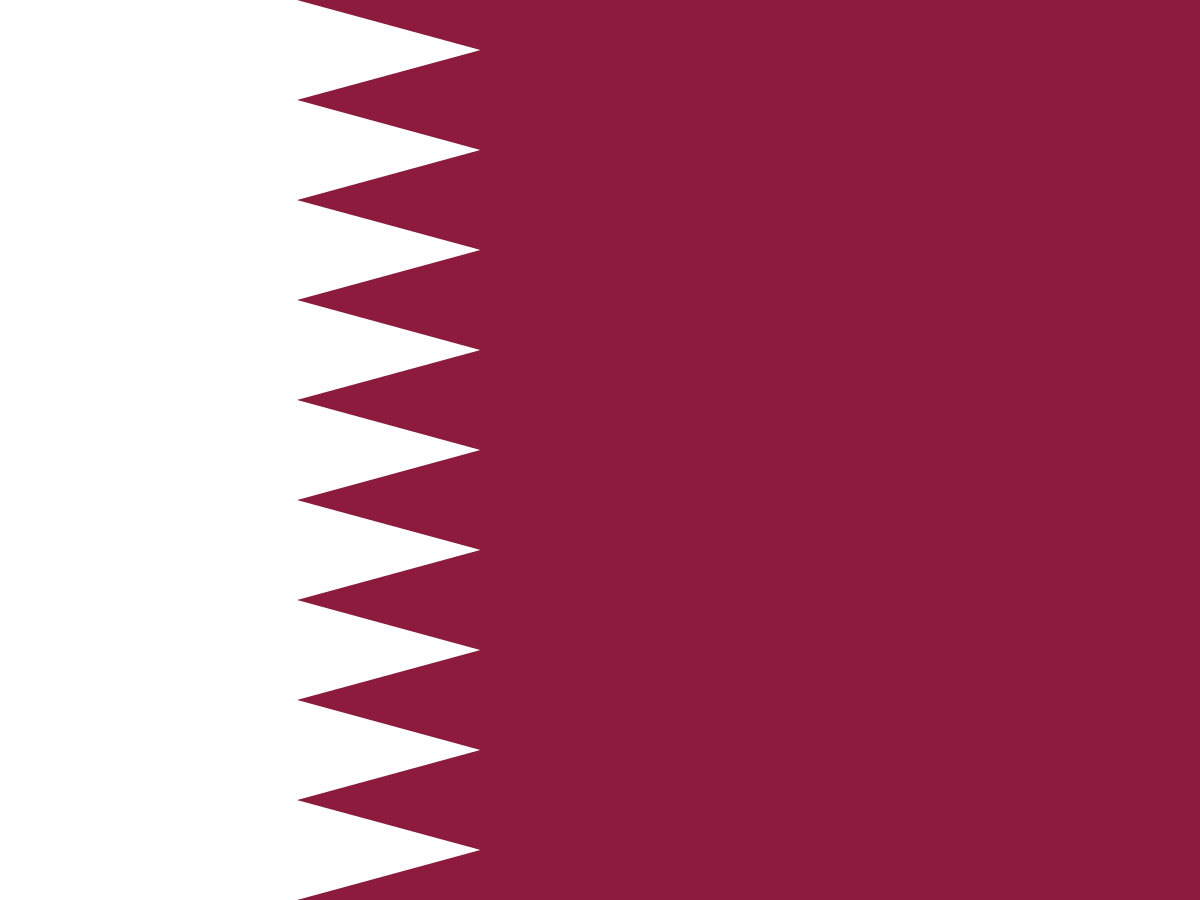
Qatar's national flag is maroon and white. The maroon section is at the hoist and the white section at the fly, with the two colours separated by a distinctive nine-point serrated edge.
The flag is unusually tall compared with many national flags and has one of the world's most recognisable colour combinations.
Maroon
The flag's maroon colour developed from the red flags historically used in the Gulf. Qatar's red became darker through exposure to the intense sun and was eventually established as the distinctive maroon associated with the country.
White
The white section represents peace and provides a strong contrast with the maroon field. White is also a common colour in flags and traditions across the Gulf region.
The nine points
The boundary contains nine triangular points. They are traditionally associated with Qatar being recognised as the ninth member of the reconciled Gulf emirates following the 1916 Anglo-Qatari treaty.
Flag proportions
Qatar's flag has an unusually tall design. Its official proportions are 11:28, making it noticeably deeper than most rectangular national flags.
A short history of Qatar
Qatar's history stretches from ancient settlements and Gulf trading networks to pearl fishing communities and, later, a modern energy-rich state. Before the oil era, pearling, fishing, trading and camel herding were central to life on the peninsula.
Qatar became a British-protected state in the early 20th century and gained full independence in 1971.
History timeline
Ancient period — Early settlementArchaeological evidence shows that people have lived on the Qatari peninsula for thousands of years, with links to wider Gulf trading networks.
7th century — Islam reaches QatarThe peninsula became part of the expanding Islamic world and developed closer links with neighbouring Gulf communities.
18th century — Al Thani family risesThe Al Thani family became increasingly influential in Qatar and remains the country's ruling family.
19th century — Pearling economyPearling became a major source of income, with coastal communities relying on seasonal diving and Gulf trade.
1868 — British recognitionAn agreement with Britain helped establish Qatar's position as a distinct political entity in the Gulf.
1916 — Anglo-Qatari treatyQatar entered a treaty relationship with Britain and became a British-protected state while retaining internal autonomy.
1939 — Oil discoveredOil was discovered at Dukhan. Commercial production was delayed by the Second World War but eventually transformed the country's economy.
1949 — First oil exportsQatar began exporting oil, creating a major new source of government revenue and accelerating modernisation.
1961 — OPEC membershipQatar joined OPEC as its oil industry became increasingly important.
1971 — IndependenceQatar became fully independent from Britain on 3 September 1971 and joined the United Nations later that month.
1970s–1990s — Natural gas developmentQatar began developing the enormous North Field gas reserves that would eventually make it a leading LNG exporter.
1995 — New leadershipHamad bin Khalifa Al Thani became Emir, beginning a period of rapid economic and international development.
1996 — Al Jazeera launchedAl Jazeera was launched in Doha and grew into a major international news network.
2006 — Asian GamesDoha hosted the Asian Games, strengthening Qatar's reputation as an international sporting destination.
2010 — World Cup awardedQatar was selected to host the 2022 FIFA World Cup, the first tournament of its kind in the Arab world.
2017–2021 — Gulf diplomatic crisisSeveral neighbouring states imposed a diplomatic and economic blockade on Qatar. The dispute ended with the Al-Ula agreement in 2021.
2022 — FIFA World CupQatar hosted the FIFA World Cup, becoming the first Middle Eastern and Arab host nation.
TodayQatar is a sovereign emirate with a major hydrocarbon economy and growing investment in finance, tourism, logistics, technology and sport.
Pearling
Before oil transformed Qatar, pearling was one of the peninsula's most important industries. Divers spent months at sea collecting oysters, while merchants traded pearls around the Gulf and beyond.
The collapse of the traditional pearling economy in the early 20th century caused severe hardship before oil revenues changed Qatar's fortunes.
Dhow boats
Traditional dhows are wooden sailing vessels historically used for fishing, pearling and trade throughout the Arabian Gulf. They remain an important symbol of Qatar's maritime heritage.
Geography
Qatar is a relatively flat, low-lying peninsula extending northwards into the Arabian Gulf. Much of the country consists of rocky desert, gravel plains and sandy areas, with very little permanent freshwater.
Khor Al Adaid
Khor Al Adaid, often called the Inland Sea, is a spectacular area where seawater reaches deep into the desert. It is one of Qatar's best-known natural landscapes and lies close to the Saudi Arabian border.
Climate
Qatar has a hot desert climate. Summers are extremely hot and humid, while winters are considerably milder. Rainfall is low and generally occurs in short, irregular periods.
Wildlife
Despite its desert environment, Qatar supports Arabian oryx, dugongs, sea turtles, dolphins, flamingos and many migratory birds.
Arabian oryx
The Arabian oryx is one of Qatar's best-known national animals. Conservation programmes have helped recover the species after it was once close to extinction in the wild.
Marine life
Qatar's surrounding waters support dugongs, dolphins, sea turtles, coral communities and many fish species. Seagrass beds and coastal habitats are particularly important for marine wildlife.
Qatari culture
Qatari culture combines Arabian Peninsula traditions, Islamic heritage and Gulf maritime history. Hospitality, family, poetry, traditional dress, falconry and food remain important parts of cultural life.
Falconry
Falconry has deep roots in Gulf society and remains an important Qatari cultural tradition. Falcons are carefully bred, trained and cared for.
Traditional dress
Traditional Qatari clothing includes the thobe for men and the abaya for women. Clothing reflects wider Gulf and Islamic traditions while retaining local styles.
Qatari food
Qatari cuisine has been influenced by Arabian, Persian, Indian and East African traditions. Popular dishes include machboos, harees, thareed and balaleet.
Machboos
Machboos is one of Qatar's best-known dishes. It usually combines spiced rice with meat or seafood and ingredients such as dried lime, cardamom and cinnamon.
Doha
Doha is Qatar's capital and largest city. It has developed rapidly, combining traditional markets and historic areas with modern skyscrapers, museums and major sporting facilities.
Souq Waqif
Souq Waqif is a traditional-style market in central Doha. Its shops, restaurants and narrow lanes offer a strong contrast with the city's modern skyline.
Museum of Islamic Art
Doha's Museum of Islamic Art contains a major collection spanning more than a millennium of Islamic artistic heritage. Its waterfront building is one of Doha's best-known landmarks.
The economy
Qatar has one of the world's highest levels of income per person, largely because of its enormous natural gas and oil reserves. LNG exports are particularly important, while the country is also investing in finance, tourism, logistics and technology.
North Field
The North Field is one of the world's largest natural gas fields. Qatar's development of this resource transformed its economic position and made it a leading LNG exporter.
Liquefied natural gas
Qatar is a major exporter of liquefied natural gas (LNG). Natural gas is cooled into liquid form so it can be transported by specialised ships to customers around the world.
Qatar and sport
Qatar has invested heavily in international sport, hosting events including the Asian Games, athletics championships and the FIFA World Cup. Sport has become an important part of the country's international profile.
The 2022 FIFA World Cup
Qatar hosted the 2022 FIFA World Cup, the first World Cup held in the Arab world. The tournament was played in eight stadiums, most in and around Doha.
Al Jazeera
Al Jazeera was launched in Doha in 1996 and became one of the world's best-known Arabic-language news networks. Its international channels have given Qatar a prominent role in global media.
Qatar's international role
Qatar has developed an active foreign policy and has often sought to act as a mediator in regional conflicts and diplomatic disputes. Its wealth has also enabled major international investments.
Why is Qatar's flag interesting?
Qatar's flag is one of the world's most distinctive national flags because of its unusual maroon colour, nine-point serrated edge and tall proportions.
The design connects the modern country with its Gulf history and the development of its national identity.
Explore Qatar on FlagAtlas
Continue exploring Qatar and the world's flags with these FlagAtlas resources.