Americas
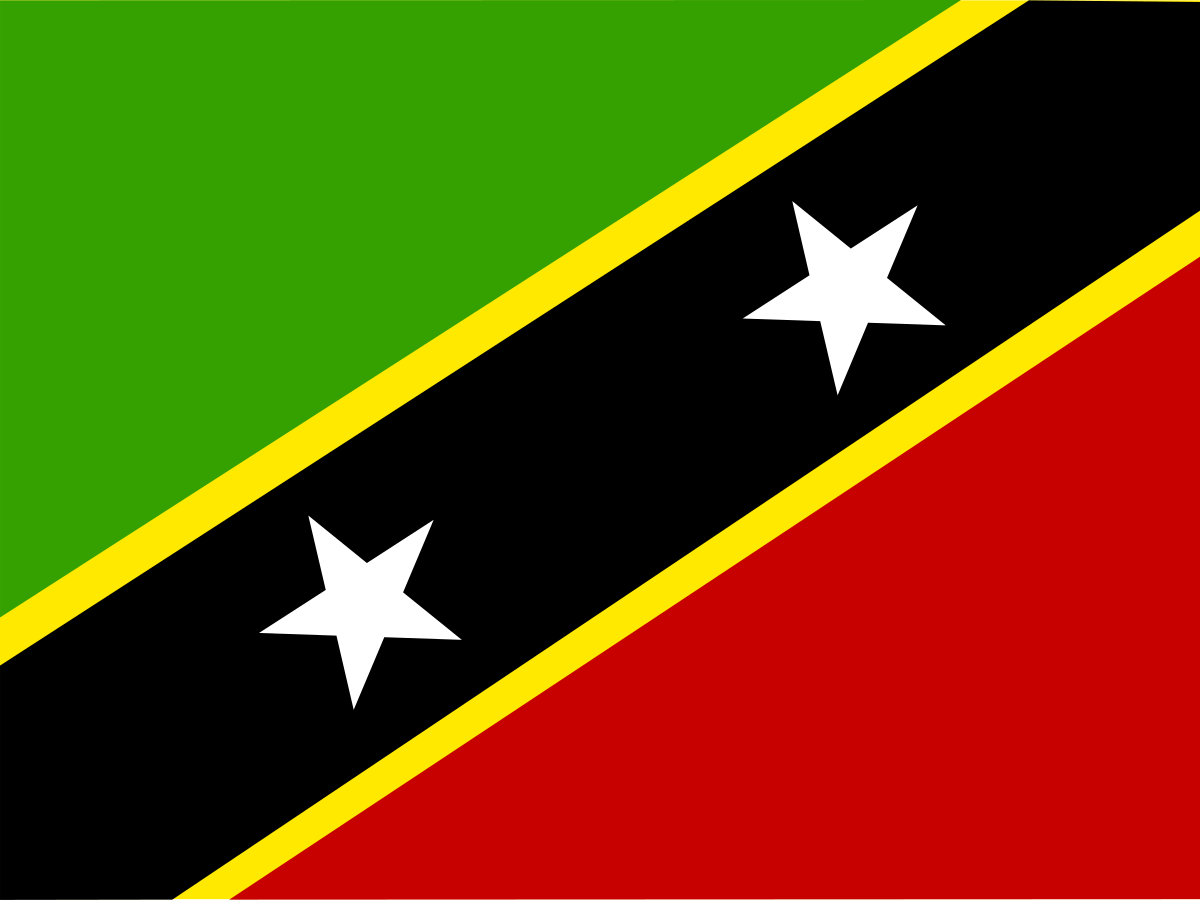
Saint Kitts and Nevis Flag
Green represents the fertile land, red stands for the African heritage struggle against slavery, yellow symbolises year-round sunshine, black represents the African heritage, and the two white stars stand for the two islands.
Capital
Basseterre
Continent
Americas
Population
53 thousand
Development indicators
GDP per capita
$17,800
USD per year (approx. 2023)
Human Development Index
0.838
Very High development
World Bank income classification
High Income (HIC)
HIC
🌡️ Climate: Tropical
Flag symbolism
Green represents the fertile land, red stands for the African heritage struggle against slavery, yellow symbolises year-round sunshine, black represents the African heritage, and the two white stars stand for the two islands.
starsdiagonal
Did you know?
Saint Kitts and Nevis was the first British colony in the Caribbean, settled in 1623.
Test your knowledge
Think you know your world flags? Try the FlagAtlas daily challenge, speed quiz, or explore all Americas flags.
📚 Revising for GCSE Geography? Visit our free revision page →
About Saint Kitts and Nevis
Saint Kitts and Nevis is a two-island country in the eastern Caribbean and the smallest sovereign state in the Americas by both area and population. The two islands lie between the Caribbean Sea and the Atlantic Ocean.
Basseterre, on Saint Kitts, is the capital. The country is known for volcanic mountains, beaches, tropical vegetation and a history closely connected with sugar production and the British Caribbean.
CapitalBasseterre
RegionCaribbean
PopulationAbout 50,000
CurrencyEast Caribbean dollar
Official languageEnglish
Independence1983
The Saint Kitts and Nevis flag
The national flag was adopted on 19 September 1983, the day the country became independent. It has green and red fields separated by a black diagonal band edged in yellow, with two white five-pointed stars on the black band.
The colours were deliberately chosen to represent the islands' land, sunlight, African heritage, struggle against slavery and hopes for freedom.
Green
Green represents the fertile land of Saint Kitts and Nevis. Agriculture, especially sugar cultivation, was historically central to the islands' economy.
Red
Red represents the struggle from slavery through colonialism towards independence. It is a reminder of the sacrifices made during the islands' long journey to self-government.
Yellow
The yellow borders of the black band represent the year-round sunshine of the Caribbean islands.
Black
The black diagonal band represents the country's African heritage and the people whose ancestors were brought to the Caribbean during the era of slavery.
The two white stars
The two white stars represent the two islands of Saint Kitts and Nevis. White also symbolises hope and liberty, giving the stars a positive meaning within the design.
A short history
Saint Kitts and Nevis has a long Indigenous history before European settlement. The islands were colonised by Europeans in the 17th century and became major sugar-producing territories under British rule.
The federation achieved internal self-government before becoming an independent state in 1983. Nevis has also had a long-running political movement seeking greater autonomy, including an independence movement of its own.
History timeline
Before European settlement — Indigenous peoplesThe islands were inhabited by Indigenous Caribbean peoples long before Europeans arrived.
1493 — Columbus reaches the regionChristopher Columbus encountered the Caribbean islands during his second voyage, although permanent European colonisation came later.
1623 — English settlement on Saint KittsSaint Kitts became one of the earliest English colonies in the Caribbean.
1625 — French settlementFrench settlers established a presence on Saint Kitts, beginning a long period of rivalry between Britain and France over the island.
17th–18th centuries — Sugar economySugar became the dominant crop and plantation economy, relying heavily on enslaved African labour.
1713 — British control consolidatedUnder the Treaty of Utrecht, Saint Kitts became British, while the wider region remained contested.
1783 — Nevis and Saint Kitts remain BritishThe Treaty of Versailles confirmed British control after the American Revolutionary period.
1834 — Slavery abolishedEmancipation legislation ended slavery in the British Caribbean, followed by a period of apprenticeship before full freedom.
1871 — Leeward Islands federationSaint Kitts and Nevis became part of the British Leeward Islands administrative federation.
1930s — Labour unrestEconomic hardship and poor working conditions contributed to labour disturbances and the growth of organised political movements.
1967 — Associated StatehoodSaint Kitts, Nevis and Anguilla became an associated state of the United Kingdom with substantial internal self-government.
1970s — Anguilla separatesAnguilla broke away from the associated state and later became a separate British overseas territory.
1983 — IndependenceSaint Kitts and Nevis became an independent country on 19 September 1983 and adopted its current national flag.
1990s–2000s — Tourism expandsTourism grew as the country diversified beyond the traditional sugar economy.
2005 — Sugar industry endsCommercial sugar production was ended on Saint Kitts after centuries as the island's dominant industry.
TodaySaint Kitts and Nevis is a small independent Caribbean state whose economy is strongly connected with tourism, services and international finance.
Basseterre
Basseterre is the capital and main commercial centre of Saint Kitts and Nevis. It sits on a bay on the southwest coast of Saint Kitts and contains historic buildings, government offices, markets and the main port.
Saint Kitts
Saint Kitts is the larger of the two islands. Its centre is dominated by Mount Liamuiga, a volcanic peak rising to about 1,156 metres, while the island's coastline contains beaches and historic plantation sites.
Nevis
Nevis is the smaller of the two islands and is dominated by Nevis Peak, a volcanic mountain. The island is known for its green interior, hot springs, beaches and historic links to Alexander Hamilton, who was born on Nevis.
Mount Liamuiga
Mount Liamuiga is a dormant volcano and the highest point in Saint Kitts and Nevis. Its slopes are covered with tropical vegetation and provide habitats for many native species.
Climate
Saint Kitts and Nevis has a tropical climate with warm temperatures throughout the year. Rainfall varies by location, with the mountainous interiors generally wetter than some coastal areas.
Wildlife
The islands support tropical birds, reptiles and marine life. Green monkeys are a familiar sight on Saint Kitts, while surrounding waters contain coral reefs, sea turtles and a variety of fish.
Marine environment
The waters around Saint Kitts and Nevis are important for coral reefs, sea turtles and fisheries. Marine conservation is increasingly important as the country balances tourism with protection of its coastal environment.
Caribbean culture
Culture in Saint Kitts and Nevis combines African, European and Caribbean influences. Music, dance, carnival and food all reflect the islands' complex colonial and post-emancipation history.
Carnival
Saint Kitts hosts National Carnival, known as Sugar Mas, around the Christmas and New Year period. Parades, music, costumes, pageants and street celebrations are major parts of the event.
Music
Calypso, soca and other Caribbean musical traditions are popular. Music forms a major part of carnival and community life on both islands.
Food
Traditional food includes goat water, saltfish, conch, seafood, rice and peas and locally grown vegetables. Caribbean cooking traditions are combined with ingredients and recipes that developed during the islands' plantation history.
Sugar and the plantation era
Sugar transformed Saint Kitts and Nevis for centuries. Large plantations dominated the landscape and economy, while enslaved Africans provided much of the labour. Historic estates and sugar works remain important reminders of this period.
Brimstone Hill Fortress
Brimstone Hill Fortress National Park on Saint Kitts is one of the Caribbean's best-preserved military complexes. Built by the British over many decades, it reflects the strategic importance of the island during European colonial rivalry.
The economy
Tourism is a major part of the modern economy, alongside services, construction, manufacturing and agriculture. The country has also developed offshore financial and business services.
Tourism
Visitors are attracted by beaches, volcanic scenery, historic sites, sailing and cruise tourism. The country's small scale allows travellers to combine cultural and natural attractions relatively easily.
Sport
Cricket is particularly popular, reflecting the country's British Caribbean heritage. Football and athletics are also widely followed and played.
Alexander Hamilton
Alexander Hamilton, one of the founding figures of the United States, was born on Nevis in the 18th century. His birthplace has become an important historical site on the island.
Why is this flag interesting?
The Saint Kitts and Nevis flag is distinctive because its diagonal black band creates a strong visual split between green and red. The two white stars immediately reinforce the country's identity as a federation of two islands.
Explore Saint Kitts and Nevis on FlagAtlas
Keep exploring flags, geography and printable activities without relying on unconfirmed country-specific links.
Sources & further reading
This expanded page keeps the supplied FlagAtlas content and adds educational background on the flag, history, geography, culture and economy of Saint Kitts and Nevis.
Encyclopaedia Britannica — Saint Kitts and Nevis