About Saint Lucia
Saint Lucia is a mountainous island country in the eastern Caribbean, part of the Windward Islands. It is famous for its volcanic landscape, tropical forests and the dramatic twin Pitons.
Castries is the capital and largest city. Saint Lucia became an independent country in 1979 and remains a member of the Commonwealth.
CapitalCastries
RegionCaribbean
PopulationAbout 180,000
CurrencyEast Caribbean dollar
Official languageEnglish
Independence1979
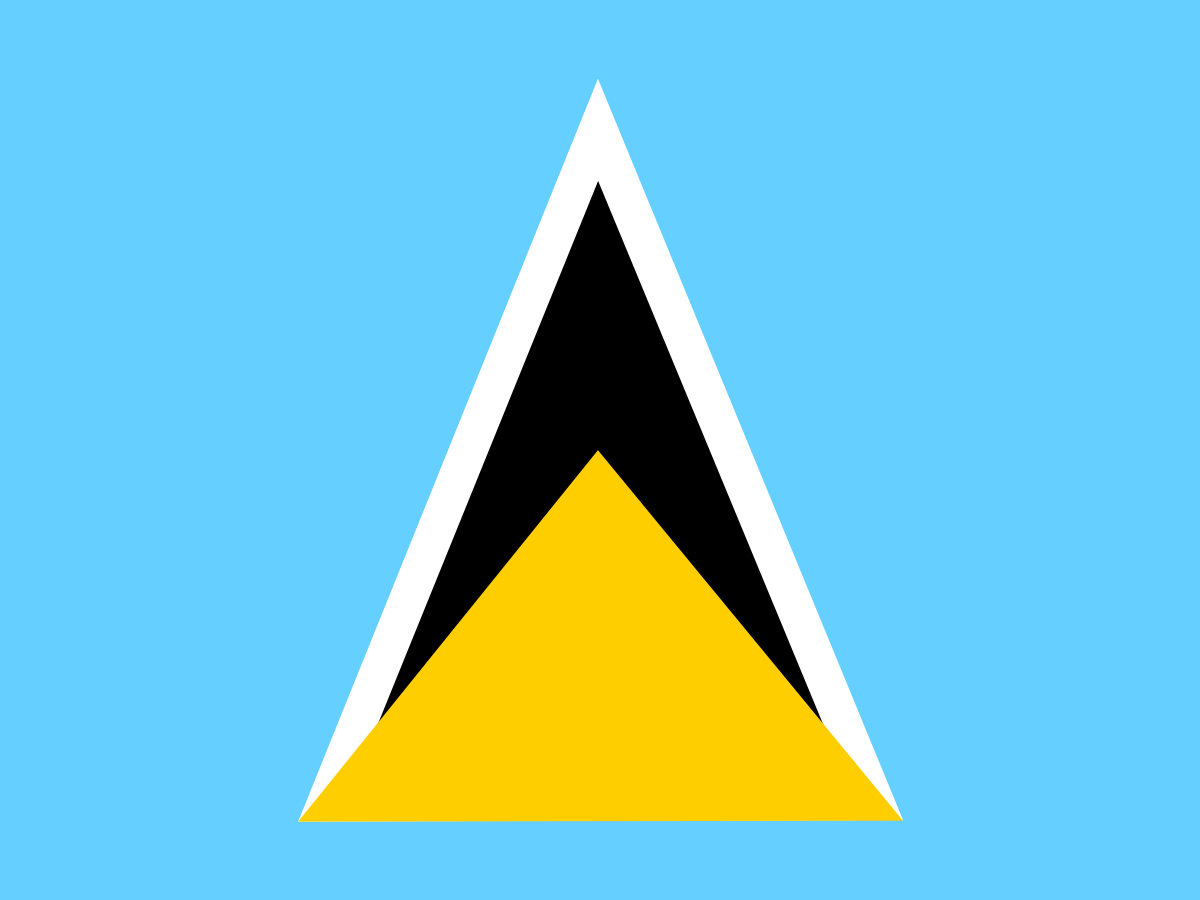
The Saint Lucia flag
Saint Lucia's national flag was designed by Dunstan St. Omer. The current design was adopted at independence and later modified, with the present version dating from 2002.
It has a cerulean-blue field with overlapping black, white and gold triangular shapes. The central design is inspired by the island's famous Pitons.
Cerulean blue
The government's official description says cerulean blue represents fidelity and reflects Saint Lucia's tropical sky and its surrounding waters, including the Caribbean Sea and Atlantic Ocean. citeturn0search0
Gold
The gold represents the Caribbean sunshine and prosperity. It also gives the central design a strong visual link to the island's bright tropical environment. citeturn0search0
Black and white
The black and white elements represent the cultural influences of Africa and Europe and the two communities living and working together. citeturn0search0
The triangles and the Pitons
The central triangular forms are a stylised reference to Saint Lucia's famous twin Pitons at Soufrière. The government's description also connects the triangular design with the hope and aspirations of the people. citeturn0search0
The designer — Dunstan St. Omer
Saint Lucian artist Dunstan St. Omer designed the national flag. His design became one of the most recognisable symbols of modern Saint Lucia. The government identifies him as the designer of the national flag. citeturn0search0
A short history of Saint Lucia
Saint Lucia has a complex history shaped by Indigenous Caribbean peoples, European rivalry, plantation agriculture and the movement towards independence. Britain and France fought repeatedly for control of the island before British rule became established.
Saint Lucia gained associated statehood in 1967 and became fully independent on 22 February 1979.
History timeline
Before European settlement — Indigenous Saint LuciaIndigenous peoples inhabited the island long before European colonisation. Historical sources record earlier names including Iouanalao and Hewanorra.
16th–17th centuries — European contactEuropean sailors and colonists began appearing in the region. The precise story of the island's earliest European encounters remains partly uncertain.
17th century — French and English settlementBoth France and England established settlements and competed for control of the island.
18th century — Repeated British-French conflictSaint Lucia changed hands several times during the colonial wars of the Caribbean.
1814 — British rule confirmedThe Treaty of Paris confirmed British possession of Saint Lucia after the Napoleonic Wars.
1834 — EmancipationSlavery was abolished throughout the British Empire, transforming the island's plantation society.
1930s–1950s — Political changeTrade unions and political organisations grew as Saint Lucians pushed for better working conditions and greater representation.
1958–1962 — West Indies FederationSaint Lucia joined the short-lived West Indies Federation as Britain explored new forms of Caribbean self-government.
1967 — Associated StatehoodThe Associated Statehood Act gave Saint Lucia internal self-government while Britain retained responsibility for external affairs and defence. citeturn0search11
1979 — IndependenceSaint Lucia became an independent nation on 22 February 1979.
1980s–1990s — Tourism growsTourism became increasingly important alongside agriculture, manufacturing and services.
2002 — Flag modificationThe national flag was modified, with the official proportions and colours defined for the modern design. citeturn0search11
TodaySaint Lucia is a Caribbean parliamentary democracy with a diversified economy and a strong international reputation for tourism, scenery and culture.
Castries
Castries is Saint Lucia's capital and main commercial centre. It sits around a natural harbour and is an important centre for government, shopping, cruise tourism and transport.
The Pitons
The Pitons — Gros Piton and Petit Piton — are two dramatic volcanic plugs rising beside the Caribbean Sea at Soufrière. They are Saint Lucia's most famous natural landmarks and are reflected directly in the national flag.
Soufrière
Soufrière lies in the shadow of the Pitons and is associated with Saint Lucia's volcanic landscape. The area includes hot springs, volcanic features and rainforest and is one of the island's major tourism regions.
Mount Gimie
Mount Gimie is Saint Lucia's highest mountain, rising to about 959 metres. The mountainous interior contains dense tropical rainforest and numerous rivers.
Climate
Saint Lucia has a tropical climate with warm temperatures throughout the year. The mountainous interior receives more rainfall than many coastal areas, supporting lush rainforest.
Rainforest
The interior of Saint Lucia contains tropical rainforest that supports a rich variety of plants, birds and other wildlife. Forest conservation is important for biodiversity, water supplies and tourism.
Saint Lucia parrot
The Saint Lucia parrot (Amazona versicolor) is the country's national bird. Conservation efforts helped this endemic species recover from a very small population, making it an important national conservation success story.
Wildlife
Saint Lucia's wildlife includes endemic birds, reptiles and tropical marine species. Its forests and surrounding waters provide habitats for a wide range of animals.
The economy
Saint Lucia's economy is strongly connected to tourism and services, alongside agriculture, manufacturing and other activities. Bananas were historically an important export crop, while tourism has become one of the country's most significant industries.
Tourism
Visitors are drawn to Saint Lucia for its beaches, Pitons, rainforest, sailing, diving, volcanic attractions and resorts. The island combines natural scenery with a strong Caribbean cultural identity.
Bananas and agriculture
Agriculture has played an important role in Saint Lucia's economy, particularly banana production. Small-scale farming continues to contribute to rural livelihoods and the domestic food supply.
Saint Lucian culture
Saint Lucian culture reflects African, European, Caribbean and Indigenous influences. Music, food, festivals, storytelling and the island's distinctive Creole heritage all contribute to its identity.
Creole culture
Kwéyòl, the French-based Creole language spoken in Saint Lucia, remains an important part of cultural life. It is especially associated with traditional music, storytelling and festivals.
Music
Saint Lucia has a lively music scene including soca, calypso, reggae and zouk. Local music is particularly prominent during carnival and community celebrations.
Food
Saint Lucian cuisine includes green figs and saltfish, seafood, plantains, breadfruit, cassava and Creole-style dishes. The food reflects the island's Caribbean and African heritage as well as its tropical agriculture.
Carnival
Saint Lucia's Carnival is one of the island's major annual cultural celebrations. Music, costumes, parades, competitions and street events bring together communities and visitors.
Nobel Prize connection
Saint Lucia has produced two Nobel laureates: Derek Walcott, who won the Nobel Prize in Literature in 1992, and Arthur Lewis, who won the Nobel Prize in Economic Sciences in 1979. This is an extraordinary achievement for a small island nation.
Derek Walcott
Poet and playwright Derek Walcott was born in Saint Lucia and became one of the Caribbean's most internationally influential writers. He received the Nobel Prize in Literature in 1992.
Arthur Lewis
Economist Arthur Lewis was born in Saint Lucia and became a major figure in development economics. He shared the 1979 Nobel Prize in Economic Sciences for work on economic development.
National Day
Saint Lucia celebrates its independence on 22 February. The date is the country's national day and is marked by ceremonies, cultural events and displays of the national flag.
Flag etiquette
Saint Lucia has an official code governing the display of its national flag. Government guidance says the flag is normally flown from 6 a.m. to 6 p.m., with specific rules for ceremonies, half-staff display and respectful handling. citeturn0search0
Why is Saint Lucia's flag interesting?
Saint Lucia's flag is unusual because its central design is not simply decorative: the overlapping triangles deliberately evoke the island's twin Pitons. The combination of cerulean blue, gold, black and white also communicates ideas of sea and sky, sunshine, prosperity and cultural unity. citeturn0search0
Explore Saint Lucia on FlagAtlas
Keep exploring flags and educational resources without relying on unconfirmed country-specific links.