About Saudi Arabia
Saudi Arabia is the largest country on the Arabian Peninsula and occupies most of the peninsula's interior. It borders the Red Sea to the west and the Arabian Gulf to the east.
The country is home to Islam's two holiest cities, Makkah (Mecca) and Madinah (Medina), and has a major role in the global energy economy.
CapitalRiyadh
RegionWestern Asia
PopulationAbout 35 million
CurrencySaudi riyal
Official languageArabic
Kingdom founded1932
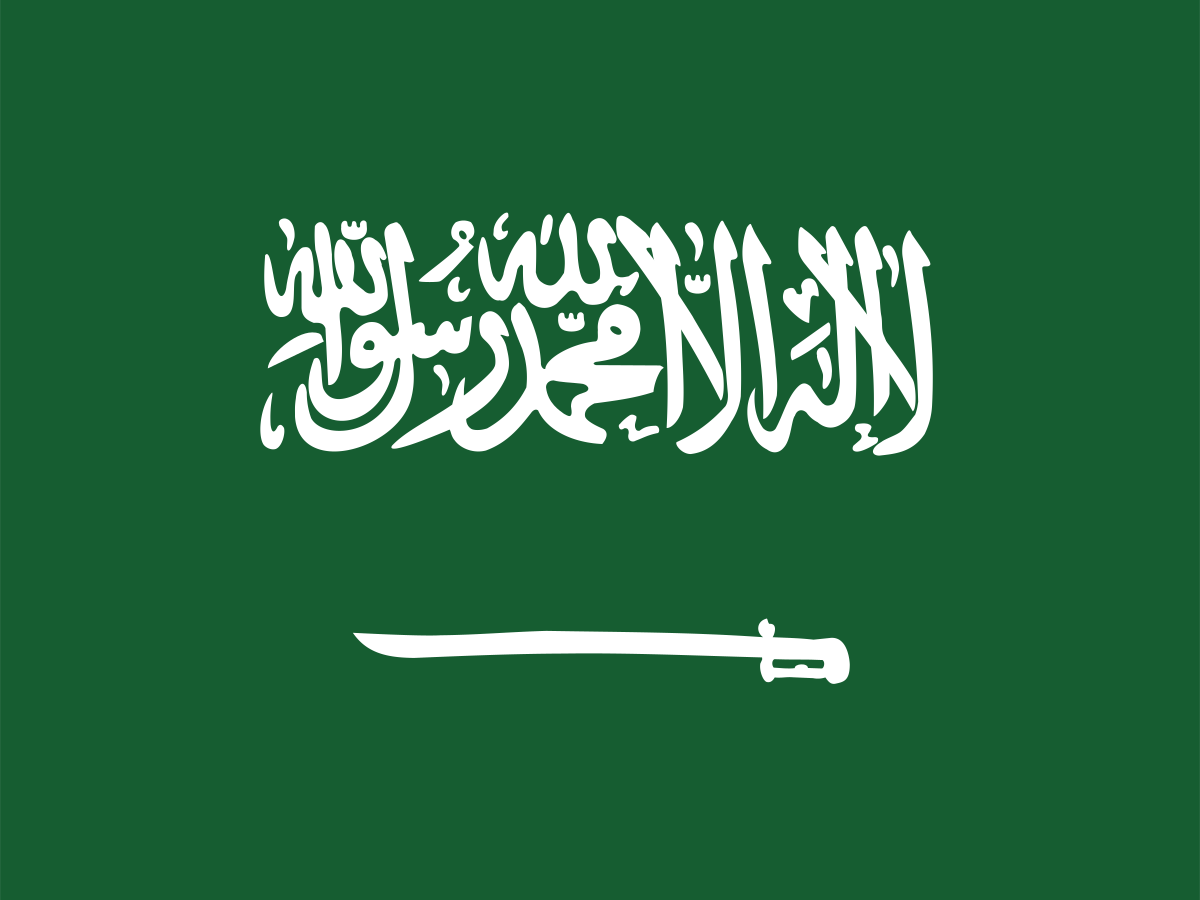
The Saudi Arabia flag
The Saudi flag is a green field bearing the shahada, the Islamic declaration of faith, in white Arabic script. A white sword is placed horizontally beneath the inscription, with its point facing the hoist.
The flag's design is deeply connected with Islam and Saudi Arabia's religious and political identity. Because the shahada is sacred text, the flag is treated with particular respect.
Green
The green field is strongly associated with Islam and has a long history in Islamic and Arabian symbolism. Green is also associated with life, fertility and the natural world.
White
The white shahada and sword provide a strong contrast against the green field. White is traditionally associated with purity and peace in many Islamic contexts.
The shahada
The central inscription is the shahada, the Islamic declaration of faith: that there is no deity but God and that Muhammad is the Messenger of God. Its presence makes the Saudi flag especially distinctive among national flags.
The sword
The white sword represents justice and strength. Its placement beneath the shahada is a defining feature of the modern Saudi flag.
Why is the Saudi flag not flown at half-mast?
Because the flag carries the shahada, lowering it to half-mast is generally considered inappropriate and disrespectful to the sacred text. This is one reason the Saudi flag is treated differently from many national flags during mourning.
A short history
The history of Saudi Arabia combines ancient Arabian kingdoms and trade routes, the rise of Islam, centuries of regional dynasties and the modern unification of the Arabian Peninsula.
The modern Kingdom of Saudi Arabia was established on 23 September 1932 by King Abdulaziz ibn Saud after decades of campaigns that brought much of the peninsula under his rule.
History timeline
Ancient Arabia — Trade and kingdomsThe Arabian Peninsula supported important trade routes linking the Mediterranean, Red Sea, East Africa and South Asia.
7th century — Rise of IslamIslam emerged in western Arabia. Makkah and Madinah became central to the new faith and remain its most important holy cities.
1744 — First Saudi stateMuhammad ibn Saud formed an alliance with the religious reformer Muhammad ibn Abd al-Wahhab, creating the basis for the First Saudi State.
1818 — First Saudi State endsOttoman-Egyptian forces defeated the First Saudi State and destroyed its capital at Diriyah.
1824 — Second Saudi StateTurki ibn Abdullah established a new Saudi state centred on Riyadh.
1891 — Rashidi conquestThe Al Saud were driven from Riyadh and Abdulaziz ibn Saud later spent years in exile in Kuwait.
1902 — Riyadh recapturedAbdulaziz ibn Saud captured Riyadh, beginning the modern phase of Saudi unification.
1925 — Hejaz incorporatedAbdulaziz took control of the Hejaz, including Makkah and Madinah.
1932 — Kingdom establishedThe Kingdom of Saudi Arabia was formally proclaimed on 23 September 1932.
1938 — Oil discoveredCommercial quantities of oil were discovered at Dammam, transforming Saudi Arabia's economic future.
1945 — International role growsSaudi Arabia's global diplomatic importance increased during and after the Second World War, including its relationship with the United States.
1960 — OPEC foundedSaudi Arabia was one of the five founding members of the Organization of the Petroleum Exporting Countries.
1973 — Oil embargoSaudi Arabia and other Arab oil producers imposed an oil embargo on countries supporting Israel during the Yom Kippur War.
1986 — Modern flag standardisationThe present basic form of the Saudi flag, with the shahada and sword, was standardised in the modern era.
2005 — King AbdullahAbdullah became king and introduced a period of gradual social and economic reforms.
2016 — Vision 2030 announcedSaudi Arabia launched Vision 2030, a programme aimed at diversifying the economy and reducing dependence on oil.
2018 — Women driveSaudi Arabia ended the prohibition on women driving, one of the most visible social changes of recent decades.
TodaySaudi Arabia remains a major regional power and is undergoing large-scale economic, social and infrastructure changes.
Riyadh
Riyadh is the capital and largest city. It has grown from a historic oasis settlement into a major political, financial and business centre with a rapidly expanding skyline and infrastructure network.
Makkah (Mecca)
Makkah is Islam's holiest city and the destination of the annual Hajj pilgrimage. At its centre is the Kaaba within Masjid al-Haram. Non-Muslims are not permitted to enter the city.
Madinah (Medina)
Madinah is Islam's second-holiest city. It is associated with the Prophet Muhammad's migration from Makkah and contains Al-Masjid an-Nabawi, the Prophet's Mosque. Access restrictions apply to certain parts of the city.
Jeddah
Jeddah is a major Red Sea port and commercial centre. Historically it has served as a gateway for pilgrims travelling to Makkah and remains one of Saudi Arabia's most important cities.
The Empty Quarter
The Rub' al Khali, or Empty Quarter, is one of the world's largest continuous sand deserts. It occupies a huge area of southern Saudi Arabia and extends into neighbouring Oman, the United Arab Emirates and Yemen.
Deserts and mountains
Saudi Arabia contains vast desert landscapes but is not entirely flat. The west includes the Hijaz and Asir mountain ranges, while the southwest has greener highland areas that receive more rainfall than the interior deserts.
Climate
Much of Saudi Arabia has an arid desert climate, with very hot summers and generally low rainfall. Coastal areas can be extremely humid, while the highlands are cooler.
The Red Sea coast
The Red Sea coastline contains coral reefs, islands, mangroves and rich marine habitats. The coast is increasingly important to Saudi Arabia's plans for sustainable tourism and major new developments.
Wildlife
Saudi Arabia supports desert-adapted wildlife including Arabian oryx, gazelles, ibex, foxes and many migratory birds. Protected areas and reintroduction programmes are helping some species recover.
The Arabian oryx
The Arabian oryx is one of the region's best-known animals. Once driven close to extinction in the wild, it has been successfully reintroduced in several protected areas across the Arabian Peninsula.
The economy
Saudi Arabia has one of the largest economies in the Middle East. Oil and gas remain central, but the country is investing heavily in tourism, technology, manufacturing, logistics, entertainment, mining and renewable energy.
Oil
Saudi Arabia has some of the world's largest proven petroleum reserves and has historically been one of the biggest oil producers and exporters. Oil revenue played a major role in the country's rapid development during the 20th century.
Vision 2030
Saudi Vision 2030 is the country's long-term programme to diversify the economy and reduce dependence on oil. Major areas include tourism, technology, infrastructure, manufacturing, entertainment and renewable energy.
Tourism
Saudi Arabia has opened many parts of the country to international tourism and is developing attractions around AlUla, the Red Sea, the mountains of the southwest, heritage sites and desert landscapes.
AlUla
AlUla is an archaeological and cultural region in northwestern Saudi Arabia. It contains ancient rock formations and historic sites, including Hegra, and has become a major focus of cultural tourism.
Hegra
Hegra (Al-Hijr / Mada'in Salih) is famous for its monumental Nabataean rock-cut tombs. It was Saudi Arabia's first UNESCO World Heritage Site and provides evidence of the ancient trade networks that crossed northern Arabia.
Saudi culture
Saudi culture is strongly shaped by Arab traditions and Islam. Family, hospitality, poetry, traditional dress, food and religious practices remain important parts of everyday life.
Arabic language
Arabic is the official language. Saudi Arabia is also home to a diverse population of expatriates who speak many other languages, particularly in major cities and industrial centres.
Food
Saudi cuisine includes rice, dates, lamb, chicken, flatbreads and spices. Famous dishes include kabsa, mandi, jareesh and mutabbaq, while Arabic coffee and dates are closely associated with hospitality.
Dates
Dates are deeply embedded in Saudi culture and agriculture. The country produces many varieties and dates are commonly served with Arabic coffee as a traditional expression of hospitality.
Arabic coffee
Arabic coffee, often flavoured with cardamom, is traditionally served in small cups and is an important part of Saudi hospitality and social customs.
Sport
Football is the most popular sport in Saudi Arabia. The country has invested heavily in domestic football and has also hosted major international sporting events and competitions.
Religion
Saudi Arabia is home to the two holiest cities in Islam and plays an exceptionally important role in the Muslim world. The annual Hajj pilgrimage brings millions of Muslims to the Kingdom, alongside the year-round Umrah pilgrimage.
Hajj
Hajj is the annual Islamic pilgrimage to Makkah and one of the Five Pillars of Islam. Saudi Arabia operates a vast infrastructure to accommodate pilgrims arriving from around the world.
Saudi flag etiquette
The shahada means the flag is treated with particular care. It is not normally lowered to half-mast, and it should not be placed on the ground or used in ways considered disrespectful to the sacred inscription.
Why is the sword on the flag?
The sword is a national symbol associated with justice, strength and the historical authority of the Saudi state. It sits beneath the shahada and points towards the hoist.
Why is the Saudi flag green?
Green has a long association with Islam and is especially prominent in Saudi national symbolism. The green field therefore connects the flag directly with the country's religious identity.
Why is Saudi Arabia called Saudi Arabia?
The name refers to the House of Saud, the ruling dynasty. The modern Kingdom of Saudi Arabia was created when Abdulaziz ibn Saud united the major regions he controlled under a single state in 1932.
Why is this flag interesting?
Saudi Arabia's flag is unusual because it carries sacred religious text as part of its national design. The combination of the shahada, sword and green field makes it instantly recognisable and also means it has special rules of respect and handling.
Explore Saudi Arabia on FlagAtlas
Keep exploring flags and educational resources without relying on unconfirmed country-specific links.
Sources & further reading
The supplied FlagAtlas Saudi Arabia page has been retained as the base, including its existing flag image, emoji copier, colouring link and navigation, with additional educational content about the flag, history, geography, culture and economy.
· Encyclopaedia Britannica · UNESCO