About Senegal
Senegal is a country on the Atlantic coast of West Africa. It surrounds The Gambia on three sides and has a long coastline facing the Atlantic Ocean.
Senegal is known for its cultural diversity, music, wrestling, historic trading centres, wildlife and its important position at the western edge of mainland Africa.
CapitalDakar
RegionWest Africa
PopulationAbout 18 million
CurrencyWest African CFA franc
Official languageFrench
Independence1960
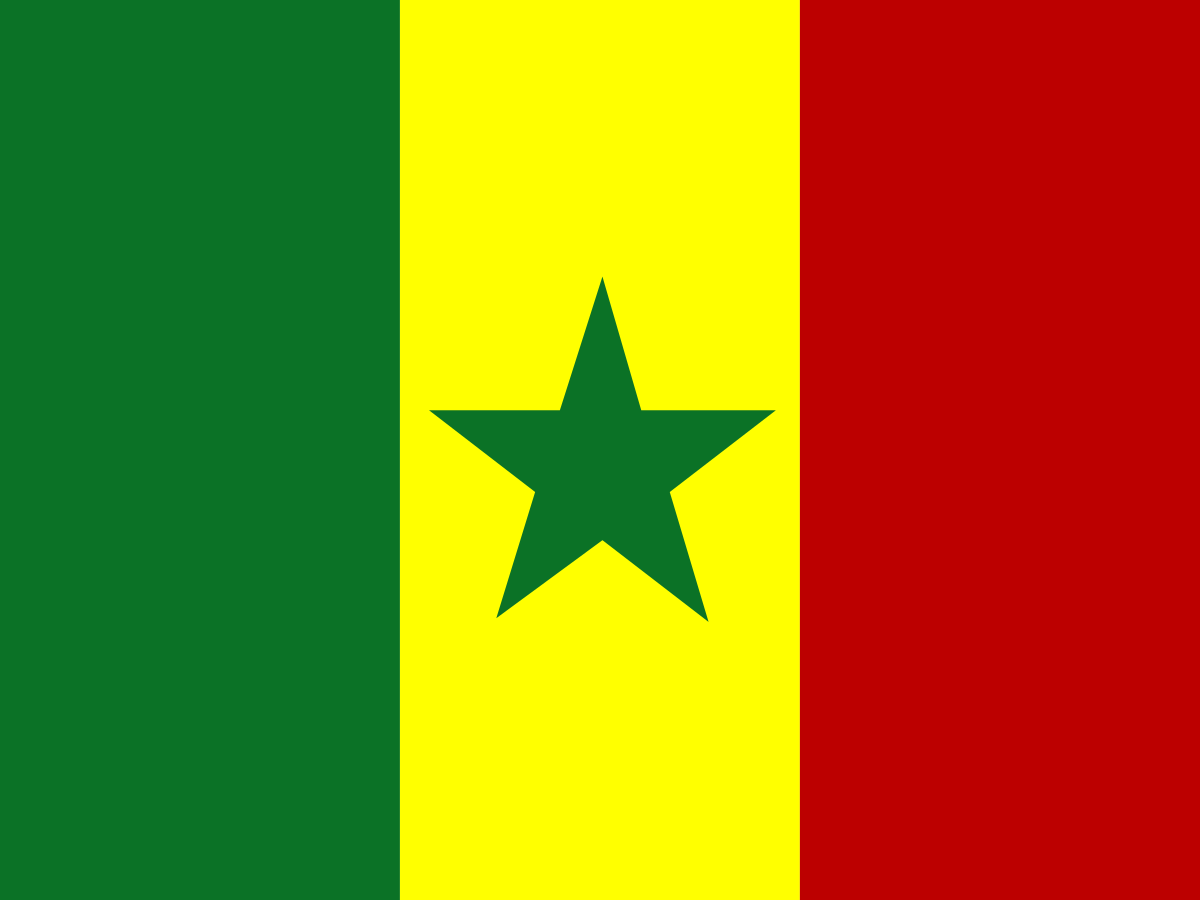
The Senegal flag
Senegal's flag has three equal vertical bands of green, yellow and red, with a green five-pointed star in the centre of the yellow band.
The three colours form part of the wider Pan-African tradition. Senegal's design is closely related to the flags of several other former French West African states, but its central green star gives it a distinctive identity.
Green
The green band has several layers of meaning. It is associated with Islam for Senegal's Muslim majority, while also representing hope and the country's rich vegetation and agricultural landscape.
Yellow
The yellow band represents wealth and prosperity. It is also associated with the country's natural resources and the energy and optimism of national development.
Red
The red band represents sacrifice and the struggle for independence. It can also be understood as a reminder of the determination required to defend national freedom.
The green star
The central green five-pointed star is one of the most recognisable elements of the Senegal flag. It represents unity and hope and is often interpreted alongside the country's strong Islamic and Pan-African identity.
Pan-African colours
Senegal's green, yellow and red are Pan-African colours associated with African independence and unity. The colours also appeared prominently in the political movements that challenged colonial rule across Africa during the 20th century.
A short history
Senegal has a long history that predates European colonialism. The region was influenced by major West African states and empires, including Ghana, Mali and Jolof, and later became an important centre of Atlantic trade.
France gradually established colonial control before Senegal became independent in 1960. Léopold Sédar Senghor became the country's first president and played a major role in shaping modern Senegalese identity.
History timeline
Ancient and medieval periods — West African kingdomsThe territory that is now Senegal was influenced by major West African political and trading networks, including the Ghana and Mali empires.
13th–16th centuries — Jolof and neighbouring statesThe Jolof Empire became an important political power in the region, alongside other Wolof, Serer, Fula and Mandinka states.
15th century — Portuguese contactPortuguese sailors reached the Senegalese coast as European maritime exploration expanded along West Africa.
17th century — French trading postsFrance established and expanded trading interests along the Senegal River and Atlantic coast.
1659 — Saint-Louis establishedThe French established Saint-Louis, which became an important centre of administration and Atlantic trade.
1857 — Dakar founded as a French settlementDakar grew into a major port and later became the capital of French West Africa.
1895 — French West AfricaDakar became the capital of French West Africa, giving Senegal an important administrative role in the colonial system.
1914 — Blaise Diagne electedBlaise Diagne became the first African elected to the French Chamber of Deputies, an important moment in Senegalese political history.
1940 — Battle of DakarBritish and Free French forces attempted unsuccessfully to take control of Dakar from Vichy French forces.
1959 — Mali FederationSenegal and French Sudan formed the short-lived Mali Federation as colonial rule came to an end.
1960 — IndependenceSenegal became independent on 4 April 1960. Léopold Sédar Senghor became its first president.
1962 — Political crisisA major political dispute between President Senghor and Prime Minister Mamadou Dia led to Dia's arrest and strengthened the presidential system.
1980 — Senghor resignsSenghor voluntarily stepped down and was succeeded by Abdou Diouf, an unusual peaceful transfer of power for the period.
1982 — Senegambia ConfederationSenegal and The Gambia formed a loose confederation, although it was dissolved in 1989.
2000 — Democratic transfer of powerAbdoulaye Wade defeated Abdou Diouf in an election, marking another important peaceful transfer of presidential power.
2012 — Macky Sall electedMacky Sall defeated Wade after major political protests over constitutional changes.
2024 — Bassirou Diomaye Faye electedBassirou Diomaye Faye won the presidential election and became Senegal's youngest president.
TodaySenegal remains one of West Africa's major political and cultural centres and is developing its economy around services, agriculture, industry, energy and emerging offshore resources.
Dakar
Dakar is Senegal's capital and largest city. Built on the Cap-Vert peninsula, it is a major Atlantic port, commercial centre and cultural hub. Dakar is also known internationally for music, fashion, art and the former Dakar Rally.
Saint-Louis
Saint-Louis lies near the mouth of the Senegal River. Its historic island centre preserves French colonial architecture and was designated a UNESCO World Heritage Site in 2000.
Gorée Island
Gorée Island, off Dakar, is famous for its preserved colonial buildings and its association with the history of the Atlantic slave trade. The island became a UNESCO World Heritage Site in 1978.
The Senegal River
The Senegal River forms much of the country's northern border with Mauritania. Its valley is important for agriculture, irrigation, fishing and settlement.
The Sahel
Much of northern and central Senegal lies within the Sahel, a semi-arid transition zone south of the Sahara. Rainfall is highly seasonal and the region is vulnerable to drought and desertification.
Climate
Senegal has a generally tropical climate with a pronounced dry season and rainy season. The south receives substantially more rainfall than the north, creating major differences in vegetation and agriculture.
The Casamance
The Casamance region in southern Senegal is greener and wetter than much of the north. It is known for mangrove wetlands, rice cultivation, forests and distinctive cultural traditions.
Wildlife
Senegal's protected areas support lions, leopards, hippopotamuses, crocodiles, antelope and many bird species. The country has several important national parks and reserves.
Niokolo-Koba National Park
Niokolo-Koba National Park is one of Senegal's most important protected areas. It contains savannah, woodland and river habitats and supports wildlife including chimpanzees, hippos, lions and antelope.
Djoudj National Bird Sanctuary
The Djoudj National Bird Sanctuary in the Senegal River delta is a major wetland and an important stopover for migratory birds travelling between Europe and Africa.
Economy
Senegal has one of the more diversified economies in West Africa. Major sectors include services, agriculture, fishing, manufacturing, mining, tourism and energy.
Agriculture
Agriculture employs a large part of the population. Important crops include groundnuts, millet, rice, maize, vegetables and fruit, with irrigation increasingly important in the Senegal River valley.
Groundnuts
Groundnuts (peanuts) have been central to Senegal's agricultural economy for generations. Senegal became one of the world's major groundnut producers during the colonial and post-colonial periods.
Fishing
Fishing has traditionally been vital to Senegalese coastal communities and is an important source of food and employment. Pressure on fish stocks has increased the importance of sustainable fisheries management.
Oil and gas
Senegal has developed significant offshore oil and natural gas resources. Production from new offshore fields has added an important new sector to the economy while raising questions about how resource revenues should support long-term development.
Tourism
Tourism is based on beaches, wildlife, history, music, culture and heritage sites. Dakar, the Petite Côte, Saint-Louis, Gorée Island and the Casamance are among the country's best-known destinations.
Culture
Senegalese culture is famous across Africa and internationally for its music, dance, wrestling, fashion, storytelling and hospitality. Wolof culture is particularly influential, alongside Serer, Pulaar, Jola, Mandinka and other traditions.
Wolof language
Wolof is one of Senegal's most widely spoken languages and is an important lingua franca. French remains the official language, while several national languages are widely used in daily life.
Teranga
The Senegalese idea of teranga is commonly translated as hospitality. It represents generosity, welcome and respect for guests and is an important part of Senegal's national cultural image.
Music
Senegal has an internationally influential music scene. Mbalax, associated especially with singer and composer Youssou N'Dour, combines traditional sabar rhythms with modern influences.
Wrestling
Traditional Senegalese wrestling, known as laamb, is one of the country's most popular sports. Major bouts can attract huge audiences and combine athletic competition with elaborate ceremony and music.
Food
Senegalese cuisine is known for rich flavours and dishes based around rice, fish, vegetables, peanuts and spices. Thieboudienne, often considered the country's national dish, combines fish, rice and vegetables.
Thieboudienne
Thieboudienne means “rice with fish” in Wolof. The dish is traditionally made with fish, rice, tomato-based sauce and vegetables and is an important part of Senegalese culinary identity.
Religion
Senegal is predominantly Muslim, with Sufi brotherhoods playing a particularly important role in religious and social life. The country also has Christian and traditional religious communities, and religious coexistence is an important part of Senegalese society.
Touba
Touba is an important religious city and the centre of the Mouride brotherhood. The Great Mosque of Touba is one of Senegal's most significant religious landmarks.
Léopold Sédar Senghor
Léopold Sédar Senghor was Senegal's first president and a major poet and intellectual. He was one of the founders of the Négritude literary and cultural movement and played a major role in shaping post-colonial Senegalese identity.
Senegal and The Gambia
Senegal almost completely surrounds The Gambia, whose narrow territory follows the Gambia River. The two countries share close cultural and economic links despite being separate sovereign states.
Why is Senegal's flag interesting?
Senegal's flag is a simple but powerful combination of Pan-African colours and a central green star. The colours connect the country to wider African independence movements, while the star gives the design its own distinctive national identity.
Explore Senegal on FlagAtlas
Keep exploring flags and educational resources without relying on unconfirmed country-specific links.
Sources & further reading
The supplied FlagAtlas Senegal page has been retained as the base, including its existing flag image, emoji copier, colouring link and navigation, with additional educational content about the flag, history, geography, culture and economy.
Encyclopaedia Britannica · UNESCO World Heritage