About Sierra Leone
Sierra Leone is a coastal country in West Africa on the Atlantic Ocean. It borders Guinea to the north and east and Liberia to the south-east. The capital, Freetown, sits on a spectacular natural harbour.
The country is known for its beaches, tropical forests, rich cultural traditions and the historic role of Freetown in the story of formerly enslaved Africans.
CapitalFreetown
RegionWest Africa
PopulationAbout 8.5 million
CurrencyLeone
Official languageEnglish
Independence1961
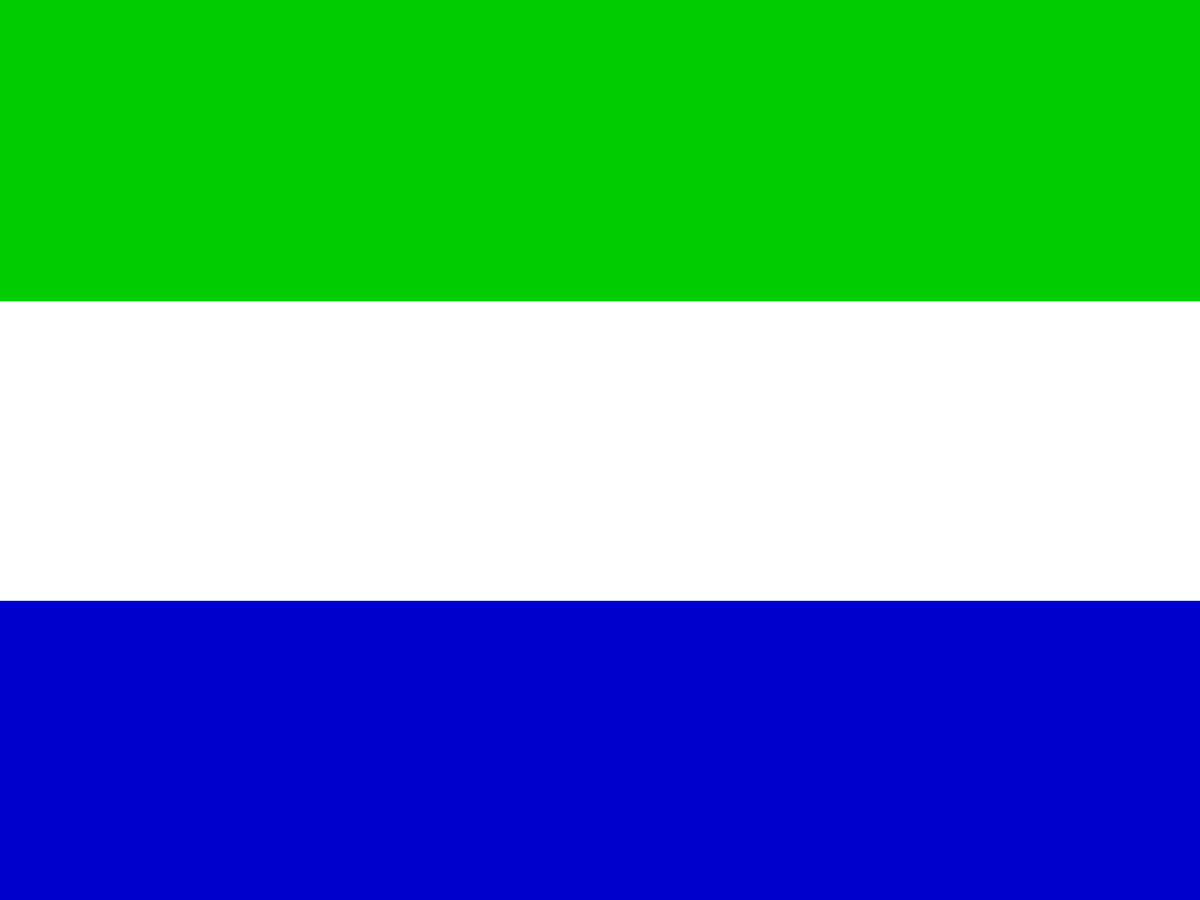
The Sierra Leone flag
The Sierra Leone flag has three equal horizontal bands: green, white and blue. It was adopted at independence in 1961.
The three colours are officially associated with the country's natural resources and agriculture, unity and justice, and the sea and natural harbour around Freetown.
Green
The green band represents Sierra Leone's agriculture, mountains and natural resources. Farming is an important part of life and the economy, while the country also has extensive forests and mineral resources.
White
The white band represents unity and justice. It separates the green and blue bands and gives the flag its simple, balanced appearance.
Blue
The blue band represents the sea and the natural harbour of Freetown. Sierra Leone's Atlantic coastline has played an important role in its history, trade and culture.
Why the flag is distinctive
Sierra Leone's flag is part of the family of African national flags using strong green, white and blue symbolism. Its colours connect the land, people, justice and Atlantic coast in a simple three-band design.
A short history
Sierra Leone's modern history is closely connected with the founding of Freetown as a settlement for formerly enslaved Africans. Britain established control over the territory during the 19th century, and Sierra Leone became independent in 1961.
The country later experienced political instability and a devastating civil war before rebuilding its democratic institutions.
History timeline
Pre-colonial era — diverse societiesThe region was home to numerous peoples and political communities, including Temne, Mende, Limba and other groups, with long-established trade networks.
1787 — Province of FreedomBritish abolitionists helped establish a settlement near present-day Freetown for formerly enslaved Black people.
1792 — Freetown foundedThe Sierra Leone Company established Freetown as a settlement for formerly enslaved people arriving from Nova Scotia.
1808 — Crown ColonyFreetown became a British Crown Colony and developed into an important centre for the campaign against the transatlantic slave trade.
19th century — Education and ChristianityFreetown became a major centre of education, missionary activity and trade in West Africa. Fourah Bay College was founded in 1827.
1896 — ProtectorateBritain declared a protectorate over the interior while the Freetown colony remained under separate colonial administration.
1961 — IndependenceSierra Leone became independent from Britain on 27 April 1961, with Milton Margai as its first prime minister.
1971 — RepublicSierra Leone became a republic, with Siaka Stevens becoming president.
1991 — Civil war beginsRebellion led by the Revolutionary United Front began a brutal civil war that lasted more than a decade.
2002 — Civil war endsThe civil war was officially declared over after international intervention and peacekeeping efforts.
2014–2016 — Ebola epidemicSierra Leone was one of the countries worst affected by the West African Ebola outbreak, causing a major humanitarian and economic crisis.
2017 — Freetown landslideA major landslide and flooding in the Freetown area caused hundreds of deaths and highlighted the city's vulnerability to extreme rainfall and rapid urban growth.
TodaySierra Leone is a democratic republic working to develop its economy while addressing poverty, infrastructure needs, environmental pressures and the legacy of conflict and disease outbreaks.
Freetown
Freetown is Sierra Leone's capital and largest city. It is built around one of the world's great natural harbours and is surrounded by steep hills and tropical vegetation.
The Freetown Peninsula
The Freetown Peninsula combines mountains, rainforest and beaches. Its coastline includes popular beaches such as Lumley, River Number Two and Tokeh.
Mount Bintumani
Mount Bintumani, also called Loma Mansa, is the highest mountain in Sierra Leone, rising to about 1,945 metres in the Loma Mountains.
Climate
Sierra Leone has a tropical climate with a pronounced wet season and dry season. The coastal and mountain areas can receive particularly heavy rainfall.
Rainforest
Sierra Leone contains important areas of Upper Guinean forest, one of West Africa's most biologically valuable but heavily fragmented ecosystems.
Wildlife
Protected areas support chimpanzees, forest elephants, pygmy hippos, monkeys, antelope and many bird species. Conservation is especially important because Sierra Leone's forests have faced pressure from agriculture, logging and development.
Tacugama Chimpanzee Sanctuary
Tacugama Chimpanzee Sanctuary near Freetown works to rescue and rehabilitate chimpanzees and promote conservation. Chimpanzees are one of Sierra Leone's best-known wildlife symbols.
Tiwai Island
Tiwai Island is a protected wildlife sanctuary on the Moa River. It is known for rainforest biodiversity, primates, pygmy hippos and extensive birdlife.
Outamba-Kilimi National Park
Outamba-Kilimi National Park protects forest and savannah habitats in northern Sierra Leone and is important for species including chimpanzees, hippos and elephants.
Economy
Sierra Leone's economy includes agriculture, mining, fisheries, services and tourism. The country has significant mineral resources but also faces challenges from infrastructure, energy supply and poverty.
Agriculture
Agriculture supports a large share of the population. Important crops include rice, cassava, cocoa, coffee, palm products and groundnuts. Rice is a particularly important staple.
Mining
Sierra Leone is rich in minerals including iron ore, diamonds, rutile and bauxite. Mining has been an important source of exports, although the sector has also raised environmental and governance concerns.
Diamonds
Sierra Leone became internationally associated with alluvial diamonds, particularly during the civil war. The phrase 'blood diamonds' became strongly linked to the conflict and international efforts to regulate the diamond trade.
Tourism
Tourism is built around beaches, wildlife, mountains, history and Freetown's cultural heritage. The country has considerable potential for sustainable nature and heritage tourism.
Culture
Sierra Leone has a rich mix of African traditions shaped by its many ethnic groups and by the distinctive history of Freetown. Music, dance, storytelling and communal celebrations remain important parts of cultural life.
Krio
Krio is a widely spoken creole language that developed in and around Freetown. It contains influences from English and several West African languages and serves as an important lingua franca.
Languages and peoples
Sierra Leone is ethnically diverse. Major groups include the Temne and Mende, alongside Limba, Kono, Kuranko, Loko, Sherbro, Krio and other communities. English is the official language, while many local languages are widely spoken.
Food
Sierra Leonean cuisine often centres on rice, cassava, fish, vegetables, peanuts and spicy sauces. Popular dishes include jollof rice, cassava leaves, groundnut stew and grilled or fried fish.
Music and dance
Music in Sierra Leone blends traditional rhythms with West African and international influences. Bubu, palm-wine music and modern Afropop are among the country's musical traditions.
Religion
Sierra Leone is religiously diverse, with Islam and Christianity both widely practised. Traditional beliefs and customs also continue to influence cultural life.
Freetown and the history of abolition
Freetown has a unique place in the history of the Atlantic world. It was established as a settlement for formerly enslaved people and became an important base for Britain's campaign against the transatlantic slave trade.
Fourah Bay College
Fourah Bay College, founded in 1827, became one of the most important centres of higher education in West Africa. It contributed significantly to scholarship, education and the development of an educated West African elite.
Bunce Island
Bunce Island, in the Sierra Leone River, was a major British slave-trading post. Its ruins are an important historical site and a powerful reminder of the transatlantic slave trade.
Civil war legacy
The Sierra Leone Civil War lasted from 1991 to 2002 and caused enormous loss of life and displacement. The country subsequently went through a major process of disarmament, reconciliation and rebuilding.
Ebola
The 2014–2016 Ebola epidemic severely affected Sierra Leone. Thousands of people died across the region, and the outbreak placed enormous pressure on healthcare, schools, businesses and the wider economy.
Environment
Sierra Leone faces environmental pressures including deforestation, coastal erosion, flooding, habitat loss and climate change. Forest and marine conservation are increasingly important for protecting biodiversity and livelihoods.
Why is Sierra Leone's flag interesting?
The Sierra Leone flag uses a simple three-band design to represent the country's land and natural resources, unity and justice, and the Atlantic sea and Freetown harbour. Those ideas neatly connect the flag to Sierra Leone's geography and history.
Explore Sierra Leone on FlagAtlas
Keep exploring flags and educational resources.
Sources & further reading
The supplied FlagAtlas Sierra Leone page has been retained as the base, including its existing flag image, emoji copier, colouring link and navigation, with additional educational content about the flag, history, geography, wildlife, culture and economy.
Government of Sierra Leone · Encyclopaedia Britannica · UNESCO World Heritage