About Singapore
Singapore is a small island city-state at the southern tip of the Malay Peninsula in Southeast Asia. Its strategic position between the Indian Ocean and South China Sea helped it become one of the world's most important trading and transport hubs.
Modern Singapore is known for its dense cityscape, port, financial centre, multicultural population, strict environmental management and highly developed economy.
CapitalSingapore
RegionSoutheast Asia
PopulationAbout 6 million
CurrencySingapore dollar
Official languagesEnglish, Malay, Mandarin, Tamil
Independence1965
The Singapore flag
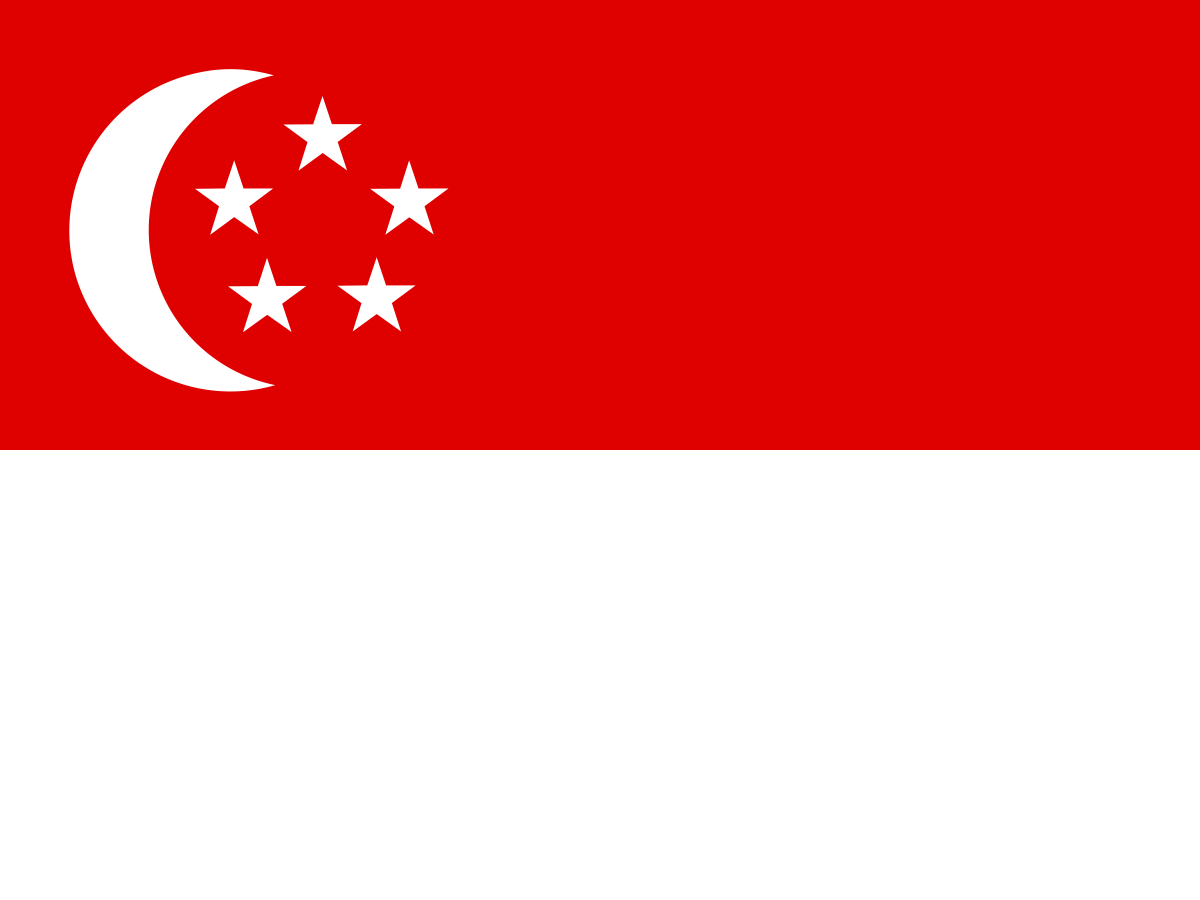
The Singapore flag was adopted in 1959, when Singapore achieved self-government, and retained when Singapore became independent in 1965. It has two equal horizontal bands: red above white.
At the upper hoist is a white crescent moon beside a circle of five white stars. The design combines national identity with symbols of ideals, unity and progress.
Red
The red field represents universal brotherhood and the equality of man. It reflects the idea that Singapore belongs to a diverse population living together as one nation.
White
The white field represents universal and everlasting purity and virtue. Together with red, it creates the distinctive two-colour base of the national flag.
The crescent moon
The crescent moon represents a young nation on the rise. It is not intended simply as a religious symbol; in the official symbolism it reflects Singapore as a young and growing country.
The five stars
The five white stars represent the nation's five ideals: democracy, peace, progress, justice and equality. They are arranged in a circle beside the crescent.
Why the flag is distinctive
Singapore's flag is particularly recognisable because the crescent and five stars sit in the upper-left corner while the red-and-white field remains deliberately simple. Its symbols were designed to reflect the aspirations of a newly self-governing society.
A short history
Singapore has been an important trading settlement for centuries. British colonial rule began in the early 19th century, followed by rapid growth as a port. After the Second World War, Singapore moved through self-government, merger with Malaysia and finally independence in 1965.
Under successive governments, Singapore developed from a relatively poor port economy into a major global centre for trade, finance, manufacturing and technology.
History timeline
14th century — Temasek/SingapuraThe island was known by names including Temasek and Singapura and had connections to regional trading networks.
1819 — British trading postStamford Raffles established a British trading settlement on Singapore, accelerating its development as a major regional port.
1824 — British controlBritain obtained full sovereignty over Singapore through agreements with the Sultan of Johor and the Dutch.
1869 — Suez Canal opensThe opening of the Suez Canal strengthened Singapore's position on the major sea route between Europe and East Asia.
1942 — Japanese occupationSingapore fell to Japan during the Second World War and was occupied until 1945.
1945 — British returnBritish administration resumed after Japan's surrender.
1959 — Self-governmentSingapore achieved internal self-government. The current flag was adopted and Lee Kuan Yew became the first prime minister.
1963 — Merger with MalaysiaSingapore joined the Federation of Malaysia along with Malaya, Sabah and Sarawak.
1965 — IndependenceSingapore separated from Malaysia and became an independent sovereign state on 9 August 1965.
1970s–1980s — IndustrialisationSingapore rapidly expanded manufacturing, infrastructure, housing, education and its port and airport facilities.
1990 — Leadership transitionGoh Chok Tong became prime minister, beginning Singapore's second major political era.
2000s — Global hubSingapore strengthened its role in finance, aviation, shipping, biotechnology, tourism and international business.
2015 — 50 years of independenceSingapore marked its 50th anniversary with nationwide celebrations.
2024 — Leadership transitionLawrence Wong became prime minister, succeeding Lee Hsien Loong.
TodaySingapore is a parliamentary republic and a highly developed global hub for trade, finance, logistics, technology and education.
Singapore City
Unlike most countries, Singapore is both a country and a city-state. The urban area covers the main island and numerous smaller islands, with a highly planned mixture of residential districts, business areas, parks and industrial zones.
Marina Bay
Marina Bay is one of Singapore's best-known modern districts, featuring the financial skyline, waterfront promenades, Gardens by the Bay and the Marina Bay Sands complex.
Sentosa
Sentosa is a resort island south of the main island. It contains beaches, attractions, hotels and leisure facilities and is one of Singapore's major tourism destinations.
Climate
Singapore has a hot, humid tropical climate throughout the year. Rainfall occurs year-round, with seasonal variations linked to the northeast and southwest monsoons.
Green Singapore
Despite its dense urban development, Singapore has invested heavily in parks, street trees, nature reserves and green corridors. It is often described as a 'City in Nature'.
Bukit Timah Nature Reserve
Bukit Timah Nature Reserve protects one of Singapore's remaining areas of primary rainforest. It contains Bukit Timah Hill, the highest natural point on the main island.
Singapore Botanic Gardens
The Singapore Botanic Gardens is a major scientific, educational and recreational site and was Singapore's first UNESCO World Heritage Site. Its National Orchid Garden is especially famous.
Wildlife
Singapore's remaining natural habitats support long-tailed macaques, otters, monitor lizards, hornbills, pangolins and many other species. Conservation has become increasingly important as urban development has expanded.
Singapore's otters
The return of smooth-coated otters to Singapore's waterways has become a notable conservation success. Otter families can now be seen around canals, reservoirs and urban waterways.
Economy
Singapore has one of the world's most developed and internationally connected economies. Major sectors include finance, manufacturing, logistics, shipping, aviation, biotechnology, tourism and professional services.
The Port of Singapore
The Port of Singapore is one of the world's busiest maritime hubs. Its position on major international shipping routes has been central to the country's development.
Changi Airport
Singapore Changi Airport is one of the world's best-known international airports. It is an important aviation hub connecting Southeast Asia with the rest of the world.
Technology
Singapore has invested heavily in digital infrastructure, research, artificial intelligence, biotechnology and advanced manufacturing. It is a major technology and startup hub in Southeast Asia.
Finance
Singapore is a major international financial centre, with important roles in banking, wealth management, insurance, foreign exchange and regional investment.
Culture
Singapore's culture reflects its position at the meeting point of Chinese, Malay, Indian and European influences. This diversity is visible in language, food, architecture, religion and festivals.
Languages
Singapore has four official languages: English, Malay, Mandarin and Tamil. English is the main language of government, business and education, while Malay is the national language.
Food
Singapore is famous for its multicultural food culture. Popular dishes include chicken rice, laksa, chilli crab, satay, roti prata, nasi lemak and char kway teow.
Hawker culture
Singapore's hawker culture is internationally recognised and was added to UNESCO's Representative List of the Intangible Cultural Heritage of Humanity in 2020. Hawker centres bring affordable food and different communities together.
Religion
Singapore is religiously diverse, with significant communities of Buddhists, Christians, Muslims, Hindus and people with other or no religious affiliations. Mosques, temples and churches often stand close together.
Education
Singapore has built a highly regarded education system and is home to major institutions including the National University of Singapore and Nanyang Technological University.
The Singapore Armed Forces
Singapore maintains a relatively large and technologically advanced defence force for a small country. National service is an important part of the country's defence system for eligible male citizens and permanent residents.
Housing
Most Singaporeans live in public housing built by the Housing & Development Board (HDB). Large planned estates combine apartments with schools, shops, transport and community facilities.
Transport
Singapore has an extensive public transport network including the MRT rail system, buses and taxis. Integrated planning and high public transport use help manage traffic in a densely populated city-state.
Merlion
The Merlion is one of Singapore's best-known symbols. Its lion head refers to the traditional story behind Singapura, while the fish body represents Singapore's origins as a fishing village and maritime settlement.
National symbols
Singapore's national symbols include the flag, national anthem 'Majulah Singapura', national flower Vanda Miss Joaquim and the lion head symbol. The symbols emphasise unity and national identity.
Why is Singapore's flag interesting?
Singapore's flag packs a lot of meaning into a very simple design: red and white represent universal brotherhood, equality, purity and virtue; the crescent represents a young nation on the rise; and the five stars represent democracy, peace, progress, justice and equality.
Explore Singapore on FlagAtlas
Keep exploring flags and educational resources.
Sources & further reading
The supplied FlagAtlas Singapore page has been retained as the base, including its existing flag image, emoji copier, colouring link and navigation, with additional educational content about the flag, history, geography, wildlife, culture and economy.
Government of Singapore · Encyclopaedia Britannica · UNESCO World Heritage