About the Solomon Islands
The Solomon Islands is an island country in Melanesia, in the southwestern Pacific Ocean. It is made up of hundreds of islands, with six major island groups and many smaller islands and islets.
The country is known for tropical forests, coral reefs, World War II history, traditional cultures and exceptional marine biodiversity.
CapitalHoniara
RegionMelanesia
PopulationAbout 700,000
CurrencySolomon Islands dollar
Official languageEnglish
Independence1978
The Solomon Islands flag
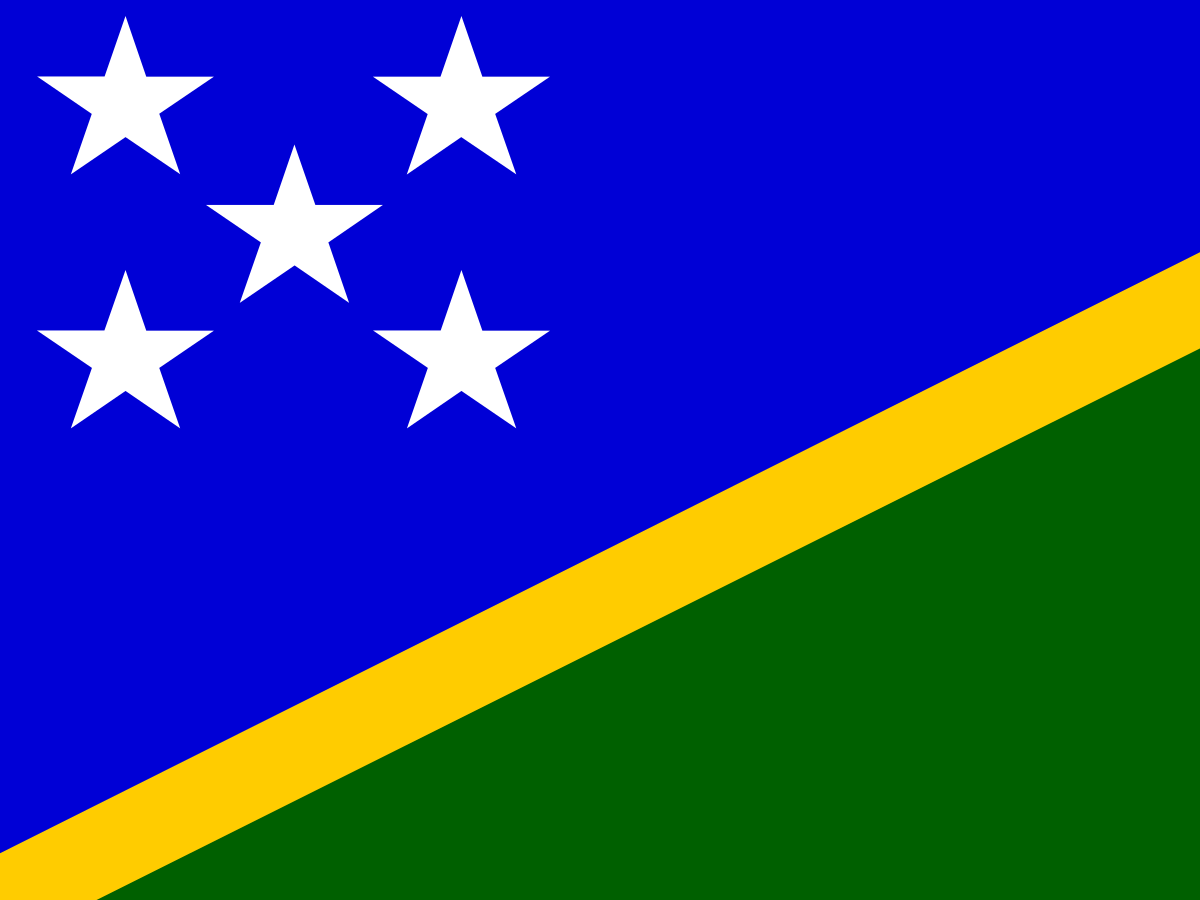
The national flag has a blue upper field and green lower field, separated by a thin yellow diagonal stripe. A blue triangle at the hoist contains five white five-pointed stars.
The flag was adopted when the Solomon Islands became independent from the United Kingdom on 7 July 1978.
Blue
The blue areas represent the surrounding ocean. Water is central to life in the Solomon Islands, where communities are spread across a large Pacific archipelago and depend heavily on fishing and coastal resources.
Green
The green field represents the land. The Solomon Islands contain extensive tropical forests and fertile areas supporting gardens, agriculture and traditional communities.
Yellow
The yellow diagonal stripe represents sunshine. It also visually separates the sea and land colours and gives the flag its distinctive diagonal design.
The five stars
The five white stars represent the country's five main island groups. They are arranged in the same relative position as the Southern Cross and have remained one of the flag's most recognisable features.
Why the flag is distinctive
The diagonal division makes the Solomon Islands flag very different from most Pacific flags. Its combination of ocean blue, land green, sunshine yellow and five stars reflects the country's geography and island identity.
A short history
The Solomon Islands have been inhabited by Melanesian peoples for thousands of years. European contact increased from the 16th century, while British influence expanded during the 19th century.
The islands became a British protectorate in 1893. During the Second World War they were the scene of major fighting, including the Guadalcanal campaign. Self-government followed in the 1970s and independence came in 1978.
History timeline
Thousands of years ago — First settlementMelanesian communities established settlements across the Solomon Islands, developing distinctive languages, traditions and trading networks.
1568 — European contactSpanish navigator Álvaro de Mendaña reached the islands and gave them the name Solomon Islands.
19th century — Missionaries and tradersEuropean missionaries, traders and recruiters increasingly visited the islands, bringing major social and economic changes.
1893 — British protectorateBritain declared a protectorate over parts of the Solomon Islands, expanding its control over the islands during the following years.
1942 — Japanese invasionJapanese forces occupied parts of the islands during the Second World War.
1942–1943 — Guadalcanal campaignGuadalcanal became one of the most important campaigns of the Pacific War. The fighting involved major land, sea and air battles.
1943–1945 — Allied advanceAllied forces gradually pushed Japanese forces north and west through the Solomon Islands and neighbouring Pacific territories.
1976 — Self-governmentThe Solomon Islands achieved internal self-government as the colonial period came to an end.
1978 — IndependenceThe Solomon Islands became an independent sovereign state on 7 July 1978.
1990s — Political and economic pressuresRapid population growth, land disputes and economic difficulties contributed to increasing social and political tensions.
1998–2003 — Ethnic tensionsConflict between groups centred mainly around Guadalcanal and Malaita led to serious instability.
2003 — RAMSIThe Regional Assistance Mission to Solomon Islands arrived to help restore security and strengthen government institutions.
2017 — RAMSI endsThe long-running regional assistance mission formally concluded after helping stabilise the country.
2019 — Diplomatic shiftThe Solomon Islands switched diplomatic recognition from Taiwan to the People's Republic of China, a major change in foreign policy.
TodayThe Solomon Islands is a parliamentary democracy whose economy depends heavily on agriculture, fisheries, forestry, tourism and other natural resources.
Honiara
Honiara is the capital and largest urban centre, located on the north coast of Guadalcanal. It grew substantially during and after the Second World War and contains important government, commercial and transport facilities.
Guadalcanal
Guadalcanal is the largest island in the country and the site of Honiara. It became globally famous during the Second World War because of the Guadalcanal campaign.
The islands
The country contains hundreds of islands and islets. Major island groups include Guadalcanal, Malaita, Santa Isabel, Choiseul, New Georgia and Makira.
Climate
The Solomon Islands has a tropical maritime climate, with warm temperatures and high humidity throughout the year. Rainfall varies between islands and seasons, while tropical cyclones can occasionally affect the country.
Rainforests
The islands contain extensive tropical rainforest and many areas of relatively intact natural habitat. Forests are important for biodiversity, traditional livelihoods and the national economy.
Marine life
The surrounding seas contain extraordinary coral reefs, fish, sea turtles, dolphins and other marine species. The Solomon Islands forms part of the Coral Triangle, one of the world's most biologically diverse marine regions.
Coral reefs
The Solomon Islands has some of the world's richest coral reef ecosystems. Healthy reefs support fisheries, coastal protection and tourism, but face threats from climate change, warming seas and human activity.
Wildlife
Terrestrial wildlife includes fruit bats, flying foxes, reptiles, birds and numerous endemic species. Many species evolved in isolation on individual islands, producing unusual local varieties.
Birds
The islands are particularly rich in birdlife, including hornbills, parrots, kingfishers and many endemic forest birds. Some species are found only on particular islands or island groups.
Economy
The economy depends heavily on agriculture, forestry, fisheries, mining and services. Subsistence farming remains important for many households, while commercial fishing and logging have also played major roles.
Fishing
Fishing is a major source of food, employment and export income. Tuna fisheries are especially important because the Solomon Islands lies in productive tropical Pacific waters.
Agriculture
Rural households commonly grow coconut, cocoa, root crops, vegetables and fruit. Copra and cocoa have historically been important agricultural exports.
Forestry
Logging has generated significant export income but has also raised concerns about deforestation, land rights and sustainable resource management. Protecting forests is increasingly important for biodiversity and climate resilience.
Tourism
Tourism is based around diving, snorkelling, fishing, surfing, hiking, cultural experiences and Second World War sites. The country's remote islands offer relatively undeveloped destinations for visitors.
World War II history
The Solomon Islands contains numerous historic sites, wrecks and battlefields from the Pacific War. Guadalcanal and the waters around it became a major battleground between Allied and Japanese forces in 1942–43.
The Battle of Guadalcanal
The Guadalcanal campaign lasted from August 1942 to February 1943 and was a turning point in the Pacific War. Fighting took place on land and across surrounding seas and skies.
Culture
Solomon Islands culture is extremely diverse, with many different languages, communities and traditions. Customary land ownership, traditional dance, carving, weaving, shell money and community ceremonies remain important.
Languages
English is the official language, but it is spoken alongside many indigenous languages. Solomon Islands Pijin is widely used as a lingua franca between communities.
Music and dance
Traditional music and dance vary between islands. Panpipes, drums, chanting and group dances are important parts of ceremonies and cultural celebrations.
Shell money
In parts of the Solomon Islands, traditional forms of shell money continue to have cultural importance. Shell currency and ornaments can be associated with marriage, ceremonies and exchange.
Religion
Christianity is widespread in the Solomon Islands, including Anglican, Catholic, Methodist and evangelical traditions. Christian practices coexist in many communities with older cultural customs and beliefs.
Education
Education access has expanded considerably since independence, although the country's scattered islands make providing schools and services challenging. The University of the South Pacific has a campus in Honiara.
Transport
Because communities are spread over hundreds of islands, boats and small aircraft are essential forms of transport. Roads are concentrated mainly around the larger islands and urban areas.
Climate change
The Solomon Islands is highly vulnerable to sea-level rise, coastal erosion, changing rainfall and ocean warming. Many communities live close to the coast, making climate resilience particularly important.
National symbols
The national flag is one of the country's principal symbols. The national coat of arms, national anthem 'God Save Our Solomon Islands' and national motto also form part of the country's official identity.
Why is the Solomon Islands flag interesting?
The flag tells a simple geographic story: blue for the surrounding Pacific Ocean, green for the islands, yellow for sunshine and five stars for the five main island groups. Its diagonal design makes it particularly distinctive among Pacific national flags.
Explore the Solomon Islands on FlagAtlas
Keep exploring flags and educational resources.
Sources & further reading
The original FlagAtlas Solomon Islands page has been retained as the base, including its correct flag image, 🇸🇧 emoji copier and colouring-page link. The new sections expand the page with educational information about the flag, history, geography, wildlife, culture and economy.
Government of Solomon Islands · Encyclopaedia Britannica · UNESCO World Heritage