About Somalia
Somalia is a country on the Horn of Africa, with a long coastline along the Gulf of Aden and Indian Ocean. It occupies a strategically important position between Africa and the Arabian Peninsula.
Somalia has a rich history of ancient trading centres, Islamic scholarship, pastoral traditions and maritime commerce. Its capital and largest city is Mogadishu.
CapitalMogadishu
RegionHorn of Africa
PopulationAbout 17 million
CurrencySomali shilling
Official languagesSomali & Arabic
Independence1960
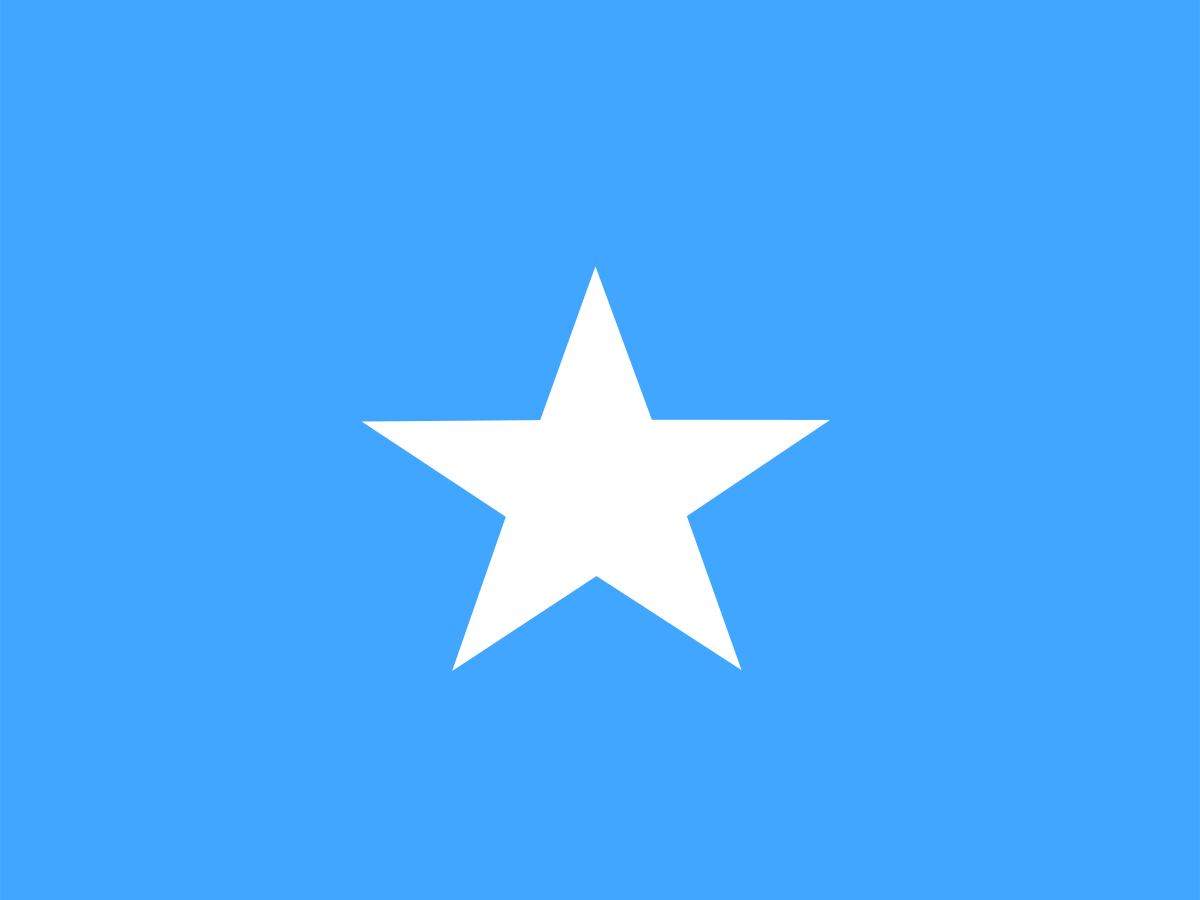
The Somalia flag
The Somali flag is a simple light blue field with a white five-pointed star at its centre. It was adopted on 12 October 1954 and became the flag of the independent Somali Republic in 1960.
The light blue was historically associated with the United Nations, while the star became a powerful symbol of Somali national identity.
Light blue
The light blue field is traditionally associated with the sky and the surrounding waters. The colour was also chosen to honour the United Nations, which administered the former Italian Somaliland territory during the transition towards independence.
The five-pointed star
The white five-pointed star, known as the Star of Unity, represents the idea of Somali unity. Its five points have traditionally been associated with the major Somali-inhabited territories: former British Somaliland, former Italian Somaliland, the Ogaden, the Northern Frontier District and Djibouti.
The Star of Unity
The central star is more than decoration: it represents the aspiration for Somali unity across territories where Somali people live. This is one reason the star has such strong political and cultural significance.
Why the flag is distinctive
Unlike many national flags, Somalia's flag uses just two main colours and a single central symbol. The uncluttered design makes the white star on blue immediately recognisable.
A short history
Somalia's history includes ancient coastal trading networks, Islamic sultanates and strong links with Arabia, Persia and the wider Indian Ocean. European powers later divided Somali-inhabited territories between different colonial administrations.
Italian Somaliland and British Somaliland followed different colonial paths. In 1960, the two territories united to form the independent Somali Republic. Political instability and civil conflict later reshaped the country, while Somaliland declared itself independent in 1991 but remains internationally unrecognised as a separate state.
History timeline
Ancient era — Indian Ocean tradeSomali coastal settlements participated in long-distance trade involving frankincense, livestock, spices and other goods.
7th–10th centuries — Growth of IslamIslam spread through the Somali coast and hinterland, strengthening links with Arabia and the wider Muslim world.
Medieval period — Coastal sultanatesPowerful Islamic states and trading centres developed along the Somali coast and inland regions.
16th century — Adal SultanateThe Adal Sultanate became a major regional power in the Horn of Africa and fought against the Ethiopian Empire.
19th century — European expansionBritain and Italy established colonial territories in Somali-inhabited lands, while Ethiopia expanded into the Ogaden.
1920s — Consolidation of colonial ruleItalian and British administrations strengthened their control over their respective Somali territories.
1941 — British military administrationDuring the Second World War British forces took control of Italian Somaliland.
1950 — UN trusteeshipFormer Italian Somaliland became a United Nations Trust Territory under Italian administration, with independence planned for 1960.
1954 — Flag adoptedThe light blue flag with the white Star of Unity was adopted for the Somali National League and subsequently became the national flag.
1960 — Independence and unionBritish Somaliland became independent on 26 June, followed by the independence of Italian Somaliland on 1 July. The two territories united to form the Somali Republic.
1969 — Military coupGeneral Mohamed Siad Barre seized power following the assassination of President Abdirashid Ali Shermarke.
1977–1978 — Ogaden WarSomalia fought Ethiopia over the Ogaden region. Ethiopia, supported by the Soviet Union and Cuba, eventually repelled Somali forces.
1991 — Government collapsesSiad Barre was overthrown. Civil war and political fragmentation followed, while Somaliland declared independence.
2000 — Transitional governmentA Transitional National Government was established as part of efforts to rebuild national institutions.
2012 — Federal governmentA new federal government was established, marking a major stage in the rebuilding of Somalia's state institutions.
TodaySomalia continues to rebuild its institutions and economy while facing security, humanitarian and climate-related challenges.
Mogadishu
Mogadishu is Somalia's capital and largest city. Located on the Indian Ocean coast, it has been an important trading port for centuries and contains historic mosques, markets and coastal districts.
The Horn of Africa
Somalia occupies much of the eastern tip of Africa known as the Horn of Africa. Its location gives it access to major maritime routes linking the Indian Ocean, Red Sea and Gulf of Aden.
Somali coastline
Somalia has the longest coastline of any country on mainland Africa. The coast includes sandy beaches, coral habitats, mangroves and productive fishing waters.
Climate
Much of Somalia has a hot, dry climate. Rainfall is highly variable and many areas experience recurring droughts, while the southern regions generally receive more rainfall than the far north.
Deserts and semi-deserts
Large areas consist of arid and semi-arid landscapes. Pastoral communities have traditionally adapted to these conditions by moving livestock between grazing and water sources.
Wildlife
Somalia's varied habitats support camels, antelope, gazelles, hyenas, baboons, leopards and many bird species. Marine habitats add turtles, dolphins and a wide variety of fish.
Marine life
Somalia's extensive Indian Ocean coastline supports important fisheries and marine ecosystems. Coastal communities have long depended on fishing alongside pastoral and agricultural livelihoods.
Economy
Somalia's economy includes livestock, agriculture, fisheries, telecommunications, trade and remittances. Livestock exports are particularly important and the country's diaspora contributes significantly through remittances.
Livestock
Livestock production is central to Somali life and the economy. Camels, goats, sheep and cattle are widely kept, with livestock and livestock products important for both domestic livelihoods and exports.
Agriculture
Agriculture is concentrated mainly in the south and along river valleys, where crops such as bananas, maize, sorghum, sesame and vegetables can be grown.
Telecommunications
Somalia has developed a surprisingly dynamic mobile telecommunications sector. Mobile phones and digital payments are widely used, providing important services in a country where conventional infrastructure has been disrupted.
Trade
Somalia's strategic coastline supports trade with neighbouring countries and wider markets across the Red Sea and Indian Ocean. Ports including Mogadishu, Berbera and Kismayo are important to regional commerce.
Culture
Somali culture has strong traditions of poetry, oral storytelling, music, pastoralism, hospitality and clan-based social organisation. Poetry in particular has historically played an unusually important role in public life.
Somali language
Somali is a Cushitic language of the Afroasiatic family and is spoken across Somalia and neighbouring parts of the Horn of Africa. Arabic is also an official language and has deep religious and cultural importance.
Poetry
Somali society has a famous oral poetry tradition. Poetry can preserve history, express political ideas, settle disputes and communicate social values, making poets important cultural figures.
Food
Somali cuisine reflects African, Arabian and Indian Ocean influences. Common foods include canjeero, rice, sambusas, meat dishes, camel milk and spiced stews.
Religion
Somalia is overwhelmingly Muslim, with Sunni Islam forming the dominant religious tradition. Islam has influenced Somali law, education, architecture, customs and everyday life for many centuries.
Architecture
Historic Somali architecture includes mosques, coastal trading buildings and settlements influenced by centuries of interaction with Arabia and the wider Indian Ocean. Mogadishu contains some of the country's best-known historic structures.
Education
Somalia's education system has faced major disruption but has expanded in many areas since the 2000s. Universities and private educational institutions operate in several cities, including Mogadishu.
Transport
Roads connect the major population centres, while air transport is particularly important because of Somalia's size and infrastructure challenges. Ports are also essential for trade and coastal communities.
Climate change
Somalia is highly vulnerable to droughts, floods, extreme heat and changing rainfall patterns. Climate shocks can have major effects on livestock, crops, water supplies and food security.
Piracy and maritime security
Somalia's long coastline became associated internationally with piracy during the 2000s. International naval operations and changes in coastal security significantly reduced attacks, although maritime security remains important.
National identity
The Somali flag's Star of Unity reflects a long-standing idea of Somali national unity. The same symbol appears in wider Somali political and cultural traditions.
Why is Somalia's flag interesting?
Somalia's flag is one of the world's simplest national designs, yet its central star carries a substantial political history. The five-pointed Star of Unity connects the modern state to the broader idea of Somali unity across the Horn of Africa.
Explore Somalia on FlagAtlas
Keep exploring flags and educational resources.
Sources & further reading
The original FlagAtlas Somalia page has been retained as the base, including its Somalia flag image, 🇸🇴 emoji copier, development indicators, climate information and colouring-page link. fileciteturn191file0L131-L141
The expanded sections are educational background intended to complement the existing FlagAtlas page.