About South Africa
South Africa occupies the southern tip of the African continent and has coastlines on both the Atlantic and Indian Oceans. It is one of Africa's most geographically diverse countries, with mountains, savannah, semi-desert, forests and long coastal regions.
South Africa has three capital cities: Pretoria is the administrative capital, Cape Town is the legislative capital and Bloemfontein is the judicial capital.
CapitalsPretoria · Cape Town · Bloemfontein
RegionSouthern Africa
PopulationAbout 60 million
CurrencySouth African rand
Official languages12
RepublicSince 1961
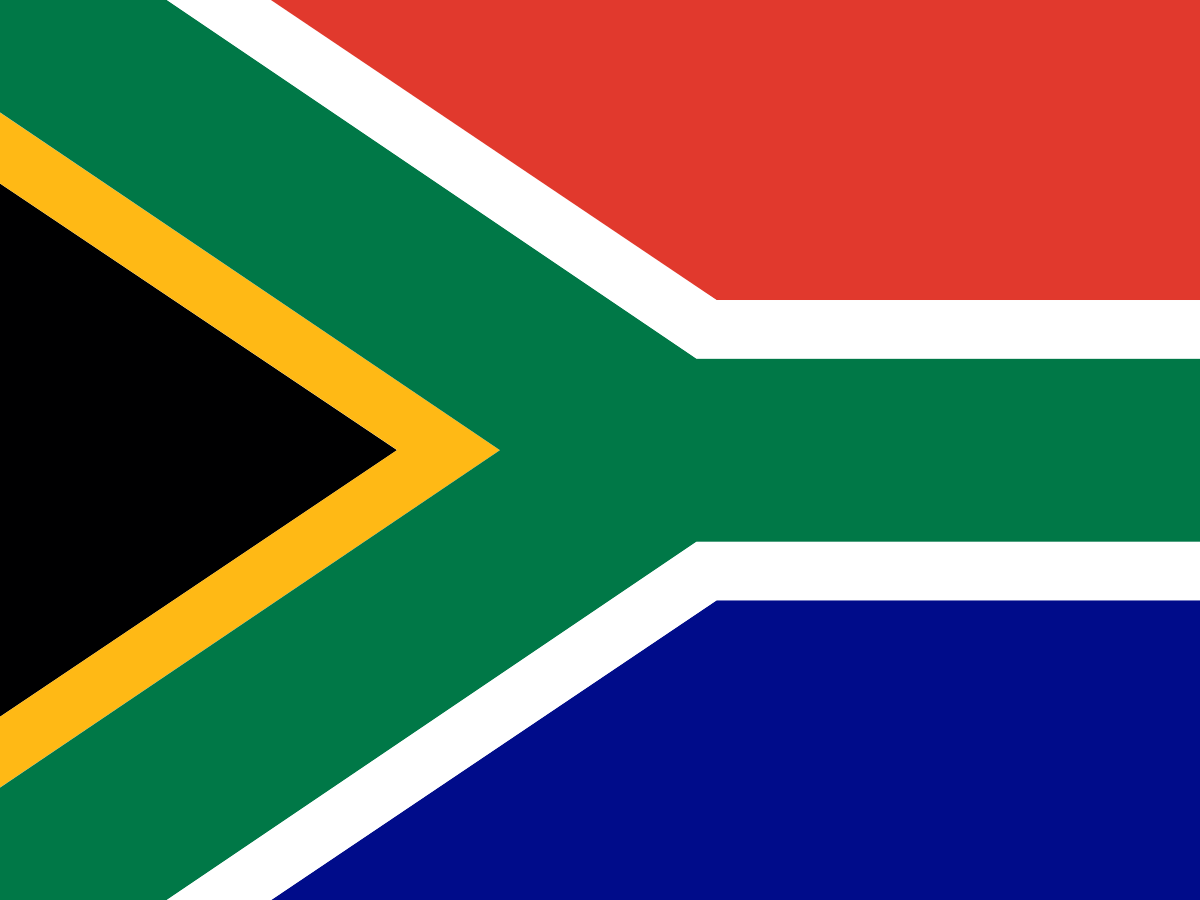
The South Africa flag
The South African flag was adopted on 27 April 1994, the day of the country's first democratic elections. Its striking design combines six colours — red, blue, green, black, white and gold — around a green Y-shaped band.
The Y is commonly described as symbolising the convergence of different elements of South African society moving together in unity.
The Y-shape
The green Y-shaped design is the flag's defining feature. The two arms of the Y converge towards the hoist, representing different paths coming together and moving forward as one.
Black
The black triangle at the hoist is one of the flag's most distinctive elements. It is separated from the green Y by a narrow gold border.
Gold
The gold bands border the black triangle and green Y. Gold is one of the six colours used in the flag and is also strongly associated with South Africa's mineral wealth.
Green
The green Y dominates the centre of the design. It is often interpreted in terms of the country's land, natural environment and the idea of different communities coming together.
White
The white bands separate the red and blue fields from the green Y. White contributes to the clean visual structure of the flag.
Red
The red upper field is one of the flag's two large horizontal colour areas. It is separated from the green Y by a white border.
Blue
The blue lower field completes the flag's bold colour combination. It sits beneath the green Y and white dividing band.
Why the flag is distinctive
South Africa's flag is one of the world's most recognisable modern national flags. Its unusual Y-shaped central design and six-colour palette make it immediately distinguishable from other African flags.
A short history
The history of South Africa includes Indigenous African societies, European settlement, colonial expansion, the Union of South Africa, apartheid and the transition to democracy. The modern flag was deliberately designed to represent a new era of national unity.
The first democratic election in 1994 brought Nelson Mandela and the African National Congress to government. The new flag was introduced at the same time as the democratic transition.
History timeline
Ancient times — Early settlementSouthern Africa was home to San and Khoekhoe communities, while later Bantu-speaking peoples developed farming, herding and complex societies in different regions.
1488 — European maritime contactPortuguese sailors rounded the southern tip of Africa, opening a new European sea route around the Cape.
1652 — Cape settlementThe Dutch East India Company established a settlement at the Cape, beginning a period of expanding European colonisation.
1795–1806 — British control of the CapeBritain took control of the Cape during the Napoleonic era and later established permanent colonial rule.
19th century — Expansion and conflictBritish and Boer expansion, mineral discoveries and African resistance reshaped the region. Major conflicts included the Anglo-Zulu War and the Anglo-Boer wars.
1867 — Diamonds discoveredMajor diamond discoveries around Kimberley transformed the economy and accelerated industrial development.
1886 — Gold discovered at WitwatersrandThe discovery of gold near Johannesburg triggered enormous economic growth and helped make the region a global mining centre.
1910 — Union of South AfricaSeveral British colonies were brought together to form the Union of South Africa.
1948 — Apartheid beginsThe National Party came to power and formally introduced a system of racial segregation and white minority rule known as apartheid.
1960 — SharpevillePolice killed demonstrators at Sharpeville during protests against apartheid pass laws, becoming a major turning point in the struggle against apartheid.
1961 — RepublicSouth Africa became a republic and left the Commonwealth.
1976 — Soweto uprisingStudents protested against the apartheid education system. The uprising became a major symbol of resistance.
1990 — Political transitionNelson Mandela was released from prison and President F. W. de Klerk's government began dismantling apartheid legislation.
1994 — Democratic election and new flagSouth Africa held its first universal democratic election. The new national flag was introduced on 27 April.
2010 — FIFA World CupSouth Africa hosted the FIFA World Cup, becoming the first African country to host the tournament.
TodaySouth Africa remains one of Africa's major economies and a highly diverse constitutional democracy, while continuing to face challenges including inequality, unemployment and energy security.
Pretoria
Pretoria is the administrative capital and home to the Union Buildings, where the executive branch of government is based. The city is also known for its jacaranda trees.
Cape Town
Cape Town is the legislative capital and one of South Africa's best-known cities. It sits beneath Table Mountain beside Table Bay and the Atlantic Ocean.
Bloemfontein
Bloemfontein is the judicial capital and a major city in the Free State. It has long been an important administrative and educational centre.
Table Mountain
Table Mountain overlooks Cape Town and is one of South Africa's most recognisable natural landmarks. It forms part of the Table Mountain National Park and supports many plant species.
Kruger National Park
Kruger National Park is one of Africa's most famous wildlife reserves. It is home to elephants, lions, leopards, rhinos, buffalo, giraffes and hundreds of other species.
Wildlife
South Africa is exceptionally rich in wildlife. The country supports the famous Big Five — lion, leopard, elephant, rhinoceros and African buffalo — along with cheetahs, hippos, giraffes, zebras, penguins and thousands of bird species.
The Big Five
The term Big Five originally referred to five difficult and dangerous animals sought by big-game hunters. Today it is mainly a conservation and safari term referring to lion, leopard, elephant, rhino and buffalo.
Biodiversity
South Africa contains several globally important biodiversity regions, including the Cape Floristic Region. The country's ecosystems range from fynbos and grassland to savannah, desert and subtropical forests.
Climate
South Africa has a wide variety of climates. Much of the interior is relatively dry, the Cape has Mediterranean conditions, the east coast is warmer and more humid, and highland areas can experience cold winters and snow.
The Karoo
The Karoo is a vast semi-desert region covering much of the country's interior. Its dry landscapes, rugged mountains and unusual geology make it one of South Africa's most distinctive environments.
Economy
South Africa has one of Africa's most diversified economies, with major sectors including mining, manufacturing, finance, tourism, agriculture, retail and telecommunications.
Mining
Mining has played a central role in South Africa's economic history. The country is historically famous for gold and diamonds and remains a major producer of platinum-group metals, coal, manganese and other minerals.
Agriculture
South African agriculture includes maize, wheat, fruit, wine, sugar, cattle and sheep. The country's varied climates allow a wide range of crops and agricultural systems.
Wine
The Western Cape is internationally famous for its wine industry. The Cape Winelands around Stellenbosch, Franschhoek and Paarl combine vineyards, mountains and historic towns.
Tourism
Tourism combines safaris, beaches, mountains, wine regions, cities and historic sites. The Garden Route, Cape Town, Kruger National Park and the Drakensberg are among the country's best-known destinations.
Drakensberg
The Drakensberg is southern Africa's highest mountain range and contains spectacular cliffs, valleys and waterfalls. It is popular for hiking and is also home to important rock art.
Languages
South Africa has 12 official languages: isiZulu, isiXhosa, Afrikaans, English, Sepedi, Setswana, Sesotho, Xitsonga, siSwati, Tshivenda, isiNdebele and South African Sign Language.
Culture
South African culture is extraordinarily diverse, drawing on African, European, Asian and Indigenous traditions. Music, dance, food, literature, sport and art all reflect this mixture.
Music
South Africa has influenced global music through styles including mbaqanga, kwaito, amapiano and South African jazz. Traditional choral singing and dance remain important cultural forms.
Food
South African food includes braai, bobotie, boerewors, bunny chow, chakalaka and malva pudding. Cuisine varies significantly between regions and communities.
Sport
Sport is a major part of South African culture. The country is particularly successful in rugby, cricket, football, athletics and swimming.
Rugby
The South African national rugby team, the Springboks, is one of the country's most important sporting symbols. Rugby also played a notable role in South Africa's post-apartheid national identity.
Religion
South Africa has a diverse religious population, including Christianity, Islam, Hinduism, Judaism and traditional African beliefs. The constitution protects freedom of religion.
Nelson Mandela
Nelson Mandela became South Africa's first democratically elected president in 1994. His leadership during the transition from apartheid made him one of the world's most influential figures in the struggle for equality and reconciliation.
Why is South Africa's flag interesting?
The South African flag is unusual because it does not rely on a single historical colour scheme. Instead, its six colours and Y-shaped design were brought together for the democratic transition of 1994, making the flag a powerful symbol of a country moving towards unity.
Explore South Africa on FlagAtlas
Keep exploring flags and educational resources.
Sources & further reading
The original FlagAtlas South Africa page has been retained as the base, including its correct flag image, 🇿🇦 emoji copier, development indicators, climate information and colouring-page link. fileciteturn192file0L131-L141
The expanded sections provide additional educational background on the flag, history, geography, wildlife, culture and economy.