About South Korea
South Korea, officially the Republic of Korea, occupies the southern part of the Korean Peninsula in East Asia. It is known for a highly developed economy, advanced technology, globally influential popular culture and a long history stretching back thousands of years.
Its capital and largest city is Seoul, one of the world's major metropolitan areas.
CapitalSeoul
RegionEast Asia
PopulationAbout 52 million
CurrencySouth Korean won
LanguageKorean
Republic established1948
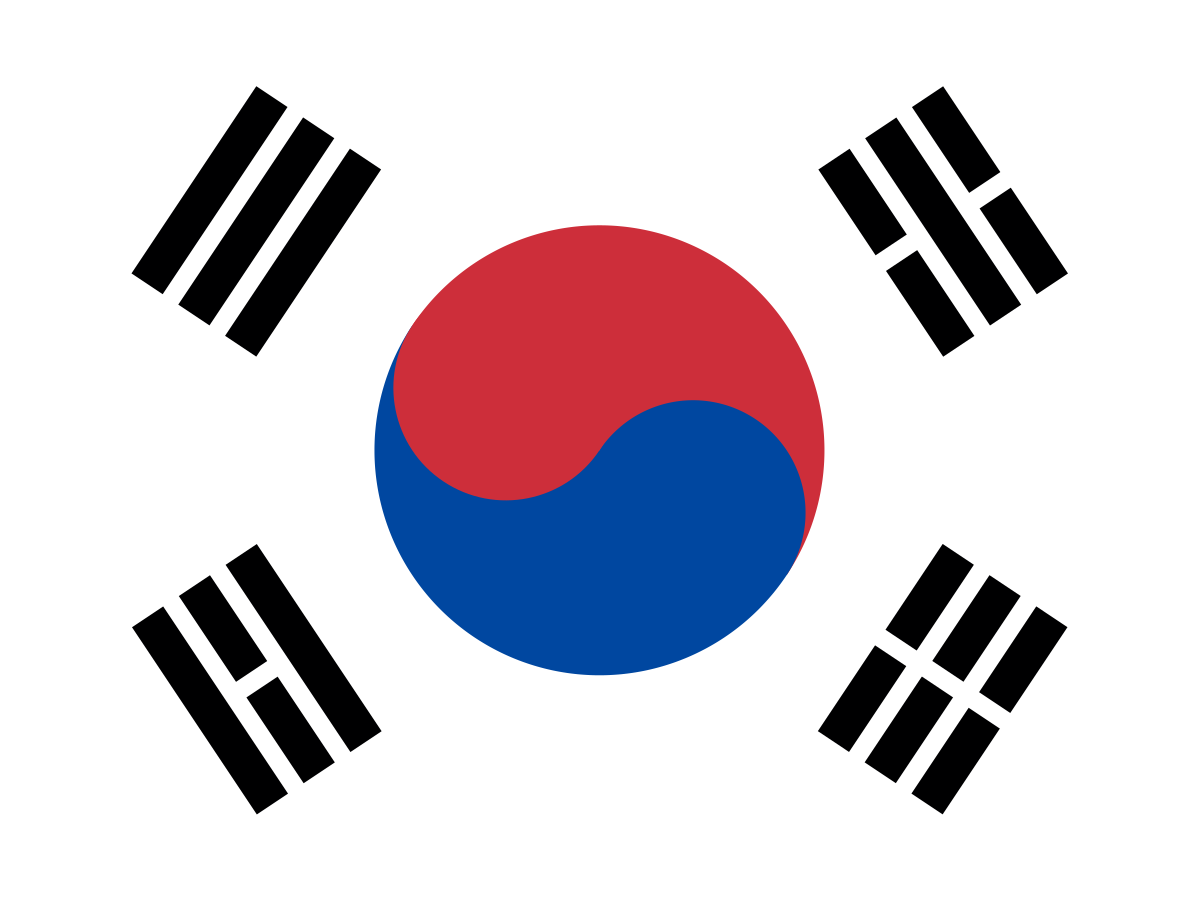
The South Korea flag
The South Korean flag is called the Taegukgi (Taegeukgi). It has a white field containing a red-and-blue taegeuk symbol at the centre and four groups of black trigrams around it.
The design expresses ideas of balance, harmony, movement and the complementary forces of the universe.
White
The white field is traditionally associated with light, peace and purity. White has also had a strong cultural association with the Korean people and was historically prominent in Korean clothing.
The Taegeuk
The central red-and-blue Taegeuk represents the balance of complementary forces. The red and blue halves curve around one another, expressing movement and harmony rather than a simple division between opposites.
Red
The red half of the Taegeuk represents the active or positive force, traditionally associated with yang.
Blue
The blue half represents the passive or receptive force, traditionally associated with eum, the Korean expression of the yin principle.
The four trigrams
The four black symbols around the Taegeuk are called gwae or trigrams. They are derived from the ancient I Ching tradition and represent combinations of broken and unbroken lines.
☰ Geon — Heaven
The three unbroken bars of Geon represent heaven and are associated with strength and creativity.
☷ Gon — Earth
The three broken bars of Gon represent earth and are associated with receptiveness and stability.
☵ Gam — Water
The pattern of Gam represents water. Its broken and unbroken lines express movement and resilience.
☲ Ri — Fire
The pattern of Ri represents fire. Together with the other trigrams, it completes the set of four symbolic natural forces shown on the flag.
Why the flag is distinctive
The Taegukgi is unusual because it combines a central philosophical symbol with four separate ancient diagrams. Rather than simply representing territory or political history, the design expresses a broader idea of balance and harmony.
A short history
Korea has a long history of kingdoms, dynasties and cultural development. The Joseon dynasty ruled from the late 14th century until the early 20th century, followed by Japanese colonial rule from 1910 to 1945.
After Japan's defeat in the Second World War, the peninsula was divided into northern and southern occupation zones. The Republic of Korea was established in 1948. The Korean War followed from 1950 to 1953, ending in an armistice rather than a peace treaty.
History timeline
c. 2333 BCE — Traditional foundation of GojoseonKorean tradition traces the first Korean kingdom to Gojoseon and the legendary figure Dangun.
57 BCE–668 CE — Three Kingdoms periodGoguryeo, Baekje and Silla became the major kingdoms of the Korean Peninsula and surrounding regions.
668 — Unified SillaSilla unified much of the Korean Peninsula, beginning a major period of cultural and religious development.
918 — Goryeo foundedWang Geon established the Goryeo dynasty, from which the modern English name Korea derives.
1392 — Joseon dynastyYi Seong-gye founded Joseon, a dynasty that would rule Korea for more than five centuries.
1443–1446 — Hangul created and promulgatedKing Sejong and his scholars developed Hangul, the Korean alphabet, to make literacy more accessible.
1592–1598 — Japanese invasionsJoseon Korea fought successive Japanese invasions, with Admiral Yi Sun-sin becoming famous for his naval victories.
1876 — Treaty of GanghwaJapan forced Korea to open ports, accelerating foreign influence and pressure on the Joseon state.
1897 — Korean EmpireKing Gojong proclaimed the Korean Empire as Korea attempted to strengthen its independence.
1910 — Japanese annexationKorea was formally annexed by Japan and remained under Japanese colonial rule until 1945.
1945 — LiberationJapan surrendered at the end of the Second World War. Korea was divided into Soviet and US occupation zones along the 38th parallel.
1948 — Republic of Korea establishedThe Republic of Korea was formally established in the south.
1950–1953 — Korean WarNorth Korea invaded the south, leading to a devastating international conflict. The war ended with an armistice in 1953.
1960 — April RevolutionMass protests contributed to the fall of President Syngman Rhee and a period of political change.
1960s–1980s — Rapid industrialisationSouth Korea transformed from a relatively poor country into a major industrial economy through export-led development.
1987 — Democratic reformsMass demonstrations helped bring constitutional reforms and a more competitive democratic political system.
1988 — Seoul OlympicsSeoul hosted the Summer Olympics, showcasing South Korea's rapid economic and international transformation.
1997 — Asian financial crisisSouth Korea was hit hard by the Asian financial crisis but implemented major reforms and recovered strongly.
2002 — FIFA World CupSouth Korea co-hosted the FIFA World Cup with Japan and reached the semi-finals.
TodaySouth Korea is a high-income democracy and major global economy with leading industries in technology, automobiles, shipbuilding, entertainment and advanced manufacturing.
Seoul
Seoul is South Korea's capital and by far its largest urban area. It combines historic palaces and traditional neighbourhoods with dense modern districts, technology companies, universities and extensive public transport.
Busan
Busan is South Korea's second-largest city and a major port. It is known for beaches, seafood, mountains and the enormous Busan International Film Festival.
Jeju Island
Jeju Island is a volcanic island south of the Korean Peninsula. It is famous for Hallasan, lava formations, waterfalls, coastal scenery and tourism.
Mountains
Around 70% of South Korea is mountainous or hilly. Mountain landscapes shape the country's climate, agriculture, recreation and settlement patterns.
Climate
South Korea has a temperate seasonal climate with cold winters and warm, humid summers. The summer monsoon brings a large proportion of annual rainfall, while typhoons can occasionally affect the peninsula.
Wildlife
South Korea's forests and wetlands support roe deer, wild boar, otters, foxes, cranes and many other species. The Korean demilitarised zone has also become an unexpectedly valuable wildlife habitat because development there has been restricted for decades.
Economy
South Korea has a highly developed, export-oriented economy. Major industries include semiconductors, automobiles, shipbuilding, electronics, batteries, chemicals, steel and telecommunications.
Technology
South Korean companies are major global players in semiconductors, smartphones, displays, batteries and consumer electronics. The country has some of the world's fastest and most widely available broadband and mobile networks.
Automobiles
South Korea is a major automobile-producing nation. Its manufacturers have become important global brands, producing passenger cars, commercial vehicles and increasingly electric vehicles.
Shipbuilding
South Korea is one of the world's leading shipbuilding countries. Large shipyards build container ships, tankers, LNG carriers and specialist vessels for customers around the world.
Education
Education is highly valued in South Korea. The country has high literacy and strong participation in higher education, although intense academic competition and long study hours are often discussed as social challenges.
Hangul
Hangul is the Korean writing system created under King Sejong in the 15th century. Its carefully structured letters are designed around the sounds and shapes involved in speech and are widely regarded as an elegant writing system.
Korean language
Korean is the principal language of South Korea. Modern Korean is normally written in Hangul, with occasional use of Chinese-derived Hanja in specialised or historical contexts.
Korean food
South Korean cuisine is known for kimchi, bibimbap, bulgogi, japchae, tteokbokki and Korean barbecue. Fermentation, rice, vegetables and chilli are important features of many dishes.
Kimchi
Kimchi is a traditional fermented vegetable dish, most commonly made with napa cabbage or radish and seasoned with chilli, garlic, ginger and other ingredients. It is an important part of Korean food culture.
K-pop
K-pop has become a worldwide cultural phenomenon. South Korean pop groups combine music, choreography, fashion, visual storytelling and highly organised global fan communities.
Korean dramas
South Korean television dramas and films have gained a huge international audience. The wider Korean Wave (Hallyu) has helped spread Korean language, food, fashion and entertainment around the world.
Film
South Korea has a highly regarded film industry. Directors such as Bong Joon Ho have helped bring Korean cinema to global audiences, while films such as Parasite achieved major international recognition.
Sport
Popular sports include football, baseball, taekwondo, archery, golf and speed skating. South Korea has achieved particular international success in archery and several winter and combat sports.
Taekwondo
Taekwondo is a Korean martial art that developed into a global sport. It became an official Olympic sport in 2000 and is now practised in countries around the world.
Religion
South Korea has a diverse religious landscape including Christianity, Buddhism and traditional Korean beliefs. A substantial part of the population also identifies as having no religion.
Korean architecture
South Korean architecture ranges from historic hanok houses and royal palaces to dense modern skyscrapers. Traditional buildings often use timber, tiled roofs and courtyards, while contemporary Seoul is dominated by high-rise development.
Democracy
South Korea is a constitutional democracy with a directly elected president and a national legislature. Democratic institutions developed significantly during the late 20th century after periods of authoritarian government.
The DMZ
The Demilitarised Zone (DMZ) separates North and South Korea. Although heavily fortified on both sides, the zone itself has become an unusual refuge for wildlife because large-scale civilian development is restricted.
Why is the South Korea flag interesting?
The Taegukgi is much more than a national colour pattern. Its Taegeuk and four trigrams come from an ancient philosophical tradition concerned with balance, change and the relationships between natural forces.
Explore South Korea on FlagAtlas
Keep exploring flags and educational resources.
Sources & further reading
The original FlagAtlas South Korea page has been retained as the base, including its correct flag image, 🇰🇷 emoji copier, development indicators, climate information and colouring-page link. fileciteturn201file0L139-L167
The expanded sections add educational background on the flag, history, geography, culture, economy, technology and Korean society.