Africa
South Sudan Flag
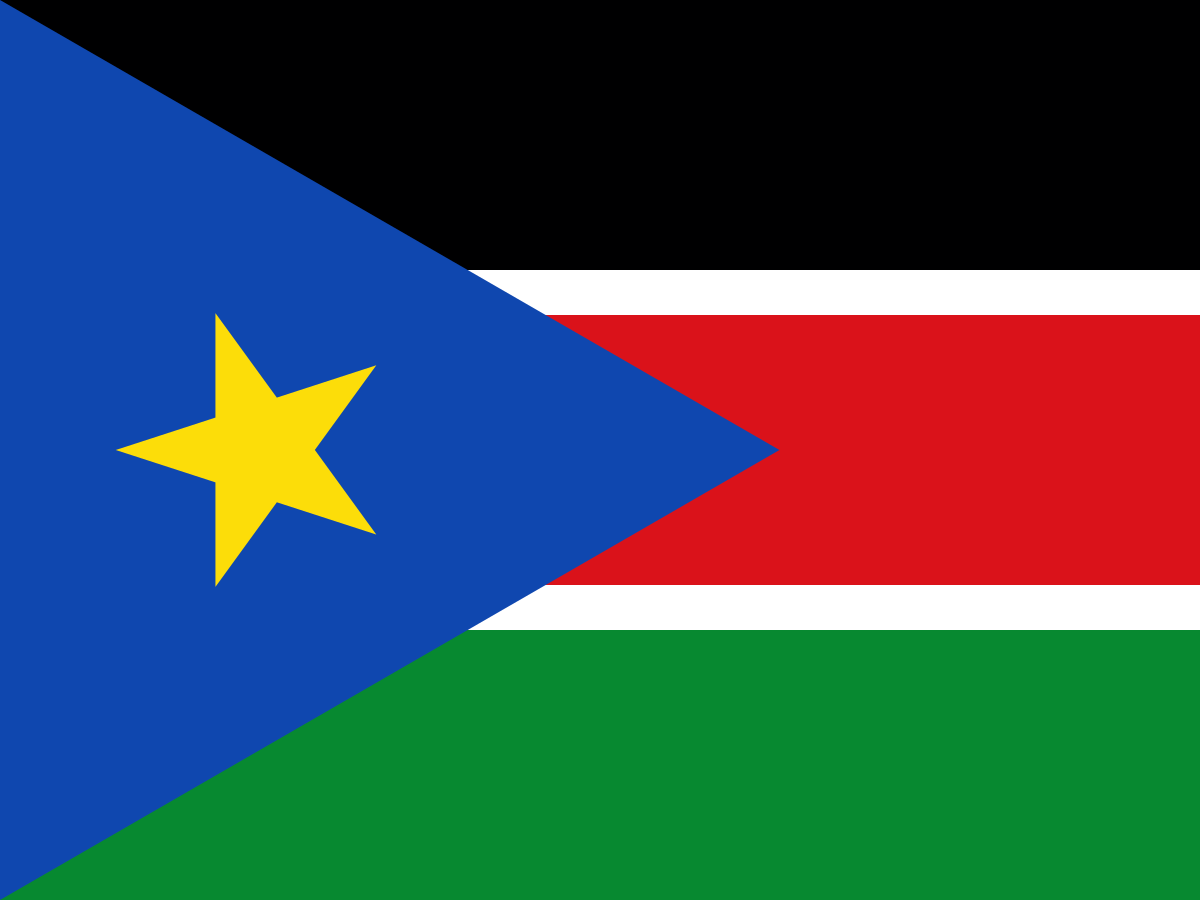
Black represents the people, red stands for the blood shed for freedom, green symbolises the land. Blue represents the Nile river. The gold star represents unity.
Capital
Juba
Continent
Africa
Population
11.0 million
Development indicators
GDP per capita
$440
USD per year (approx. 2023)
Human Development Index
0.385
Low development
World Bank income classification
Low Income (LIC)
LIC
🌡️ Climate: Tropical / Semi-arid
Flag symbolism
Black represents the people, red stands for the blood shed for freedom, green symbolises the land. Blue represents the Nile river. The gold star represents unity.
star
Did you know?
South Sudan is the world's youngest country, having gained independence from Sudan in 2011.
Test your knowledge
Think you know your world flags? Try the FlagAtlas daily challenge, speed quiz, or explore all Africa flags.
📚 Revising for GCSE Geography? Visit our free revision page →
About South Sudan
South Sudan is a landlocked country in East-Central Africa and the world's youngest internationally recognised sovereign state, becoming independent in 2011. The country is dominated by the Nile and its vast wetlands and grasslands.
CapitalJuba
RegionEast-Central Africa
CurrencySouth Sudanese pound
Official languageEnglish
Independence9 July 2011
Largest wetlandThe Sudd
The South Sudan flag
The South Sudan flag has black, red and green horizontal stripes, separated by narrow white lines, with a blue triangle at the hoist containing a golden five-pointed star. The design is closely associated with the country's independence movement.
Flag colours and star
Black represents the people of South Sudan. Red represents the blood shed during the struggle for freedom. Green represents the land and natural resources. White represents peace, while blue represents the Nile. The gold star represents the unity of the states of South Sudan.
Flag history
The present flag was adopted when South Sudan became independent on 9 July 2011. It was based on the flag used by the Sudan People's Liberation Movement/Army during the struggle for self-determination.
A short history
The region that is now South Sudan has a long history of Nilotic and other African peoples, kingdoms and communities. During the colonial period it formed part of Anglo-Egyptian Sudan. After Sudanese independence in 1956, conflict over autonomy, identity and political power contributed to two long civil wars. A 2005 peace agreement led to an autonomous Southern Sudan and eventually to the 2011 independence referendum.
History timeline
Ancient and pre-colonial periodMany Nilotic and other peoples developed communities and political traditions across the region, including along the Nile and its tributaries.
19th century — Egyptian and British expansionThe area became increasingly drawn into Egyptian and later Anglo-Egyptian rule.
1955 — First Sudanese civil war beginsConflict between northern and southern forces began shortly before Sudan gained independence.
1956 — Sudan independenceSudan became independent from Anglo-Egyptian rule, but tensions between the north and south remained unresolved.
1972 — Addis Ababa AgreementAn agreement ended the first civil war and created a period of southern autonomy.
1983 — Second civil warFighting resumed after the autonomy arrangements were undermined and the Sudan People's Liberation Movement/Army emerged as the main southern rebel movement.
2005 — Comprehensive Peace AgreementThe long civil war ended and Southern Sudan received extensive autonomy with a future independence referendum.
2011 — IndependenceAfter an overwhelming vote for independence, South Sudan became an independent country on 9 July 2011.
2013 — Civil warPolitical tensions developed into a new conflict that caused widespread displacement and humanitarian suffering.
2018 — Revitalized peace agreementA renewed peace process produced an agreement intended to end the civil war and establish a transitional unity government.
Juba
Juba is South Sudan's capital and largest city. It stands on the White Nile and is the country's main political, commercial and transport centre.
The Nile
The White Nile is central to South Sudan's geography and history. It flows north through the country and supports settlements, agriculture, fishing and wildlife.
The Sudd
The Sudd is one of the world's largest tropical wetlands. Formed by the White Nile, it covers a huge seasonal area of reeds, grasses and open water and is one of South Sudan's most important natural environments.
Geography
South Sudan is largely made up of broad plains, savanna, wetlands and wooded areas. The country has no coastline and borders Sudan, Ethiopia, Kenya, Uganda, the Democratic Republic of the Congo and the Central African Republic.
Climate
South Sudan has a predominantly tropical climate with distinct wet and dry seasons. Rainfall generally increases towards the south and highland areas, while northern regions are drier.
Wildlife
South Sudan has exceptionally important wildlife habitats. The country supports elephants, giraffes, lions, leopards, hippos, crocodiles and large antelope herds. The Sudd and surrounding grasslands are especially valuable for migratory wildlife.
The great migration
The grasslands and wetlands of South Sudan support one of Africa's largest wildlife migrations. Huge herds of antelope and other grazing animals move seasonally in response to rainfall and water availability.
People and communities
South Sudan is highly diverse, with many ethnic communities and languages. Major groups include the Dinka, Nuer, Shilluk, Bari, Azande and Anyuak, among many others.
Languages
English is the official language, while Arabic and numerous indigenous languages are widely spoken. Juba Arabic is also used as a lingua franca in parts of the country.
Culture
South Sudanese culture varies widely between communities but often places strong emphasis on family, cattle, community relationships, music, dance and oral traditions. Cattle are particularly important to the social and economic life of several pastoral peoples.
Traditional cattle culture
Among some South Sudanese communities, cattle have significance far beyond agriculture. They can be connected to wealth, marriage, social status and cultural identity, particularly among pastoral societies.
Religion
South Sudan is religiously diverse. Christianity is widespread, while traditional African beliefs and Islam are also practised. Religious traditions vary considerably between communities and regions.
Food
South Sudanese cuisine commonly uses sorghum, millet, maize, beans, vegetables, meat and fish. Meals vary between communities and regions, with food traditions reflecting both farming and pastoral lifestyles.
Economy
South Sudan's economy is heavily dependent on oil production, which provides the majority of government revenue and export earnings. Agriculture and livestock are also important to livelihoods, while infrastructure development remains a major challenge.
Oil
South Sudan has significant petroleum reserves. Oil production became central to the economy after independence, although disputes over oil infrastructure and access through Sudan have repeatedly affected production and government finances.
Challenges and humanitarian situation
South Sudan has faced major challenges including conflict, displacement, food insecurity, flooding and limited infrastructure. Peace-building, economic diversification and improved access to health and education remain major priorities.
Sport
Basketball has become particularly prominent in South Sudan, producing an increasingly successful national team and internationally recognised players. Football is also widely popular.
Why is South Sudan's flag interesting?
South Sudan's flag is closely connected to its struggle for self-determination. Its colours carry explicit political and national meanings, while the gold star on the blue triangle represents unity and the country's connection to the Nile.
Explore South Sudan on FlagAtlas