Americas
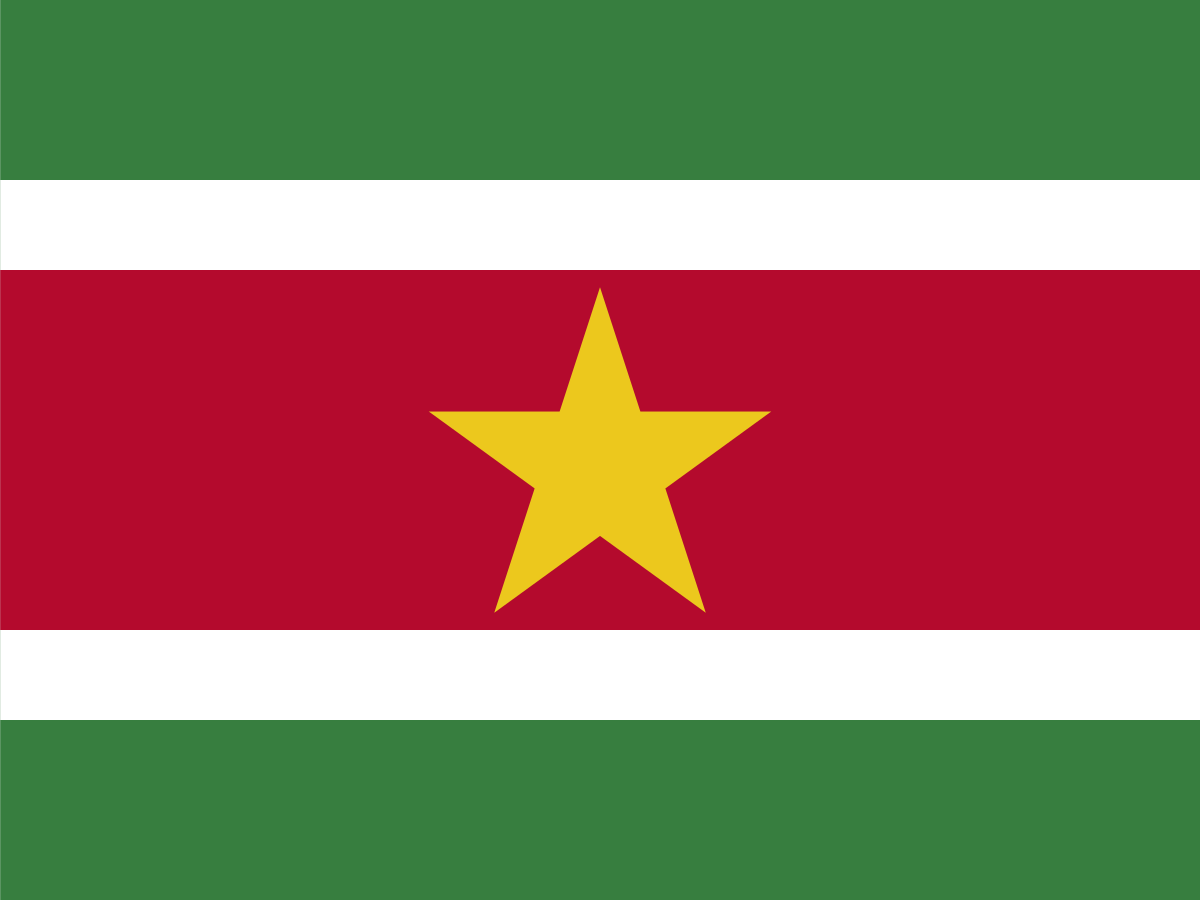
Suriname Flag
Green represents the forests and fields, white stands for freedom and justice, and red symbolises progress and love. The yellow star represents unity and a golden future.
Capital
Paramaribo
Continent
Americas
Population
600 thousand
Development indicators
GDP per capita
$6,200
USD per year (approx. 2023)
Human Development Index
0.710
High development
World Bank income classification
Upper-Middle Income (UMIC)
UMIC
🌡️ Climate: Tropical
Flag symbolism
Green represents the forests and fields, white stands for freedom and justice, and red symbolises progress and love. The yellow star represents unity and a golden future.
star
Did you know?
Suriname is the smallest sovereign country in South America.
Test your knowledge
Think you know your world flags? Try the FlagAtlas daily challenge, speed quiz, or explore all Americas flags.
📚 Revising for GCSE Geography? Visit our free revision page →
About Suriname
Suriname is a small country on the northeastern coast of South America, between Guyana and French Guiana. It is famous for its extraordinary ethnic and cultural diversity, tropical forests and Dutch colonial heritage.
CapitalParamaribo
ContinentSouth America
CurrencySurinamese dollar
Official languageDutch
Independence25 November 1975
CoastAtlantic Ocean
The Suriname flag
The Suriname flag has five horizontal stripes of green, white, red, white and green, with a large yellow five-pointed star in the centre. The design combines national unity, nature, peace and hope.
Green
The two green bands represent the fertility of the land and the country's lush natural environment. Green is also associated with hope and renewal.
White
The two white bands represent justice and freedom.
Red
The broad red band symbolises progress and love.
The yellow star
The large yellow star represents unity. Its golden colour is also associated with sacrifice and a bright future. The single star can be understood as representing the country's people coming together as one.
Why the flag is distinctive
Suriname's flag is immediately recognisable because of its unusually large central star and the strong contrast between its red centre, green outer bands and narrow white stripes.
A short history
Suriname's history has been shaped by Indigenous peoples, European colonisation, African slavery, Asian migration and independence. The Dutch established a lasting colonial presence, while plantation agriculture brought enslaved Africans to the colony. After emancipation, large numbers of contract workers arrived from India, Java and elsewhere, helping create the multicultural society seen today.
History timeline
Before European colonisation — Indigenous peoplesSeveral Indigenous peoples lived in the region, including the Arawak and Carib peoples.
17th century — European settlementEnglish and Dutch settlers established plantations and trading settlements along the coast.
1667 — Dutch controlThe Treaty of Breda confirmed Dutch control of Suriname following conflict with England.
17th–19th centuries — Plantation societySugar, coffee and other plantations became central to the colonial economy, relying heavily on enslaved African labour.
1863 — Slavery abolishedSlavery was formally abolished in Suriname, followed by a period of state-supervised labour for formerly enslaved people.
Late 19th–early 20th centuries — Contract migrationWorkers arrived from India, Java and China, transforming Suriname's population and culture.
1954 — Internal self-governmentSuriname gained greater internal autonomy while remaining within the Kingdom of the Netherlands.
1975 — IndependenceSuriname became independent from the Netherlands on 25 November 1975.
1980 — Military coupA military coup brought the National Military Council to power.
1987 — Return to civilian governmentA new constitution helped restore civilian democratic government.
1990 — Telephone coupA second military intervention briefly removed the elected government.
TodaySuriname is a democratic republic with a highly diverse population and an economy influenced by mining, agriculture, services and emerging offshore oil development.
Paramaribo
Paramaribo is Suriname's capital and largest city. Its historic inner city contains distinctive Dutch colonial architecture and is recognised as a UNESCO World Heritage site.
Historic Inner City of Paramaribo
The historic centre of Paramaribo is famous for its wooden buildings and the way Dutch, Caribbean and local influences have combined. It became a UNESCO World Heritage Site in 2002.
The Amazon rainforest
Most of Suriname is covered by tropical rainforest. The country's interior contains some of the most extensive and least disturbed forest in South America.
Climate
Suriname has a tropical climate with high temperatures and substantial rainfall. The coastal region is more densely populated, while the forested interior is much more sparsely settled.
Wildlife
Suriname's forests and rivers support extraordinary biodiversity, including jaguars, giant river otters, tapirs, giant anteaters, monkeys, macaws and many amphibian species.
Brownsberg Nature Park
Brownsberg Nature Park is one of the country's best-known protected areas, with rainforest, waterfalls and views across the Brokopondo Reservoir.
Central Suriname Nature Reserve
The Central Suriname Nature Reserve protects a huge area of rainforest and mountain ecosystems and is one of the world's major tropical wilderness areas.
Economy
Suriname's economy has long depended on gold, oil, bauxite, agriculture and services. Gold mining has become especially important in recent decades.
Gold
Gold is one of Suriname's most important exports. The sector provides employment and foreign income but also presents environmental and social challenges.
Bauxite
Suriname was historically an important producer of bauxite, which supported the country's economy for much of the 20th century.
Offshore oil
Significant offshore oil discoveries have increased expectations for future economic growth, although development also raises questions about environmental protection and how oil wealth will be managed.
Agriculture
Agriculture includes rice, bananas, vegetables and tropical crops. Rice is particularly important in the coastal districts.
Culture and diversity
Suriname is one of the world's most culturally diverse countries. Its population includes people of Hindustani, Maroon, Creole, Javanese, Indigenous, Chinese and European ancestry, among others.
Languages
Dutch is the official language. Sranan Tongo is widely used as a lingua franca, while Hindi-related languages, Javanese, Maroon languages and Indigenous languages are also spoken.
Religion
Suriname has an unusually diverse religious landscape, including Christianity, Hinduism and Islam, alongside smaller Jewish and traditional Indigenous and Maroon spiritual traditions.
Food
Surinamese cuisine reflects its multicultural population. Popular dishes include roti, pom, saoto soup, moksi alesi and peanut soup.
Pom
Pom is a celebrated Surinamese dish made using grated pomtajer, usually cooked with chicken and a richly seasoned sauce. It is particularly associated with Surinamese Creole-Jewish culinary traditions.
Music
Surinamese music includes kaseko, a lively style with African and Caribbean influences. The country also has strong Hindustani, Javanese and other musical traditions.
Sport
Football is extremely popular. Suriname has also produced many internationally successful footballers who have represented the Netherlands through eligibility rules.
Independence Day
25 November is celebrated as Independence Day, marking the country's independence from the Netherlands in 1975.
Why is Suriname's flag interesting?
The flag's design is simple but highly symbolic: green for nature and hope, white for justice and freedom, red for progress and love, and a single golden star for unity. It is a strong visual reflection of Suriname's diverse national identity.
Explore Suriname on FlagAtlas