Europe
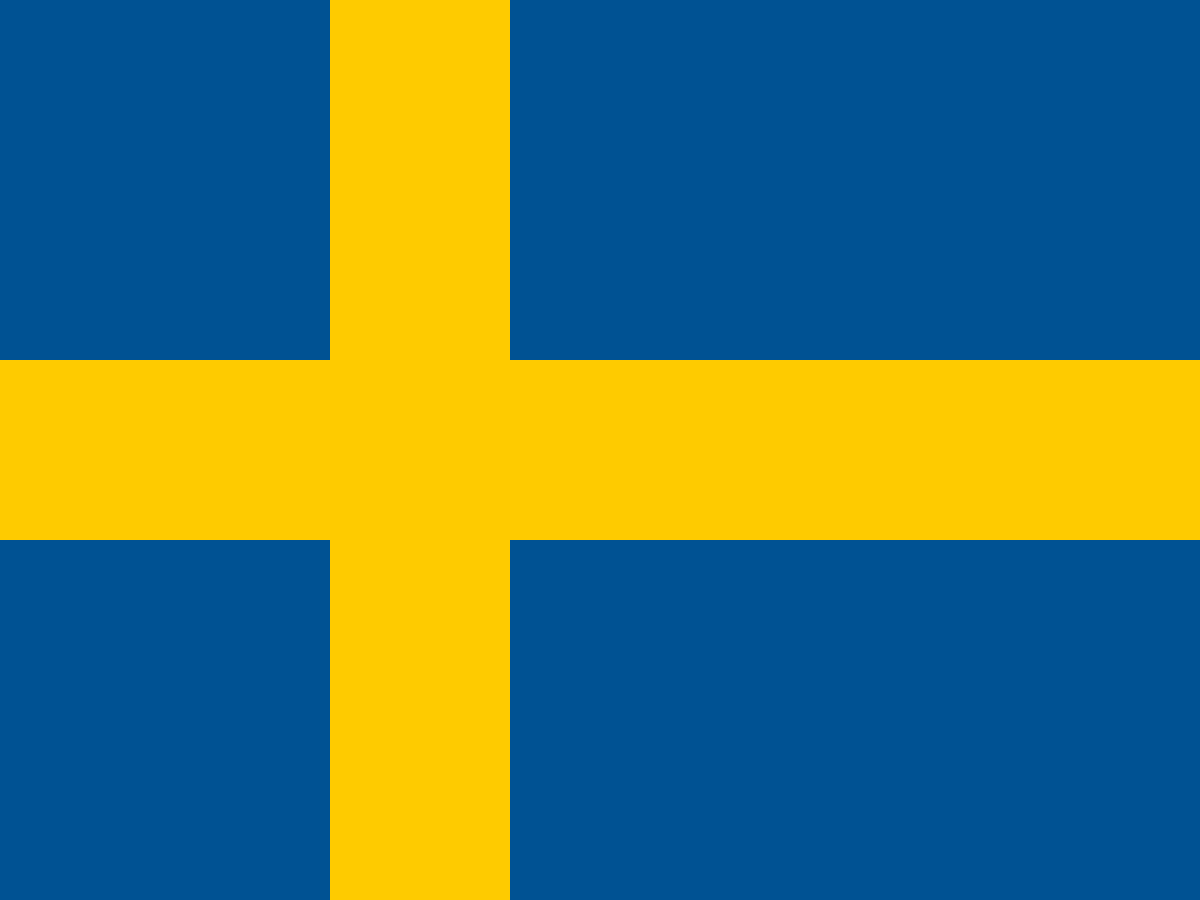
Sweden Flag
The Nordic cross design represents Christianity. The blue and yellow come from the Swedish coat of arms.
Capital
Stockholm
Continent
Europe
Population
10.0 million
Development indicators
GDP per capita
$55,400
USD per year (approx. 2023)
Human Development Index
0.952
Very High development
World Bank income classification
High Income (HIC)
HIC
🌡️ Climate: Subarctic / Temperate
Flag symbolism
The Nordic cross design represents Christianity. The blue and yellow come from the Swedish coat of arms.
nordic cross
Did you know?
Sweden has around 221,800 islands, making it one of the most island-rich countries in the world.
Test your knowledge
Think you know your world flags? Try the FlagAtlas daily challenge, speed quiz, or explore all Europe flags.
📚 Revising for GCSE Geography? Visit our free revision page →
About Sweden
Sweden is a Nordic country in northern Europe, occupying most of the eastern side of the Scandinavian Peninsula. It is known for forests, lakes, a long Baltic coastline, innovation and a distinctive Nordic cultural heritage.
CapitalStockholm
ContinentEurope
CurrencySwedish krona
LanguageSwedish
PopulationAbout 10.6 million
EU memberSince 1995
The Swedish flag
The Swedish flag is a blue field with a yellow Nordic cross. The cross extends to the edges of the flag and reflects Sweden's long historical connection with the other Nordic countries.
Blue
The blue field is traditionally associated with the Swedish landscape and sky and forms the dominant background of the national flag.
Yellow
The yellow or gold cross is traditionally linked to the Swedish coat of arms and the country's royal heritage.
The Nordic cross
The Nordic cross is a shared design feature of the flags of Sweden, Denmark, Norway, Finland and Iceland, reflecting the historical and cultural connections between the Nordic countries.
Why the flag is distinctive
Sweden's flag is one of the world's best-known Nordic cross flags. Its bright yellow cross against a deep blue field gives it a simple but highly recognisable appearance.
A short history
Sweden developed from a collection of regional kingdoms into a unified medieval state. It became a major European power during the 17th century, later losing much of its empire. Sweden and Norway were united from 1814 to 1905, after which Sweden became a separate constitutional monarchy. Sweden has remained neutral in major European wars for much of the modern era and joined NATO in 2024.
History timeline
c. 800–1050 — Viking AgeSwedish Vikings travelled widely across the Baltic and along eastern European river routes.
12th–14th centuries — Medieval SwedenSweden developed into a more centralised kingdom and Christianity became firmly established.
1397–1523 — Kalmar UnionSweden was part of the union linking Denmark, Norway and Sweden under a shared monarch.
1523 — Gustav VasaGustav Vasa became king and Sweden left the Kalmar Union, establishing the foundations of the modern Swedish state.
17th century — Swedish EmpireSweden became a major European military power and controlled territories around the Baltic Sea.
1700–1721 — Great Northern WarSweden fought Russia and other European powers and eventually lost much of its position as a Baltic great power.
1814–1905 — Union with NorwaySweden and Norway were joined in a personal union until Norway became independent in 1905.
1900s — IndustrialisationSweden developed into a highly industrialised economy with major engineering, manufacturing and export industries.
1995 — EU membershipSweden joined the European Union.
2022 — NATO applicationSweden applied to join NATO following Russia's full-scale invasion of Ukraine.
2024 — NATO membershipSweden became NATO's 32nd member on 7 March 2024.
TodaySweden is a parliamentary constitutional monarchy and a highly developed Nordic economy.
Stockholm
Stockholm is Sweden's capital and largest city, built across numerous islands where Lake Mälaren meets the Baltic Sea. Its historic Gamla Stan is one of Europe's best-known old towns.
Gothenburg
Gothenburg is Sweden's second-largest city and a major port on the west coast. It has strong maritime, engineering and manufacturing traditions.
Kiruna
Kiruna lies far north within the Arctic Circle. It is famous for the nearby Icehotel, northern lights and the dramatic relocation of parts of the town because of mining.
Swedish Lapland
Swedish Lapland covers much of the far north and includes forests, mountains, lakes and Arctic landscapes. The region is home to the Sámi, the Indigenous people of northern Scandinavia.
Climate
Sweden has a varied climate. Southern areas are relatively mild, while northern Sweden has much colder winters and long summer daylight. Above the Arctic Circle, the midnight sun occurs in summer and polar night occurs in winter.
The northern lights
The aurora borealis can be seen in northern Sweden, particularly around Swedish Lapland during the darker months of the year.
Wildlife
Sweden has extensive forests and supports moose, brown bears, wolves, lynx, reindeer, beavers and many bird species. Its lakes and Baltic waters also support diverse aquatic wildlife.
Forests and lakes
Forests cover a large proportion of Sweden and the country contains tens of thousands of lakes. The landscape is particularly famous for its boreal forests and clear inland waters.
Economy
Sweden has a highly developed, export-oriented economy with strengths in engineering, manufacturing, technology, pharmaceuticals, telecommunications and services.
Innovation
Sweden has a strong reputation for innovation and technology. Companies and products associated with the country include IKEA, Volvo, Ericsson, Spotify and many other internationally recognised brands.
Engineering and industry
Engineering has played a central role in Sweden's economic development. Important industries include vehicles, machinery, telecommunications, mining, steel and advanced manufacturing.
Food
Swedish cuisine includes meatballs, gravlax, pickled herring, crispbread, potatoes and cinnamon buns. Traditional food is closely connected to the country's climate and seasonal produce.
Fika
Fika is a Swedish social tradition involving a break for coffee and something sweet or savoury. It is an important part of everyday Swedish culture.
Midsummer
Midsummer is one of Sweden's most important traditional celebrations. People gather around maypoles, eat seasonal food, sing, dance and celebrate the long summer days.
Sámi culture
The Sámi are the Indigenous people of northern Scandinavia. Traditional livelihoods include reindeer herding, and Sámi culture and languages remain an important part of northern Sweden.
Languages
Swedish is the main national language. Sweden also recognises several minority languages, including Sámi languages, Finnish, Meänkieli, Romani Chib and Yiddish.
Religion
Sweden has historically been Lutheran and the Church of Sweden remains the country's largest religious organisation, although modern Sweden is highly secular and religiously diverse.
Sport
Football, ice hockey, athletics and skiing are particularly popular. Sweden has also achieved international success in tennis, swimming and winter sports.
ABBA and music
Sweden has had an enormous influence on international popular music. ABBA became one of the world's most successful pop groups, while Swedish songwriters and producers have worked with major artists around the globe.
Swedish design
Swedish design is known for its emphasis on simplicity, functionality and clean forms. The influence can be seen in furniture, architecture, fashion and everyday products.
Why is Sweden's flag interesting?
The Swedish flag combines a traditional Nordic cross with the country's historic blue and yellow colours. Its simple design makes it instantly recognisable while linking Sweden to the wider Nordic family.
Explore Sweden on FlagAtlas