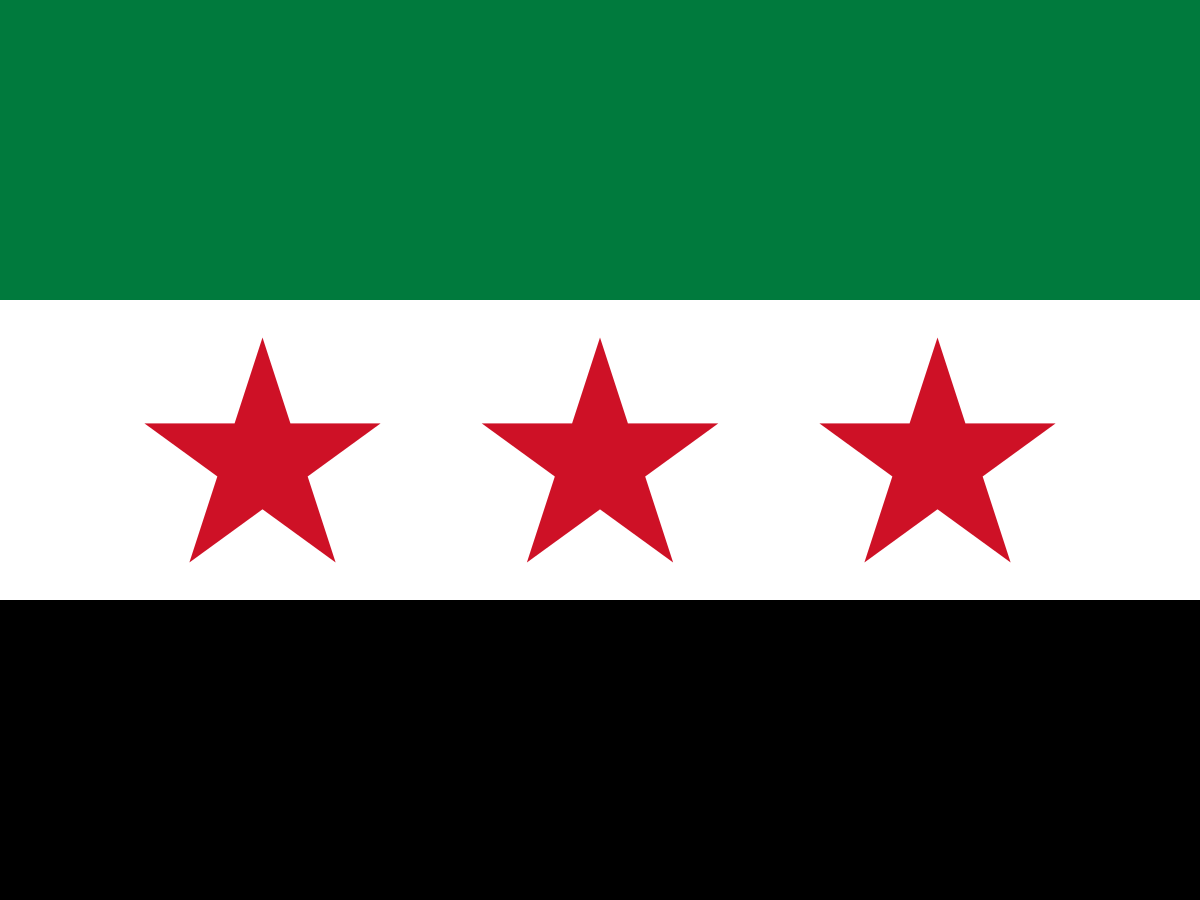
Flag of Syria
Asia

Syria Flag

Green represents hope, growth and Syria’s Arab and Islamic heritage; white represents peace and the Umayyad era; black reflects historical struggle and the Abbasid era. Three red stars represent Damascus, Aleppo and Deir ez-Zor and are also associated with freedom, dignity and justice.

🎨 Free printable colouring page
Capital Damascus
Continent Asia
Population 22.0 million

Development indicators

GDP per capita
$1,100
USD per year (approx. 2023)
Human Development Index
0.577
Medium development
World Bank income classification
Lower-Middle Income (LMIC)
LMIC
🌡️ Climate: Mediterranean / Arid

Flag symbolism

Green represents hope, growth and Syria’s Arab and Islamic heritage; white represents peace and the Umayyad era; black reflects historical struggle and the Abbasid era. Three red stars represent Damascus, Aleppo and Deir ez-Zor and are also associated with freedom, dignity and justice.

starspan-arab

Did you know?

Damascus is one of the oldest continuously inhabited cities in the world, dating back at least 11,000 years.

Test your knowledge

Think you know your world flags? Try the FlagAtlas daily challenge, speed quiz, or explore all Asia flags.

📚 Revising for GCSE Geography? Visit our free revision page →

The current Syrian flag

Syria’s current national flag is a green, white and black horizontal tricolour with three red five-pointed stars in the centre of the white stripe. It replaced the former red-white-black flag with two green stars.

Flag colours and stars

Green is associated with hope, growth and Syria’s Arab and Islamic heritage. White represents peace and the Umayyad era. Black reflects historical struggle and the Abbasid era. The three red stars are associated with Damascus, Aleppo and Deir ez-Zor and with freedom, dignity and justice.

About Syria

Syria is a country in western Asia, on the eastern Mediterranean. It borders Turkey, Iraq, Jordan, Israel and Lebanon. Damascus is the capital.

Damascus

Damascus is Syria’s capital and one of the world’s oldest continuously inhabited cities. Its historic Old City contains important markets, religious buildings and monuments.

Aleppo

Aleppo has been an important trading and cultural centre for centuries. Its historic citadel and old city reflect many civilisations.

Palmyra

Palmyra was an ancient oasis city and major trading centre. Its archaeological remains are among Syria’s best-known ancient sites.

Geography and climate

Syria includes Mediterranean coastal areas, fertile plains, steppe and desert landscapes. The Euphrates is its most important river. Climate ranges from Mediterranean on the coast to hot, dry conditions inland.

History timeline

Ancient SyriaThe region was home to major civilisations including the Arameans, Assyrians, Greeks and Romans.
661–750 — Umayyad periodDamascus served as the capital of the Umayyad Caliphate.
1516–1918 — Ottoman ruleMost of modern Syria was incorporated into the Ottoman Empire.
1920s — French MandateSyria came under French administration after the First World War.
1946 — IndependenceThe last French troops left and Syria became fully independent.
1958–1961 — United Arab RepublicSyria and Egypt formed a political union.
2011 — Uprising and warProtests developed into a prolonged conflict.
December 2024 — Assad government fallsA new transitional political period began.
2025 — Constitutional DeclarationThe new constitutional framework specified the green-white-black flag with three red stars.

Culture and food

Syrian culture reflects thousands of years of Arab, Mediterranean and wider Middle Eastern traditions. Foods include kibbeh, hummus, tabbouleh, fattoush, muhammara and baklava.

Languages

Arabic is the official language. Kurdish, Aramaic and other languages are also spoken by communities in Syria.

Economy

Syria’s economy has been heavily damaged by conflict and infrastructure destruction. Agriculture, trade, manufacturing and energy have historically been important sectors.

Why is Syria’s flag interesting?

The current flag has deep historical roots: the green-white-black design was used by Syria’s independence movement and later became a major symbol of opposition to the former regime. Its return as the national flag makes it especially significant in Syria’s recent history.

Explore Syria on FlagAtlas

☕ Buy me a coffee