Asia
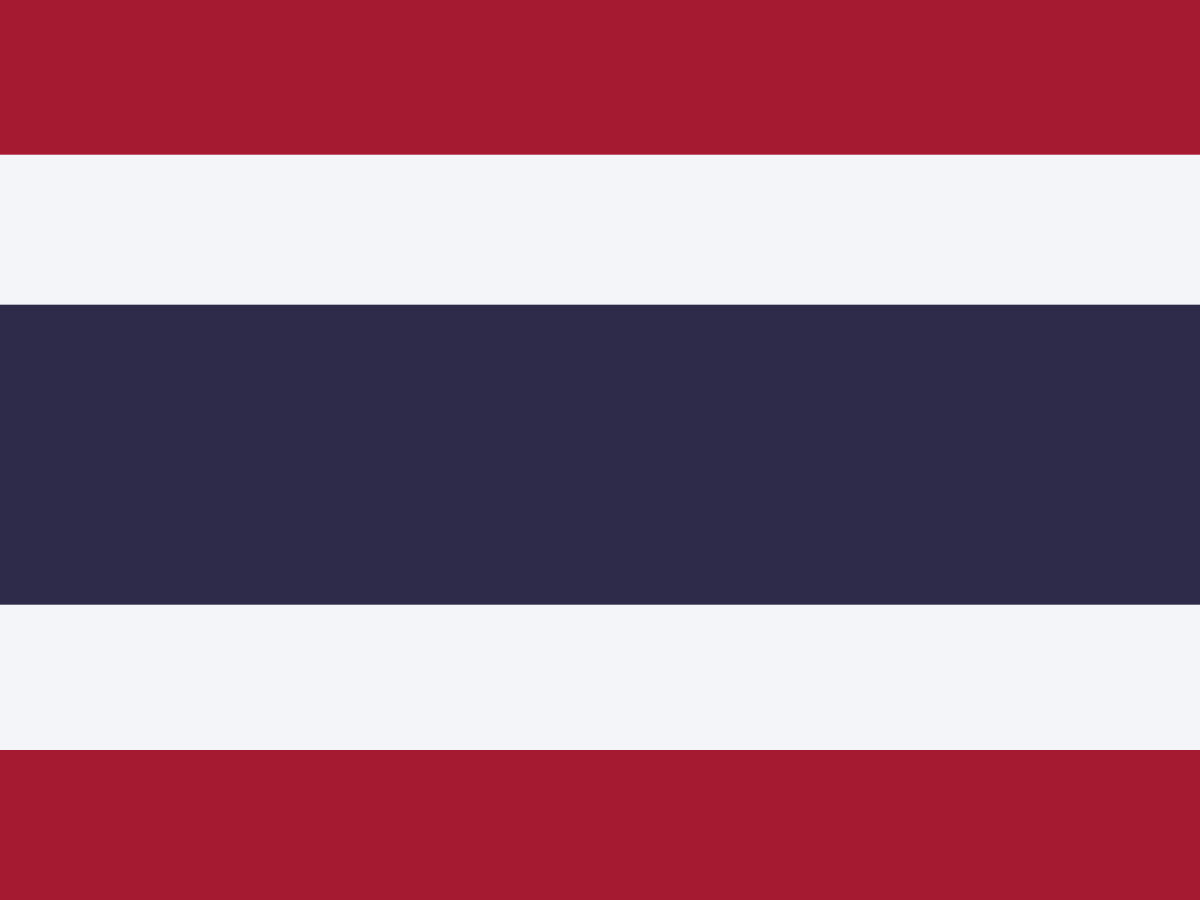
Thailand Flag
Red represents the nation and the blood of those who defended it. White stands for the purity of Buddhism. Blue represents the monarchy — King Vajiravudh changed the flag to show solidarity with World War I allies.
Capital
Bangkok
Continent
Asia
Population
70.0 million
Development indicators
GDP per capita
$7,100
USD per year (approx. 2023)
Human Development Index
0.803
Very High development
World Bank income classification
Upper-Middle Income (UMIC)
UMIC
🌡️ Climate: Tropical
Flag symbolism
Red represents the nation and the blood of those who defended it. White stands for the purity of Buddhism. Blue represents the monarchy — King Vajiravudh changed the flag to show solidarity with World War I allies.
Did you know?
Thailand is the world's largest exporter of rice.
Test your knowledge
Think you know your world flags? Try the FlagAtlas daily challenge, speed quiz, or explore all Asia flags.
📚 Revising for GCSE Geography? Visit our free revision page →
About Thailand
Thailand is a country in mainland Southeast Asia, stretching from the mountainous north to tropical islands and beaches in the south. It is known for its Buddhist temples, cuisine, historic kingdoms, forests, beaches and vibrant cities.
CapitalBangkok
RegionSoutheast Asia
CurrencyBaht
LanguageThai
Largest cityBangkok
Official nameKingdom of Thailand
The Thailand flag
The Thai flag, known as Thong Trairong or the 'tricolour flag', has five horizontal stripes: red, white, blue, white and red. The central blue stripe is twice the height of each red or white stripe.
Flag colours and symbolism
Red represents the nation and the Thai people. White represents religion, traditionally associated with Buddhism. Blue represents the monarchy. Together, the three colours reflect the traditional Thai ideas of nation, religion and monarchy.
Flag history
Thailand's current tricolour was adopted on 28 September 1917 by King Vajiravudh (Rama VI). It replaced an earlier red flag bearing a white elephant and introduced the distinctive five-stripe design still used today.
A short history
Thailand has a long history of Southeast Asian kingdoms and has retained its independence through the colonial era that reshaped much of neighbouring Southeast Asia. The kingdoms of Sukhothai and Ayutthaya were followed by the Chakri dynasty and modern Bangkok.
History timeline
13th century — Sukhothai KingdomSukhothai became one of the early major Thai kingdoms and is traditionally associated with the development of Thai political and cultural identity.
14th–18th centuries — Ayutthaya KingdomAyutthaya grew into a powerful regional state and an important centre of international trade and diplomacy.
1767 — Fall of AyutthayaAyutthaya was destroyed during the Burmese–Siamese wars.
1782 — Chakri dynasty and BangkokGeneral Chao Phraya Chakri became King Rama I and established the Chakri dynasty, with Bangkok as the capital.
19th century — ModernisationThai rulers carried out reforms while negotiating with expanding European colonial powers. Siam remained independent, although it surrendered some territories.
1932 — Constitutional revolutionA political revolution ended absolute monarchy and introduced constitutional government.
1939 — Siam becomes ThailandThe country's official name was changed from Siam to Thailand.
1945–1949 — Name changesThe country briefly returned to the name Siam before Thailand became the official name again in 1949.
Late 20th century — Economic transformationThailand underwent rapid industrialisation, urbanisation and growth in international tourism.
21st century — Political changeThailand has experienced continuing political debate and periods of military and civilian government.
Bangkok
Bangkok is Thailand's capital and largest city. It is a major centre of government, business, finance, tourism, transport, education and culture, and is built around the Chao Phraya River.
Chiang Mai
Chiang Mai is a major city in northern Thailand and was historically the centre of the Lanna Kingdom. It is known for temples, mountain scenery, markets and traditional northern Thai culture.
The Grand Palace
Bangkok's Grand Palace was established in 1782 and became the principal royal residence. The complex includes important buildings and the Temple of the Emerald Buddha.
Wat Phra Kaew
Wat Phra Kaew, the Temple of the Emerald Buddha, is one of Thailand's most important Buddhist temples. The highly revered Emerald Buddha image is a major national religious symbol.
Geography
Thailand has a varied landscape including northern mountains, the central Chao Phraya plain, northeastern plateaus and a long southern peninsula. It borders Myanmar, Laos, Cambodia and Malaysia.
The Chao Phraya River
The Chao Phraya River is central to Thailand's geography and history. It flows through Bangkok and the fertile central plain, supporting agriculture, transport and settlement.
Climate
Thailand has a predominantly tropical climate with a rainy season, a cooler or drier season and a hot season. Conditions vary between the north, central plains, Gulf coast and Andaman coast.
Islands and beaches
Thailand is famous for tropical islands and beaches including Phuket, Koh Samui, Koh Phi Phi and Krabi. Its coastlines feature coral reefs, limestone cliffs, mangroves and clear tropical waters.
Wildlife
Thailand's forests and national parks support Asian elephants, tigers, leopards, gibbons, hornbills and many reptiles and amphibians. Marine habitats are also important for coral reefs and sea turtles.
Buddhism
Theravada Buddhism is central to Thai culture and society. Temples, monks, festivals and Buddhist teachings are visible throughout the country, although Thailand is also religiously diverse.
Thai culture
Thai culture places strong emphasis on family, hospitality, respect for elders and social harmony. The traditional greeting, the wai, is made by placing the palms together and slightly bowing.
Language
Thai is the official language and uses its own distinctive script. Regional languages and dialects are also spoken, and English is widely encountered in tourism and business.
Songkran
Songkran, the Thai New Year festival, is celebrated in April. It is famous internationally for water celebrations, but its traditional meaning includes family visits, temple activities and rituals of renewal.
Food
Thai cuisine is known around the world for balancing sweet, sour, salty, spicy and bitter flavours. Famous dishes include pad thai, green curry, tom yum, som tam, massaman curry and mango sticky rice.
Economy
Thailand has a diversified economy based on manufacturing, electronics, automobiles, agriculture, tourism, food processing and services. It is one of Southeast Asia's major industrial and tourism economies.
Agriculture
Thailand is a major producer and exporter of rice, rubber, cassava, sugar and tropical fruit. Rice cultivation has long been particularly important to the country's economy and culture.
Tourism
Tourism is a major part of Thailand's economy. Visitors are attracted by Bangkok, historic cities, temples, food, beaches, islands, national parks and the country's strong hospitality tradition.
Muay Thai
Muay Thai, or Thai boxing, is Thailand's traditional combat sport. It is known for the use of fists, elbows, knees and shins and has become popular internationally.
Why is Thailand's flag interesting?
Thailand's flag is distinctive because the central blue stripe is twice as wide as the red and white stripes. Its three colours are also closely associated with the country's enduring concept of nation, religion and monarchy.
Explore Thailand on FlagAtlas