Europe
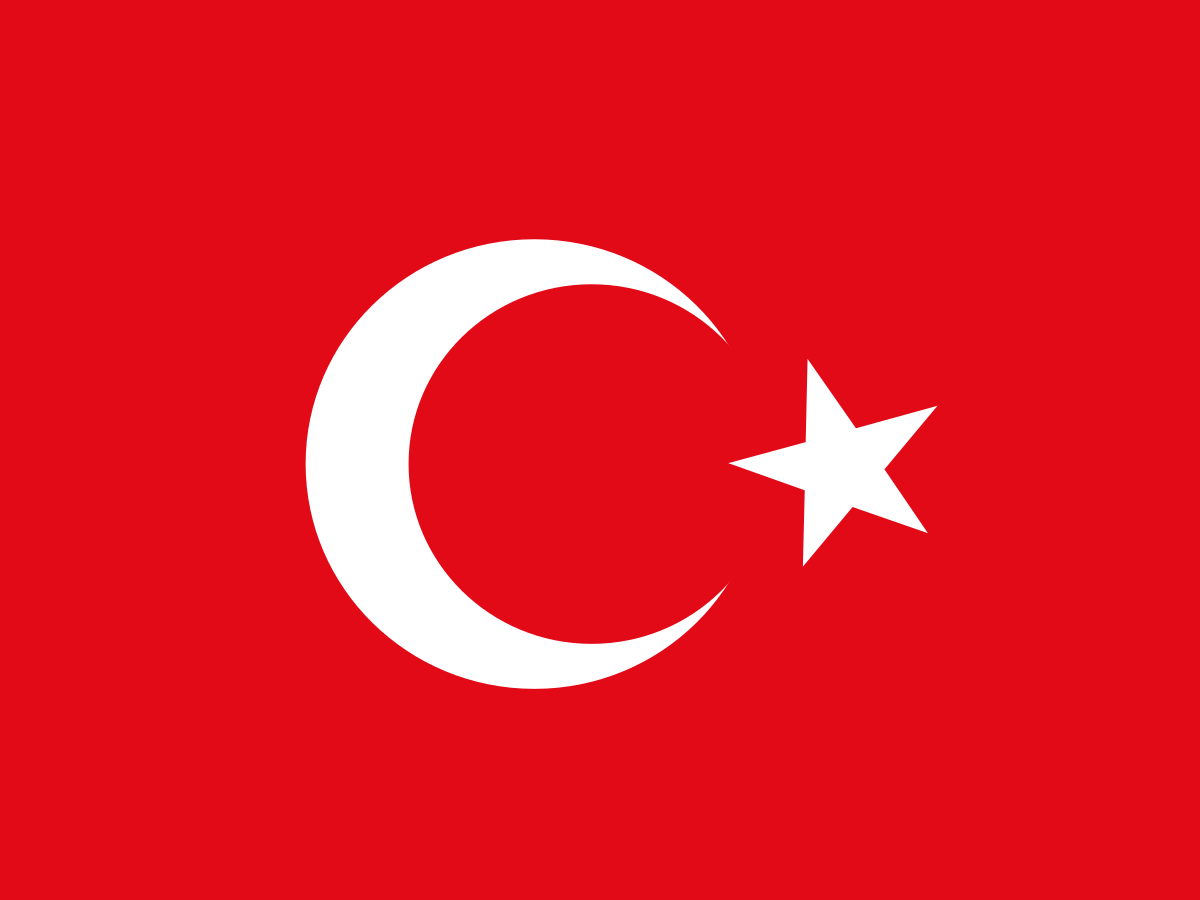
Turkey Flag
The crescent moon and star are symbols of Islam. Legend says the crescent reflected in pools of blood after a battle.
Capital
Ankara
Continent
Europe
Population
84.0 million
Development indicators
GDP per capita
$12,700
USD per year (approx. 2023)
Human Development Index
0.855
Very High development
World Bank income classification
Upper-Middle Income (UMIC)
UMIC
🌡️ Climate: Mediterranean / Semi-arid
Flag symbolism
The crescent moon and star are symbols of Islam. Legend says the crescent reflected in pools of blood after a battle.
crescentstar
Did you know?
Turkey is the world's largest producer of hazelnuts, providing about 75% of the global supply.
Test your knowledge
Think you know your world flags? Try the FlagAtlas daily challenge, speed quiz, or explore all Europe flags.
📚 Revising for GCSE Geography? Visit our free revision page →
About Türkiye
Türkiye, officially the Republic of Türkiye, sits at the crossroads of Europe and Asia. Its location between the Black Sea, Mediterranean and Aegean has made it a meeting point of civilisations for thousands of years.
CapitalAnkara
Largest cityIstanbul
RegionEurope & West Asia
CurrencyTurkish lira
LanguageTurkish
Republic founded1923
The Türkiye flag
The Turkish flag has a red field with a white crescent and five-pointed star. It is one of the world's most recognisable national flags and is commonly called Ay Yıldız, meaning 'moon-star'.
Flag colours and symbolism
Red has deep historical associations with Turkish identity and is traditionally linked with sacrifice and the struggle for independence. The white crescent and star are long-standing symbols associated with Turkish and Islamic heritage.
Flag history
The modern Turkish flag developed from Ottoman-era designs featuring a crescent and star on a red background. The present form was standardised during the early republican period, following the establishment of the Republic of Türkiye in 1923.
A short history
The lands of modern Türkiye have been home to some of the world's most important civilisations, including the Hittites, Greeks, Romans, Byzantines and Ottomans. After the First World War, the Turkish War of Independence led by Mustafa Kemal Atatürk resulted in the establishment of the modern republic.
History timeline
c. 1600 BCE — Hittite civilisationThe Hittites established a powerful state in central Anatolia and became one of the major powers of the ancient Near East.
6th–4th centuries BCE — Persian and Greek influencePersian rule was followed by the expansion of Greek culture after Alexander the Great.
1st century BCE–4th century CE — Roman AnatoliaMuch of Anatolia became part of the Roman world, with cities such as Ephesus becoming major centres.
330 CE — ConstantinopleConstantine the Great established Constantinople as a major imperial capital.
11th century — Seljuk TurksTurkic Seljuk rulers established major states in Anatolia following the Battle of Manzikert in 1071.
1299–1300s — Rise of the OttomansOsman I and his successors built a state that expanded across Anatolia and southeastern Europe.
1453 — Fall of ConstantinopleMehmed II conquered Constantinople, which became the Ottoman imperial capital and was later known as Istanbul.
16th century — Ottoman powerUnder rulers including Suleiman the Magnificent, the Ottoman Empire became a major power spanning Europe, Asia and Africa.
1914–1918 — First World WarThe Ottoman Empire fought with the Central Powers and was defeated, leading to occupation and plans to divide its territories.
1919–1922 — Turkish War of IndependenceNationalist forces led by Mustafa Kemal Atatürk fought to establish an independent Turkish state.
1923 — Republic of TürkiyeThe Republic of Türkiye was proclaimed on 29 October 1923, with Ankara as its capital.
1934 — Surname LawMustafa Kemal received the surname Atatürk, meaning 'Father of the Turks'.
20th century — ModernisationThe republic underwent major legal, social and economic reforms, including secularisation and changes to education and the alphabet.
21st century — Regional powerTürkiye has remained an important NATO member and regional power linking Europe, the Middle East, the Caucasus and Central Asia.
Ankara
Ankara has been the capital of Türkiye since 1923. It is the country's political and administrative centre and is home to the national government and parliament.
Istanbul
Istanbul is Türkiye's largest city and its cultural and economic centre. It famously spans the Bosphorus, with one side in Europe and the other in Asia.
The Bosphorus
The Bosphorus Strait connects the Black Sea with the Sea of Marmara and separates the European and Asian sides of Istanbul. It has been strategically important for trade and military power for centuries.
Hagia Sophia
Hagia Sophia in Istanbul was originally built as a Byzantine cathedral under Emperor Justinian I. It later became an Ottoman mosque, then a museum, and is now again used as a mosque.
Cappadocia
Cappadocia in central Türkiye is famous for its volcanic landscapes, fairy chimneys, underground cities and rock-cut churches. Hot-air balloon flights over the valleys have become an iconic attraction.
Ephesus
The ancient city of Ephesus on the Aegean coast was one of the great cities of the ancient Mediterranean. Its ruins include the Library of Celsus and the remains of the Temple of Artemis.
Mount Ararat
Mount Ararat is a snow-capped volcanic massif in eastern Türkiye and the country's highest mountain. It has long been associated with the biblical story of Noah's Ark.
Geography
Türkiye has a highly varied landscape including the Anatolian plateau, Black Sea mountains, Mediterranean coast, Aegean coast and eastern highlands. It borders eight countries and controls the strategic Turkish Straits.
Climate
Türkiye has several climate zones. The Mediterranean and Aegean coasts have hot, dry summers and mild wetter winters, while the interior has colder winters and hotter, drier summers. Eastern regions can experience severe winter conditions.
Wildlife
Türkiye's varied landscapes support wolves, brown bears, lynx, wild goats, deer, flamingos and many migratory birds. Its position between Europe, Asia and Africa makes it an important migration route.
Turkish language
Turkish is the official language and belongs to the Turkic language family. The modern Turkish alphabet uses Latin letters and was introduced during Atatürk's reforms in 1928.
Religion
The majority of Türkiye's population is Muslim, predominantly Sunni, while the constitution defines the country as a secular republic. Türkiye also has historic Christian and Jewish communities.
Turkish cuisine
Turkish cuisine combines Central Asian, Middle Eastern, Mediterranean and Balkan influences. Famous foods include kebab, meze, pide, lahmacun, baklava, dolma and Turkish delight.
Tea and coffee
Tea is deeply embedded in everyday Turkish life, while Turkish coffee has a long cultural tradition. Turkish coffee culture is recognised by UNESCO as intangible cultural heritage.
Economy
Türkiye has a large and diversified economy based on manufacturing, services, tourism, agriculture, construction and trade. Major industries include automobiles, textiles, machinery, electronics and food processing.
Tourism
Türkiye attracts visitors with its archaeological sites, historic cities, Mediterranean and Aegean resorts, Cappadocia, mountains and distinctive cuisine. Istanbul is one of the world's major city-break destinations.
The Ottoman Empire
The Ottoman Empire lasted for more than six centuries and at its height controlled territory across southeastern Europe, the Middle East and North Africa. Its architectural, political and cultural legacy remains visible throughout modern Türkiye.
Mustafa Kemal Atatürk
Mustafa Kemal Atatürk founded the modern Turkish republic and introduced sweeping reforms to transform the new state. He remains one of the most important figures in Turkish history.
Why is the flag interesting?
Türkiye's flag is instantly recognisable because of its bold red field and white crescent and star. Its design connects the modern republic with centuries of Ottoman and Turkish history.
Explore Türkiye on FlagAtlas