Most flag crosses come from Christianity and medieval European heraldry — carried on the banners of kingdoms, city-states and crusaders, then fixed as national symbols. That's why they cluster in Europe. But a cross can be religious, heraldic, or purely a matter of national tradition, and some "crosses" (like Australia's Southern Cross) aren't crosses at all.
The Christian connection
The cross is the central symbol of Christianity, so it's no surprise that as Christian kingdoms rose across medieval Europe, the cross found its way onto their war banners and standards. Crusader armies marched under crosses; cities and kingdoms adopted them as marks of identity and faith. Over centuries, many of those banners hardened into fixed national flags. This is the single biggest reason crosses are so common on European flags — and comparatively rare elsewhere.
The Nordic cross
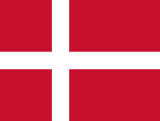
The most recognisable cross family of all is the Nordic cross: a cross whose centre is shifted towards the flagpole rather than sitting in the middle. It began with Denmark's Dannebrog — generally considered the oldest continuously used national flag in the world, with a legend dating its origin to 1219. Denmark's design became the template for every one of its neighbours: Sweden, Norway, Finland and Iceland (plus the Faroe Islands and Åland) all fly a Nordic cross in their own colours. The offset cross represents Christianity, and the shared shape is a deliberate mark of the region's common history.
St George's Cross and the English tradition
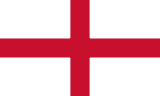
England's flag is the Cross of St George — a plain red cross on a white field — named for the country's patron saint and adopted from the medieval period. It wasn't unique to England: the same red-on-white cross was used by the Republic of Genoa and appears in the arms of Milan, Barcelona and Sardinia. The country of Georgia also builds its flag around a red St George's cross. England's version endured to become one of the most familiar flags in the world, and one of the three crosses later folded into the Union Jack.
Diagonal crosses: the saltire
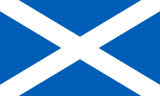
Not every cross is upright. A diagonal cross — an X-shape — is called a saltire, and it has its own rich tradition. Scotland's flag is the white saltire of St Andrew on a blue field, said to be one of the oldest national flags still in use; Ireland contributes the red saltire of St Patrick. Beyond the British Isles, Jamaica flies a bold gold saltire dividing green and black (famously using none of the usual red, white or blue). The saltire is still a Christian cross in origin — St Andrew was martyred on an X-shaped cross — just tilted.
The Greek cross and other Christian flags
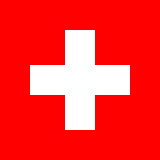
A Greek cross has four arms of equal length and usually sits centred — the opposite of the offset Nordic style. Switzerland's white cross on a red square is the classic example. Others wear their Christianity just as openly: Greece's flag carries a white cross in the canton for the Greek Orthodox Church; Tonga places a red cross on white to reflect its devout Christian identity; and the Dominican Republic is divided by a white cross bearing a Bible at its centre. Georgia's striking "Five Cross Flag" combines a large central St George's cross with four smaller crosses — a design with deep medieval and Christian roots, revived in 2004.
Crosses and political unions

Crosses can also record the joining of nations. The Union Jack is the best example: it layers the Cross of St George (England), the saltire of St Andrew (Scotland) and the saltire of St Patrick (Ireland) into a single flag, a visual record of the union of three kingdoms. That combined flag then spread around the world in the corner of other flags — a story we tell in flags with the Union Jack and the story behind the Union Jack (including why Wales isn't on it).
Not every cross means the same thing
So while most flag crosses share a Christian root, their exact meaning varies. Some are overtly religious (Switzerland, Tonga, Greece); some honour a specific patron saint (England's St George, Scotland's St Andrew); some are really about heraldry and heritage more than active faith today; and some, like the Union Jack's crosses, are chiefly about political union. As always with flags, the only way to know for sure is to look at each country's own history — which you can do on the individual country pages in our Flag Explorer.
Frequently asked questions
Why do so many flags have crosses?
Mostly because of Christianity and medieval European heraldry — crosses were carried on kingdoms' and crusaders' banners and became fixed national symbols, especially in Europe.
What is the Nordic cross?
A cross shifted towards the flagpole, used by Denmark, Sweden, Norway, Finland and Iceland. Denmark's Dannebrog is the oldest and the model for the rest.
Which countries have a cross on their flag?
England, the Nordic countries, Switzerland, Greece, Georgia, Tonga, the Dominican Republic, Scotland (a diagonal cross) and the UK, among others.
Is the Southern Cross on Australia's flag a Christian cross?
No — it's a constellation of stars, not a religious cross. The same stars appear on New Zealand, Brazil, Samoa and Papua New Guinea.
What's the difference between a Nordic cross and a Greek cross?
A Greek cross has four equal arms and is usually centred (Switzerland); a Nordic cross has a longer horizontal arm and sits towards the flagpole (Scandinavia).