Home › Territories & Regions › Faroe Islands
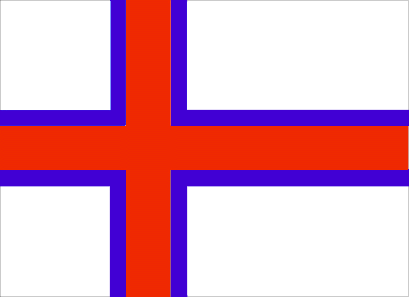
Flag of the Faroe Islands
A red Nordic cross with a blue border on white — Merkið, the flag of the Faroe Islands.
The flag of the Faroe Islands is a Nordic cross — a red cross outlined in blue, set on a white field, with the cross shifted towards the hoist. Known in Faroese as Merkið (“the banner”), it belongs to the same family as the flags of Denmark, Norway, Iceland and Sweden. The Faroe Islands are a self-governing territory of Denmark: a group of 18 islands in the North Atlantic, roughly midway between Norway and Iceland.
About the Faroe Islands flag
Merkið was designed by Faroese students in 1919. During the Second World War, when Denmark was occupied, the Faroe Islands were told to fly their own flag rather than the Danish one, and it was first recognised for Faroese use on 25 April 1940 — still marked today as Flag Day. It was fully recognised as the islands' official flag when the Faroes gained home rule in 1948. Its white field is often linked to the bright northern sky and sea foam, while the red and blue echo the colours found in neighbouring Nordic flags such as those of Norway and Iceland.
Faroe Islands flag colours
The Faroe Islands flag uses three colours — a red cross with a blue border on white. These are the approximate shades if you're recreating it:
Faroe Islands flag facts
Frequently asked questions
What does the flag of the Faroe Islands look like?
A white flag with a red Nordic cross outlined in blue, the cross shifted towards the hoist — the same cross pattern used across the Nordic countries.
What is Merkið?
Merkið ("the banner") is the Faroese name for the flag. It was designed by Faroese students in 1919 and officially recognised in 1948.
Are the Faroe Islands part of Denmark?
They're a self-governing territory within the Kingdom of Denmark, with their own parliament, language and flag — not a separate UN country, which is why they sit here under Territories & Regions.
When is Faroese Flag Day?
Flag Day (Flaggdagur) is 25 April, marking the flag's first recognition for Faroese use in 1940.