South Pacific
French Polynesia Flag
Explore French Polynesia's flag history, symbolism, geography and facts — the red and white bands with a Polynesian outrigger canoe sailing beneath the sun, flown across the islands of Tahiti, Bora Bora and beyond.
Capital
Papeete
Region
South Pacific
Population
280,000
Status & key facts
Political status
Overseas collectivity
Wide-ranging autonomy
Currency
CFP franc
XPF — pegged to the euro
Sovereign state
France
Overseas collectivity of France
🌡️ Climate: Tropical — warm and humid, with a hotter, wetter season from November to April
Flag symbolism
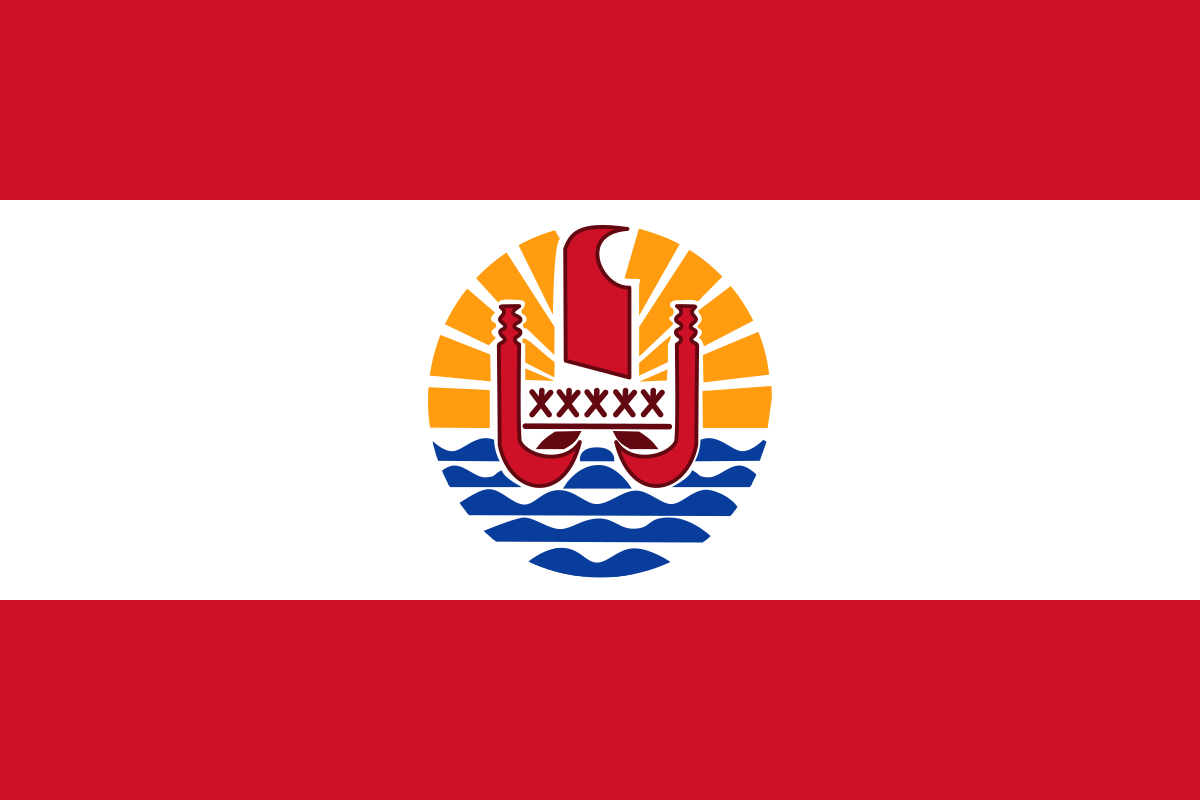
Two red bands above and below a wider white band, with a disc-shaped emblem at the centre. The emblem shows a Polynesian outrigger canoe on the ocean waves, carrying figures, beneath a golden sun and its rays.
outrigger canoesunthe sea
Did you know?
The figures aboard the canoe are usually said to represent the five island groups of French Polynesia — and the red and white of the flag are the traditional colours of Tahiti and its old royal house.
Test your knowledge
Think you know your world flags? Try the FlagAtlas daily challenge, speed quiz, or explore all the territory flags.
📚 Revising for GCSE Geography? Visit our free revision page →
About French Polynesia
French Polynesia is an overseas collectivity of France in the South Pacific Ocean, made up of around 118 islands and atolls scattered across five archipelagos over an expanse of ocean roughly the size of Europe. The best known are Tahiti, Bora Bora and Moorea in the Society Islands.
French Polynesia has wide-ranging autonomy, with its own assembly and president managing most local affairs, while remaining part of the French Republic; its people are French citizens and the head of state is the President of France. Papeete, on Tahiti, is the capital, and the currency is the CFP franc.
CapitalPapeete
RegionSouth Pacific
PopulationAbout 280,000
Area4,167 km² (land)
CurrencyCFP franc (XPF)
LanguageFrench & Tahitian
The flag of French Polynesia
The flag has three horizontal bands — red, a wider white, and red — with a circular emblem in the centre of the white band. The red and white are the traditional colours of Tahiti.
What the emblem shows.
A traditional Polynesian outrigger canoe sails across blue and white waves, carrying a row of figures, beneath a golden sun with spreading rays. The sea, the sun and the voyaging canoe together stand for the ocean-going heritage of the Polynesian people.
The emblem was adopted in 1984. As part of France, French Polynesia also flies the French tricolour alongside its own flag.
The canoe, the sun and the five archipelagos
The heart of the flag is the va'a, the outrigger canoe that carried the Polynesians on some of the greatest ocean voyages in human history. On the emblem it sails beneath the sun, a symbol of light and life, across the waves of the Pacific.
The figures aboard the canoe are generally understood to represent the five island groups that make up French Polynesia — the Society, Tuamotu, Gambier, Marquesas and Austral archipelagos — travelling together as one people.
A short history of French Polynesia
The islands were settled more than a thousand years ago by Polynesian voyagers, master navigators who crossed vast stretches of open ocean by canoe. On Tahiti, the Pōmare family united much of the region into a kingdom in the late eighteenth and early nineteenth centuries.
European explorers reached the islands in the 1760s and 1770s, and Tahiti became a French protectorate in 1842 and later a colony. In the twentieth century the islands moved from colony to overseas territory and then to their present status as an overseas collectivity with broad self-government.
Between 1966 and 1996, France carried out nuclear weapons tests at the atolls of Moruroa and Fangataufa — a significant and much-debated chapter in the territory's modern history. Today French Polynesia governs most of its own affairs within the French Republic.
The French Polynesia flag's history
The flag combines old Tahitian colours with a modern Polynesian emblem.
Kingdom of TahitiRed and white, the colours of the Pōmare royal house, were long associated with Tahiti.
1984 — the emblemThe canoe-and-sun emblem was added to the red and white bands, creating the present flag.
TodayThe flag flies across the islands alongside the French tricolour.
Geography of French Polynesia
French Polynesia's islands fall into two broad kinds: high volcanic islands, such as Tahiti and Bora Bora, with dramatic green peaks ringed by lagoons, and low coral atolls, especially in the Tuamotu group, which are little more than rings of reef around a lagoon. Together they are spread across an enormous area of the South Pacific.
The islands' setting
French Polynesia lies roughly halfway between Australia and South America. The Cook Islands are its nearest neighbours to the west, while Hawaii lies far to the north — a measure of just how remote these islands are.
People, language and culture
French is the official language, and Tahitian (Reo Tahiti) and other Polynesian languages are widely spoken. Polynesian, or Mā'ohi, culture is strong, seen in music and dance such as the ʻōteʻa, in the annual Heiva festival, and in the art of tattooing — the English word "tattoo" itself comes from the Polynesian tatau.
The islands are famous the world over for their beauty and inspired painters such as Paul Gauguin, who worked in Tahiti and the Marquesas. Tahitian black pearls and world-class surf breaks are among the territory's other well-known exports and attractions.
French Polynesia today
French Polynesia runs most of its own affairs through an elected assembly and a local government led by a president, while defence, foreign affairs and the currency remain shared with France. Its economy rests on tourism — the overwater bungalows of Bora Bora are famous worldwide — together with black-pearl farming and fishing.
As with several Pacific territories, there are differing views locally about the islands' long-term future within or beyond France; FlagAtlas presents the facts of its current status without taking a side.
Explore French Polynesia on FlagAtlas
Continue exploring French Polynesia and the world's flags with these FlagAtlas resources.
Sources & further reading
This page combines the information already present on the FlagAtlas French Polynesia page with additional context. Statistics such as population and area are dated because they can change over time.
Encyclopaedia Britannica — French Polynesia