Crown Dependency
Isle of Man Flag
Explore the Isle of Man's flag history, symbolism, geography and facts — the striking triskelion of three armoured legs on a red field, and the self-governing island in the middle of the Irish Sea.
Capital
Douglas
Region
British Isles
Population
84,000
Status & key facts
Political status
Crown Dependency
Self-governing
Currency
Manx pound
At par with £ sterling
Relationship to the UK
Not part of the UK; UK handles defence & foreign affairs
British Crown Dependency
🌡️ Climate: Temperate maritime — mild, wet and often windy, with cool summers
Flag symbolism
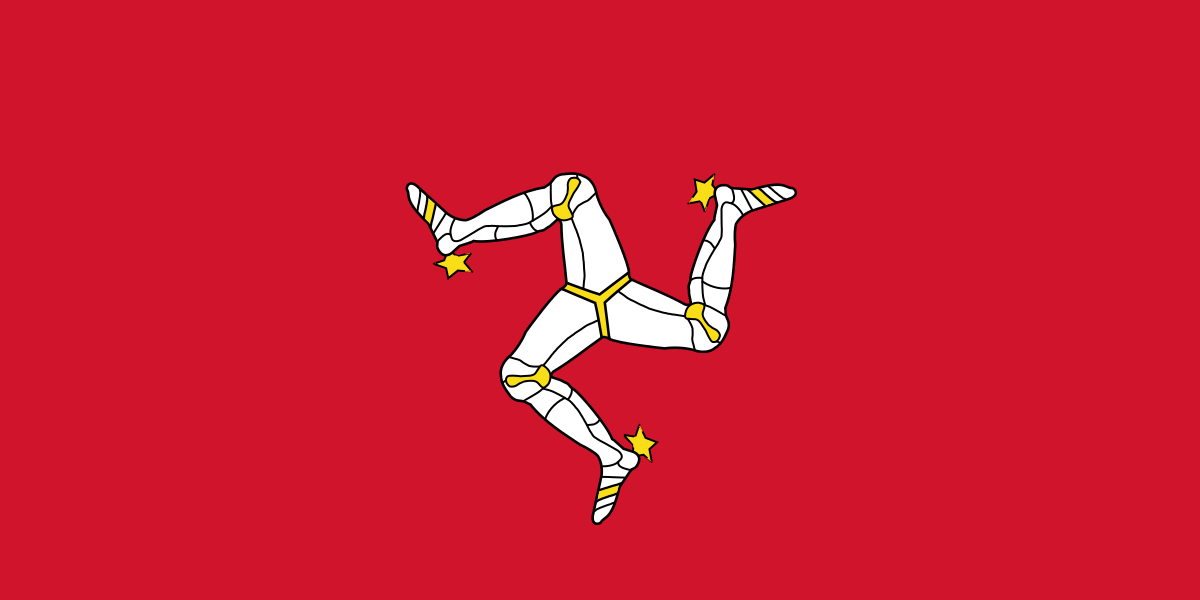
A red field bearing the triskelion: three armoured legs, each with a golden spur, joined at the thigh and bent at the knee so that they appear to run. Its Latin motto is Quocunque Jeceris Stabit — "whithersoever you throw it, it will stand."
triskelionthree legsny tree cassyn
Did you know?
The island's parliament, Tynwald, is often described as the oldest continuously functioning parliament in the world, with roots traced back over a thousand years to the island's Norse era.
Test your knowledge
Think you know your world flags? Try the FlagAtlas daily challenge, speed quiz, or explore all the territory flags.
📚 Revising for GCSE Geography? Visit our free revision page →
About the Isle of Man
The Isle of Man is a self-governing island in the Irish Sea, lying between Great Britain and Ireland. It is a British Crown Dependency — not part of the United Kingdom, and not part of the European Union — with its own parliament, laws and taxes. The reigning British monarch is its head of state under the title Lord of Mann, and the United Kingdom is responsible for the island's defence and foreign affairs.
Douglas is the capital and largest town. The island has its own currency, the Manx pound, which circulates alongside and at par with pound sterling.
CapitalDouglas
RegionIrish Sea / British Isles
PopulationAbout 84,000
Area572 km²
CurrencyManx pound (= GBP)
LanguageEnglish; Manx Gaelic
The flag of the Isle of Man
The flag is a red field charged with the triskelion — three armoured legs joined at the thigh, each bent at the knee and wearing a golden spur, arranged so that they run clockwise. The emblem is known in Manx as ny tree cassyn, "the three legs."
Whichever way it falls, it stands.
The flag's motto, Quocunque Jeceris Stabit, means "whithersoever you throw it, it will stand" — a play on the idea that the three-legged symbol always lands on its feet.
The three-legged emblem is medieval, appearing on the arms of the Kings of Mann and the Isles from the thirteenth century. The red flag bearing the triskelion was adopted as the island's official flag in 1932.
The three legs of Mann
The triskelion — a symbol of three running legs radiating from a central point — is one of the oldest symbolic motifs in Europe. The Isle of Man shares this "three-legged" device with Sicily, whose Trinacria also features three legs, and both are thought to derive from much older triple-symbol traditions.
On the Manx flag the legs are shown clad in armour with golden spurs, and are usually drawn running clockwise. The design has become a powerful emblem of Manx identity, appearing on everything from coins and stamps to sports shirts.
A short history of the Isle of Man
The island has been inhabited since prehistoric times and developed a strong Celtic culture. From the late eighth century it came under Norse (Viking) influence, becoming part of a sea kingdom — the Kingdom of Mann and the Isles — and it was in this period that Tynwald, the island's parliament, took shape.
After Norse rule the island passed between Scottish and English control before coming under a series of English lords, the Lords of Mann, including the Stanley family and later the Dukes of Atholl. In 1765 the lordship was bought back by the British Crown in an act known as the Revestment.
Since then the Isle of Man has developed as a self-governing Crown Dependency, gradually gaining greater control over its own affairs while remaining outside the United Kingdom.
The Isle of Man flag's history
The three-legged emblem is far older than the modern flag, but the red banner itself is a twentieth-century creation.
13th century — the emblemThe triskelion appears on the arms of the Kings of Mann and the Isles.
Norse era — TynwaldThe island's parliament took shape during the period of Norse rule.
1765 — RevestmentThe lordship of Mann was bought back by the British Crown.
1932 — official flagThe red flag bearing the triskelion was formally adopted as the island's flag.
TodayThe three legs remain the enduring symbol of Manx identity.
Geography of the Isle of Man
The Isle of Man sits roughly in the middle of the Irish Sea, within sight of England, Scotland, Wales and Ireland on a clear day. Its landscape is one of rolling hills and uplands, rising to the summit of Snaefell, the island's highest point, with a coastline of cliffs, bays and small harbours.
The island's neighbours
England and Scotland lie to the east, Ireland to the west, and Wales to the south — the Isle of Man is one of the few places from which all the countries of the British Isles can, in the right conditions, be seen.
People, language and culture
English is the everyday language, while Manx Gaelic — a Celtic language once close to extinction — has been the subject of a strong revival, including a Manx-language primary school. The island has a rich Celtic and Norse cultural heritage.
The Isle of Man is famous for the TT (Tourist Trophy) motorcycle races held on public roads each year, and for the tailless Manx cat, both closely associated with the island around the world.
The Isle of Man today
The Isle of Man is a prosperous, self-governing Crown Dependency with an economy built on financial and business services, e-gaming, tourism and manufacturing. It issues its own banknotes, coins and postage stamps.
Its parliament, Tynwald, continues to legislate for the island, and each July the community gathers for Tynwald Day, when new laws are proclaimed in the open air at St John's — a ceremony with roots in the island's Norse past.
Explore the Isle of Man on FlagAtlas
Continue exploring the Isle of Man and the world's flags with these FlagAtlas resources.
Sources & further reading
This page combines the information already present on the FlagAtlas Isle of Man page with additional context. Statistics such as population and area are dated because they can change over time.
Encyclopaedia Britannica — Isle of Man